
Bangladesh joins WTO investment facilitation pact
ASJADUL KIBRIA | Monday, 30 March 2026
Bangladesh has formally announced its decision to join the Investment Facilitation for Development (IFD) Agreement at the World Trade Organization's 14th Ministerial Conference (MC 14), marking its first entry into a plurilateral trade initiative.
The move signals Dhaka's growing engagement in global investment frameworks, even as divisions among major economies continue to stall efforts to integrate the pact into the WTO's legal structure.
Following the decision on the third day of the MC14, the total number of the agreement's co-sponsors has risen to 129. 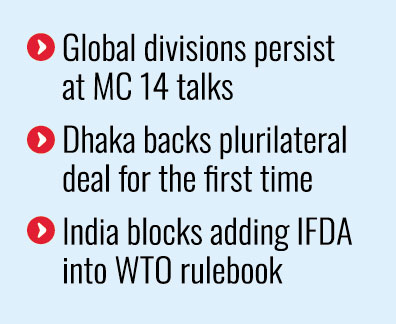 Earlier on Thursday, Türkiye lifted its objections to joining the IFD deal, which is widely seen as a China-led initiative.
In the WTO context, a plurilateral agreement is one entered into by a group of members rather than the entire membership. Such arrangements are intended to allow willing countries to move forward while others remain unprepared or reluctant.
Earlier, on March 17, Bangladesh's Cabinet approved the proposal to join the IFDA under the WTO's plurilateral Joint Statement Initiative. The decision was taken at a Cabinet meeting held at the Secretariat, chaired by Prime Minister Tarique Rahman.
MC14 is being held in Yaoundé, the capital of Cameroon, where trade ministers and negotiators from 166 member countries are meeting to address key issues such as WTO reform, investment, e-commerce, fisheries and agricultural subsidies.
However, India has blocked efforts to incorporate the IFD agreement into the WTO's legal framework at MC14, arguing that the pact undermines the organisation's foundational principles and exceeds its mandate.
At the conference, a group of countries led by China has pushed to include the IFD agreement in the WTO framework as an Annex 4 plurilateral accord.
Based on most-favoured-nation (MFN) treatment, the agreement remains open to all WTO members. Unlike multilateral agreements, however, it is binding only on those members that choose to adopt it.
India's Commerce Minister Piyush Goyal reiterated his country's opposition, stating: "Incorporation of the IFD Agreement risks eroding the functional limits of the WTO and undermining its foundational principles."
He added that, as part of broader WTO reform discussions, members are exploring legal safeguards and "guardrails" for plurilateral agreements before integrating any such outcomes.
At the same time, he indicated India's willingness to engage in constructive discussions under the WTO reform agenda.
On Saturday, an intensive working session on the IFD Agreement was facilitated by Dwright Fitzgerald Bramble, Trade and Foreign Minister of Saint Vincent and the Grenadines.
Members reviewed prospects for incorporating the IFDA into the WTO legal framework, according to a WTO press statement.
During the session, the facilitator noted broad support for the agreement and highlighted its development benefits. Around 60 delegations, including some non-IFDA participants, took the floor to advocate its inclusion as a plurilateral agreement under Annex 4 of the WTO Agreement.
They argued that such incorporation would help unlock investment potential in developing economies and reinforce confidence in the multilateral trading system. Bangladesh announced its decision to join the agreement during the session.
At present, a total of 18 plurilateral agreements exist or are under negotiation or discussion within the WTO. Of these, two are suspended, leaving 16 active at varying stages.
When contacted, Nesar Ahmed, a former trade negotiator for Bangladesh at the WTO, said the decision to join the plurilateral agreement on investment facilitation is a positive step for the country.
"As negotiations and discussions on a number of plurilateral agreements are gaining momentum, it is important for Bangladesh to closely follow developments and participate wherever possible," he told The Financial Express.
"Both opportunities and obligations exist in any agreement, and it is crucial to maximise the benefits while utilising available flexibilities," he added. "Let us hope that Bangladesh will ultimately benefit from the IFD agreement in the near future."
asjadulk@gmail.com