
Bangladesh not waiting for the world to save us: PM
Saturday, 19 September 2015
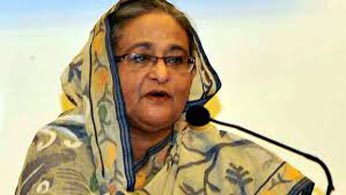
Prime Minister Sheikh Hasina on Saturday said Bangladesh has not been sitting around waiting for the world "to save us" rather it's fighting for its own future with limited resources and technologies.
"We are keen to see the Sustainable Development Goals (SDGs), and the upcoming climate agreement in Paris, adopted and moving into implementation. But Bangladesh has not been sitting around waiting for the world to save us....we are fighting for our own future, albeit with limited resources and technologies," she said in an article published in The Huffington Post on Friday.
The Huffington Post is a liberal-oriented American online news aggregator and blog site offering news, blogs, and original content and covers, inter alia, politics, business, entertainment and environment.
In July 2012, The Huffington Post was ranked #1 on the 15 Most Popular Political Sites list by eBizMBA Rank, a BSS report said on Saturday.
In the article, the Prime Minister said in just a few weeks, the world will adopt the 2030 Agenda for Sustainable Development.
“For my country, Bangladesh, the goal of combating climate change and its impacts is crucial, as we are on the frontline of this global threat.”
She said Bangladesh is one of the most densely populated countries in the world (1,218 people per sq km), with the lowest quantity of per-capita arable land (0.05 hectares). "Although we made considerable progress on the Millennium Development Goals (MDGs), climate change in the form of extreme- weather events, tidal surges, and erratic rainfall has negatively impacted agricultural production, industrial development and social structures," she said.
Sheikh Hasina said this can create millions of environmental refugees, even though Bangladesh's contribution to climate change in terms of greenhouse-gas emissions is negligible. And the situation will worsen without urgent action. Studies estimate that a meter rise in sea level would submerge one fifth of the country, displacing over 30 million people. Mass migration to cities is inevitable, impacting livelihoods, biodiversity, food, water, sanitation and basic infrastructure.
"That is why in 2011, we amended the constitution to protect and improve the environment and preserve and safeguard natural resources, biodiversity, wetlands, forests and wildlife for present and future citizens. In line with this policy, at least eight new laws were enacted or amended since 2009 to preserve forestlands in the country.
She said forest coverage rose to 17.08 per cent in 2014-15 from a mere seven to eight per cent in 2005-06, thanks to the introduction of initiatives such as the Social Afforestation Programme, which ensures people's participation in planting and raising trees in every available space, both urban and rural. Currently, more than 120 million saplings are raised and distributed every year among the people, compared to 40 million in 2001-2006.
The Prime Minister said Bangladesh was the first developing nation to create a Climate Change Strategy and Action Plan. "From 2009-2010 to 2014-15, the government allocated Tk 30.30 billion (US$ 385 million) to our climate- change trust fund. All of our activities have been targeted toward adaptation to environmental changes with a view to protecting human lives from floods and hurricanes, and protecting the environment from pollution caused by rapid urbanization and unsustainable industrialization."
-SS