
Bangladesh starts developing new airport service culture
Says minister Afroza Khanam
Saturday, 1 August 2026
Bangladesh is moving to develop a new service culture at its airports while modernising the national flag carrier, expanding aviation infrastructure and positioning the country as a regional aviation hub, Civil Aviation and Tourism Minister Afroza Khanam has said, reports BSS.
"We are not merely solving problems; we are building a new service culture at Bangladesh's airports," she said in an exclusive interview with the state-run news agency, outlining the government's wide-ranging plans for the country's aviation and tourism sectors.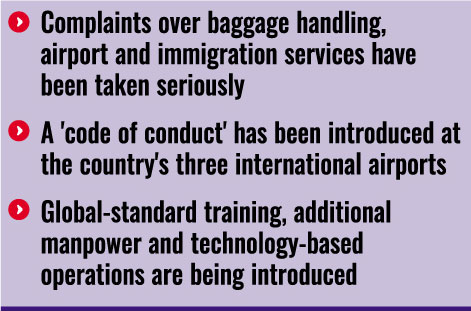 The minister said the government has taken passenger complaints over baggage handling, airport mismanagement and immigration services seriously and has already introduced a series of measures to improve discipline and service standards.
She said that a 'code of conduct' has been introduced at the country's three international airports, while executive magistrates are carrying out regular monitoring at the field level.
For baggage security, vigilance teams, body-worn cameras, CCTV surveillance and a Baggage Reconciliation System have been introduced, she said, adding that baggage delivery time has also been reduced significantly.
International-standard training, modern ground-handling equipment, additional manpower and technology-driven operations are being introduced, while coordination among immigration, customs, airlines and other airport agencies has been strengthened to ensure faster, safer and hassle-free services.
Afroza said these reforms form part of a much broader government vision to transform Bangladesh into a regional aviation hub.
"Under the Prime Minister's leadership, we are working towards transforming Bangladesh into a regional aviation hub," she said.
The strategy includes expanding international connectivity, modernising airline fleets, improving passenger services and developing world-class airport infrastructure, she added.
One of the centrepieces of the aviation expansion plan is the modernisation of Biman Bangladesh Airlines.
The minister said a decision has been taken to add 24 new aircraft - 14 Boeing and 10 Airbus aircraft - to Biman's fleet, gradually transforming the national carrier into a modern mixed-fleet airline.
At the same time, the government has initiated a process to lease five aircraft this year, with 40 companies submitting applications to provide aircraft under lease arrangements, she added.
"Our objective is not merely to expand the fleet. We want to build a fuel-efficient, cost-effective and internationally competitive flag carrier," Afroza said.
The new aircraft will be inducted in phases in line with manufacturers' production schedules. Under the government's longer-term roadmap, Biman's fleet is expected to expand to 47 aircraft by FY 2034-35.
Afroza said the government is also pursuing reforms within Biman based on three broad pillars - governance, business strategy and service transformation. Merit-based appointments, accountability and good governance are being prioritised, while existing routes are being commercially reassessed and profitable routes strengthened.