
Bangladesh: Towards resonant and consistent growth
Montasir Sani | Tuesday, 24 March 2015
It is indeed commendable that Bangladesh has been able to manage a sustainable growth rate of more than 6.0 per cent for the last few years. If Bangladesh is able to increase the GDP (gross domestic product) growth rate to 7.0 per cent, the size of the economy will be double in each decade. Is it possible? The answer is a straightforward yes. If India, China, Cambodia, Mozambique, and Uganda can, why can't we?
Much of the Bangladesh economy is bank-based. Sound banking system can enhance the level of confidence among surplus units so that they will feel comfortable to put their saving in banks. Development of risk management techniques, segregation of the deserving borrowers from risky borrowers, working beyond the influence of those who dictate terms for loans, effective monitoring of loans will be enough to bring confidence in the financial arena. If the financial market is in a sound base, financial inclusion process will be smooth that will enhance the entire value of savings and enhance investment which is one of the key determinants of GDP Growth the country is aspiring to achieve. Recently, Bangladesh Bank has announced 10 per cent rebate in case of repayment of loans on time to curb the rampant loan default culture. But it is also important to establish sound monitoring procedures so that loan default will not be a recurrent practice. Hallmark scandal, Basic Bank scandal and many other financial scams have badly impacted our banking system. If default culture is curbed substantially, market interest rate will automatically come down and it will facilitate loans at lower rates that will foster economic growth.
Alongside the banking system, share market can be considered a complimentary tool. When people lose confidence in banking system, share market can play a role to transfer funds from the deficit units to surplus units. Bangladesh Securities and Exchange Commission (BSEC) and other wings of the government have done a lot to improve the condition of the share market but the efficiency and effectiveness of share market will greatly depend on the number of knowledgeable investors. If investors not only focus on technical analysis (consideration of market trends) but also on fundamental analysis (consideration of intrinsic factors that determine value) it will be just a matter of time for share market to function smoothly.
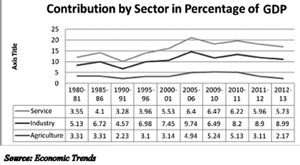
Industrialisation is very important to flourish economic activity. Bangladesh government has already formulated Industrial Policy 2010 and announced comprehensive motivational package for the establishment of new industries. From the economic trends published by ministry of finance, it is found that the contribution of industry in proportion of GDP has been increasing over the years where the contribution of agriculture has been declining and the contribution of the services sector is almost stagnant. We can say that Bangladesh is on the right track. The soil of Bangladesh is very fertile so it is an exigent need that the government takes initiatives for technological up-gradation in agricultural production that can add substantial value to the economy.
Electricity is an X factor of economic development. Around 60 per cent population of the countryhas come under electricity facilities. However, per head electricity production is only 292 Kilowatt hour which is very low compared to that of other countries. The government is committed to ensuring electricity for the entire population within 2021. To this end, Power System master Plan-2010 has been formulated. According to this Plan, the demand for electricity in 2015, 2021, and 2030 will be 10000, 19000 and 34000 megawatt respectively. To satisfy the demand, power generation plants having capacities of 24000 and 39000 megawatt will have to be established in 2021 and 2030 respectively. It is expected that Bangladesh will be able to overcome power shortage problem very soon and facilitate trade and investment in a desired manner.
Transportation system of Bangladesh has improved a lot. The construction of Padma Bridge has already started. Adding up the bridge to the transportation system will enhance connectivity between Dhaka and the southern part of the country. It will accelerate economic activity and transportation cost will come down to a great extent. Apart from this, Elevated Expressway, Bus Rapid Transit-BRT Line-3, Mass Rapid Transit Line-6-MRT Line-6 etc., will contribute significantly to economic progress. It is true that these projects will take some time to be in place due to many constraints, but once these are implemented, the country will experience a remarkable surge in economic activities.
The critical factor for achieving sustainable growth depends on effective participation of the private sector. The higher the demand of credit in the private sector, the higher the acceleration in economic activities. In other words, the lower the participation of public sector in investment, the lower will be the chances of corruption. From the statistics it is found that the proportion of private investment has been increasing over the years while the public sector's investment has been decreasing. It will inject efficiency in business operations and create the necessity of sustainability. One of the frustrating things is that there is a gap between savings and investment even though there is always a shortage of loanable funds. The positive thing is that the gap has been narrowing down over the years.
Expansion of market could be a stimulating force for growth. Though the RMG sector is topping in the export earnings, it is not certain whether Bangladesh will be able to sustain the momentum. It is high time that the country focused on product diversity and market expansion.
Bangladesh will be in the "7.0 per cent club" if there is a sustainable growth in investment rounding up to 32 per cent. Smooth functioning of economic system can make anything possible. In CPI (Corruption Perception Index), the position of Bangladesh is 145th and in case of risky cities Dhaka is positioned at number 2. But it is surprising that Bangladesh has been able to achieve GDP growth rate above 6.0 per cent for the last seven years or so. One can well imagine if there was political stability in the country and less corruption, the scenario would have been much better. It is thus not too far-fetched to contemplate on GDP growth over 7.0 per cent.
animontasir@yahoo.com