
Bangladesh's love for imported fruits
Md Ziaul Haque Bhuiyan | Monday, 8 December 2025
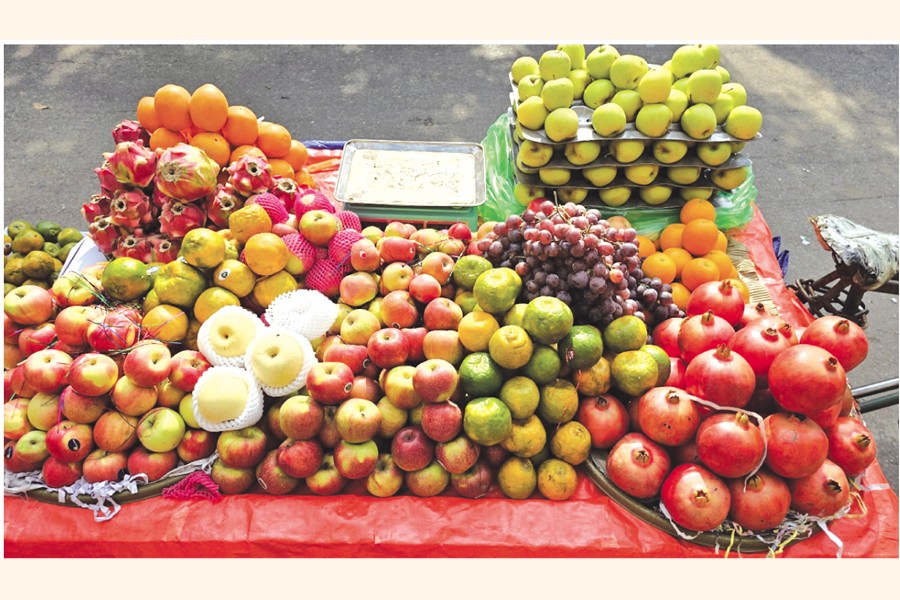
11.jpg) Bangladesh, a land blessed with abundant fertility and six vibrant seasons, should have fruit markets overflowing with local flavours that reflect our identity, yet the reality tells a different story. Walking up to a fruit cart in Panthapath, a bustling area in Dhaka, I was struck by the overwhelming dominance of imported fruits. Apples from South Africa, grapes from Egypt, oranges from China, and pears from the USA were all laid out neatly, their prices inflated by the long journeys they had undertaken. Almost everything on display was imported, with local produce barely visible. It made me stop and ask: why does a country with such natural abundance depend so heavily on foreign fruits?
Bangladesh, a land blessed with abundant fertility and six vibrant seasons, should have fruit markets overflowing with local flavours that reflect our identity, yet the reality tells a different story. Walking up to a fruit cart in Panthapath, a bustling area in Dhaka, I was struck by the overwhelming dominance of imported fruits. Apples from South Africa, grapes from Egypt, oranges from China, and pears from the USA were all laid out neatly, their prices inflated by the long journeys they had undertaken. Almost everything on display was imported, with local produce barely visible. It made me stop and ask: why does a country with such natural abundance depend so heavily on foreign fruits?
According to recent trade data, Bangladesh imported almost Taka 10,000 Crores worth of apples and oranges which might seem absurd at first glance but shows the reality of our fruit import. This dependency weakens our economy at a time when foreign reserves need careful protection. Agricultural economist Farzana Rahman notes that this reliance is not just a production issue, it also stems from a cultural mindset where many consumers equate "imported" with "superior", often without considering nutrition, value, or long-term impact.
I experienced this mindset recently while buying fruit in Banani. A rickshaw-puller bargained for imported grapes priced at Taka 500 per kilogram. His budget was Taka 400, yet he still chose grapes over fresher, healthier, and more affordable local options like guava or papaya. When I asked why, he simply replied, "I want to taste some international fruit." That short exchange stayed with me. It reflected how aspiration often outweighs logic, even for those with very limited incomes.
Imported fruits also undergo long shipping journeys and are preserved with chemicals to maintain appearance and shelf life. Nutritionist Dr Tanvir Ahmed explains that these preservatives reduce nutritional value, while local fruits are harvested and sold fresh, reaching consumers with higher nutrient retention and richer flavour. In many cases, choosing local is not only the smarter financial choice, but also the healthier one.
The gap in local fruit production is not due to a lack of potential. Food and Agriculture Organization of the United Nations (FAO) data indicate that fruit production in Bangladesh has been growing at approximately 12.5 per cent per annum over the last 20 years. Bangladesh has ideal soil and climate conditions to cultivate a wide variety of fruits across all six seasons. However, several structural barriers prevent the country from unlocking this potential. Many farmers still rely on outdated methods that limit productivity. A 2020 report by the Food and Agriculture Organization (FAO) indicated that over 60 per cent of smallholder farmers in Bangladesh have no access to modern farming tools or climate-resilient practices, which keeps yields low and quality inconsistent.
Infrastructure is another critical barrier. Farmers often lack access to cold storage, leading to post-harvest losses of up to 30 per cent for perishable fruits, according to a 2022 study by the Bangladesh Agricultural Research Council. Inadequate rural transport networks and weak supply-chain linkages mean that even when fruit is successfully harvested, it often fails to reach urban markets in time or in marketable condition. These inefficiencies discourage farmers from expanding fruit cultivation, as the risk of loss remains high.
Government support has not yet matched the sector's potential. While some programmes exist, they remain fragmented and underfunded. Fruit cultivation does not receive the policy attention, incentives, or subsidies that crops like rice or jute enjoy. The Bangladesh Agricultural Development Corporation (BADC) allocates only a small fraction of its development budget to fruit crops. Without crop insurance, accessible credit, or guaranteed procurement, most farmers hesitate to diversify into fruit farming despite its profitability.
Cultural perception further undermines local produce. Imported fruits are often seen as aspirational or linked to social status. As a result, local fruits struggle to gain equal recognition, even though they are healthier, tastier, and more suited to our climate. We celebrate the arrival of mangoes and jackfruit with immense pride, yet we often overlook the wide range of seasonal fruits available throughout the year across Bangladesh. Additionally, approximately 30 per cent of what is produced is lost post-harvest. If we celebrated guava, papaya, pineapple, starfruit, lychee, and banana with the same enthusiasm, consumer behaviour would shift significantly.
Here is a key insight that highlights the economic urgency of promoting local fruit. According to a Prothom Alo report published in October 2024, Bangladesh now imports around 1.68 million kilograms of fruit every day, with the annual value of imported fruits reaching about US$ 300 million. If even a portion of this demand shifts to local alternatives through increased production and consumer awareness, the country could save millions of dollars in foreign currency each year. Strengthening local cultivation of comparable fruits, while promoting their quality and nutrition, can therefore play an important role in easing pressure on our reserves and improving economic resilience.
There are also encouraging examples to draw from within our own borders. In Jashore, farmers who shifted to cluster-based banana cultivation reported higher yields and better market prices, enabling many to increase their household income and reinvest in improved farming techniques. Such success stories show that when farmers receive practical support and market access, fruit cultivation can become a sustainable and profitable livelihood.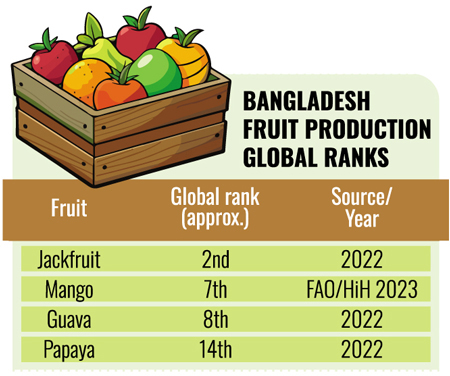 The environmental impact of imported fruits is also noteworthy. Transporting fruits across continents contributes to carbon emissions, with air-freighted fruits being particularly harmful. A 2023 report by the International Transport Forum estimated that food transportation accounts for nearly 6 per cent of global greenhouse gas emissions. Promoting local fruit production not only strengthens the economy, it also reduces our environmental footprint and supports a more sustainable future.
Health concerns add another layer of importance. Imported fruits treated with sulfur dioxide, wax coatings, and other preservatives may carry long-term health risks, especially when monitoring and inspection systems are inconsistent. Encouraging local fruit consumption is not only an economic and cultural shift, it is a public health priority.
History offers clear lessons on what strategic focus can achieve. Bangladesh's journey toward rice self-sufficiency demonstrates the power of aligned government policy, farmer education, and investment in agricultural capacity. By adopting high-yielding rice varieties, improving irrigation, and supporting farmers, the country transformed its food security landscape. Similarly, India's Green Revolution and the Amul dairy cooperative model show how organised, community-driven change can transform an entire sector. These examples reinforce the importance of policy alignment, innovation, and farmer empowerment in driving agricultural growth.
If Bangladesh applies the same determination to its fruit sector, real progress towards self-sufficiency is within reach. Practical steps can accelerate this journey. Introducing high-yield and climate-resilient fruit varieties, improving cold storage facilities, and enhancing rural road networks will reduce waste and increase market access. Offering farmers credit, insurance, and training tailored to fruit cultivation would encourage diversification. Public campaigns through schools, healthcare providers, and media can help reshape consumer perception by highlighting the benefits of eating local fruits. Policymakers can also consider targeted measures such as moderate tariffs on non-essential fruit imports and public-private partnerships to scale production and processing facilities.
Choosing local fruits is not just about taste or tradition. As Farzana Rahman notes, it is a step towards building a more resilient and self-reliant Bangladesh. When we support local growers, we are not only protecting our health and environment, but also strengthening our economy. Reducing dependence on imported fruits, even slightly, could save millions of dollars every year, money that could uplift farmers, improve agricultural infrastructure, and secure our food future.
The journey to fruit self-sufficiency will take time, but it is achievable when the government, private sector, farmers, and consumers move together with purpose. Let us choose the fruits that grow from our own soil, celebrate the richness of our six seasons, and reclaim pride in what Bangladesh produces. With every local fruit we buy, we cast a vote for our economy, our farmers, our culture, and the future of our children. It is time to nourish our own land and ensure it continues to nourish us for generations to come. So, let's choose local, and grow Bangladesh.
The writer is a Chief of Staff at a leading startup. zia.haque92@gmail.com