
GOVT ENDORSES BUILDING TWO FREE-TRADE ZONES
Bay of Bengal coast becoming entrepot for duty-free trading
Chinese Economic-Industrial Zone in Anwara also cleared
FE REPORT | Thursday, 18 June 2026
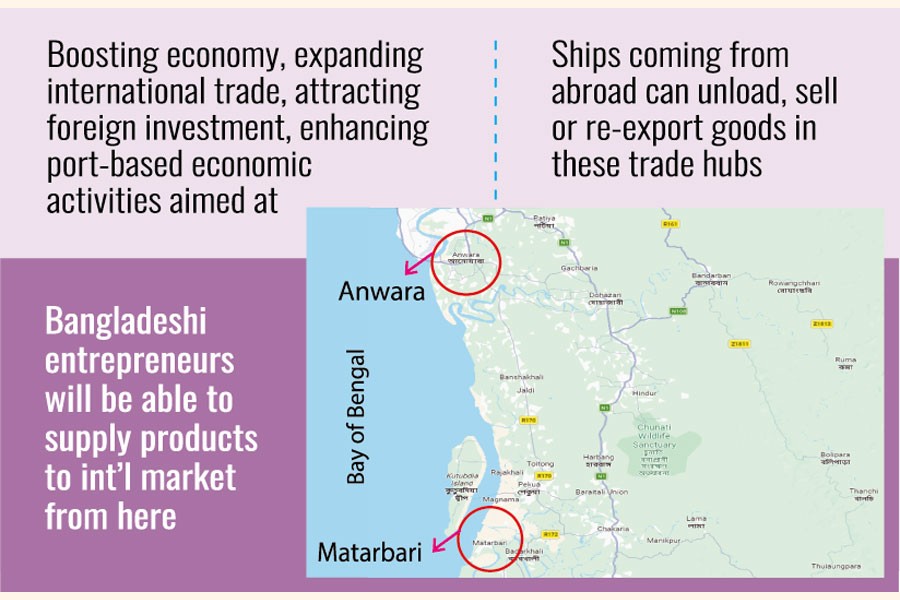
An entrepot is poised to emerge along the coast of the Bay of Bengal for duty-free trading by foreign and local entrepreneurs as the government approves building two free-trade zones near Chittagong seaport and beside Matarbari deep-sea port.
An entrepot is a trading centre, port, or warehouse where goods are imported, stored, and then re-exported to other countries. These goods are typically exempt from import and export duties.
Such trade zoning, which exists in some other countries, is first of its kind in Bangladesh, officials said after the approval given Wednesday in principle.
The approval was given by the Cabinet Committee on Economic Affairs (CCEA) in a meeting chaired by Finance and Planning Minister Amir Khosru Mahmud Chowdhury at Bangladesh Secretariat in the capital.
Briefing newsmen after the meeting, Cabinet Secretary Nasimul Ghani said the setting up of the free-trade zones still remained at concept stage but got the approval at the meeting. "Detailed plan, investment structure, and management method of the zones will be finalised later."
He informs that each free-trade zone will be established in 300 acres of land aiming to boost the country's economy, expand international trade, attract foreign investment, and increase port-based economic activities.
Mr Ghani notes that in the free-trade zones many customs and tax-related rules and regulations remain relaxed or absent in conducting international commercial activities where both foreign and local traders and investors can conduct business easily.
He also says ships coming from abroad will have the opportunity to unload, sell or re-export goods in these areas. At the same time, Bangladeshi entrepreneurs will also be able to easily supply products to the international market from here.
According to him, the setting up of such a zone will significantly increase the overall economic activity of the country.
The government hopes the volume of economic activity will increase, country's gross domestic product (GDP) will see a positive impact, port utilisation and shipping traffic will increase, and rapid transfer of goods and services will be possible once the free-trade zones are established.
Mr Ghani mentions that such free-trade zones are being operated in different countries, including the United Arab Emirates. "Though Dubai has limited natural resources, huge investments have come there due to the free economic zone and commercial facilities and it has developed into one of the centres of international trade. Bangladesh is also trying to create such an environment."
Both domestic and foreign investors will be able to invest in the free-trade zones. Manufacturing-oriented industries, warehousing, logistics, commercial services, and even tourism-based activities can be developed there.
Also, the cabinet committee approved in principle the formation of a special-purpose company and related development and land-lease agreements to establish a Chinese Economic and Industrial Zone (CEIZ) in Anwara Upazila of Chittagong.
This initiative will play an important role in further strengthening economic and trade relations between Bangladesh and China. "Establishment of an integrated Chinese industrial zone will make it easier for Chinese investors to invest in Bangladesh," the official says about the government view.
However, he says, the amount of investment, infrastructure development and project- implementation schedule have not yet been determined.
Also, the meeting approved in principle import of urea fertiliser from Russia under direct- purchase method.
syful-islam@outlook.com