
Making private sector-led economy vibrant
BB launches massive Tk 600b refinancing fund
Generating employment for over 2.50m people among cardinal objectives
FE REPORT | Sunday, 24 May 2026
A massive refinancing and support fund worth Tk 600 billion has been launched to reinvigorate Bangladesh's slowing private-sector-led economy with vibrant business activity.
Generating employment for over 2.50 million people is among cardinal objectives of the stimulus package Bangladesh Bank (BB) rolled out Saturday, in line with the new government's economic agenda.
The broader objective of the scheme aims to help resume production in the closed or struggling industrial units, boost agricultural output and exports and strengthen rural economic activities.
The package has two components: a Tk 410-billion refinancing fund, sourced from banks with excess liquidity through long-term deposits of at least three years at 10-percent interest, and a Tk 190-billion support fund drawn from the central bank's own resources, subject to government guarantee.
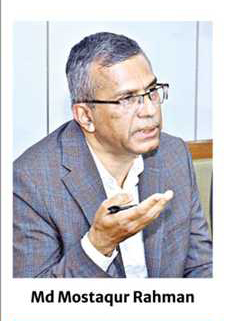
Bangladesh Bank Governor Md Mostaqur Rahman rolled out the stimulus package at a press conference at the BB headquarters where deputy governors and other senior central bankers concerned were present.
Of the refinancing allocation, Tk 200 billion has been earmarked for closed industrial and services-sector enterprises, Tk 50 billion for cottage, micro, small and medium enterprises (CMSMEs), while Tk 100 billion for agriculture and rural economic activities.
Another Tk 30 billion has been allocated for export diversification while a similar amount will be used to develop the northern region as an agricultural hub.
The support package that comes from BB's own funds includes Tk 50 billion for pre-shipment credit refinance, Tk 50 billion for cottage, micro and small entrepreneurs, and Tk 20 billion each for leather and leather goods, and frozen fish and fish exports.
Besides, Tk 10 billion has been allocated separately for unemployed youth employment, rural economic activities, green investment and overseas employment.
The central bank has also set aside Tk 5.0 billion each for startups and the creative economy.
Presenting the stimulus package, governor Mostaqur Rahman said the country's economic growth had weakened steadily over the past three years amid mounting stress in the banking and industrial sectors.
He said GDP growth, which earlier stood at 5.8 per cent in FY'23, later declined to 4.2 per cent in FY'24 and was now projected to fall further to around 3.7 per cent in FY'25.
He notes that key sectors like readymade garments, textiles, steel, ceramics, information technology and manufacturing have faced "significant setbacks due to persistent economic pressures".
Mr Rahman also refers to rising non-performing loans, incidents of money laundering and weakening depositor confidence and says higher lending rates have discouraged small and medium entrepreneurs from expanding businesses.
"To address the current challenges and restore economic momentum, the central bank has introduced a special support package," he told reporters.
The governor announces that at the customer level, the interest rate on loans for large industries will be 7.0 per cent while rates for smaller borrowers may be slightly higher.
As planned, the allocation for the creative economy would be provided as grants from corporate social responsibility (CSR) funds instead of loans.
In response to a question, the BB governor said the central bank would use its own funds that will come from its profits, not reissuing any money.
On the other hand, he says, the Tk 410-billion refinancing scheme will be formed with idle liquidity of banks. "So, there is nothing that would fuel inflationary pressure further," he claims.
About the cost of fund, a BB official, on condition of anonymity, says the central bank will source execs liquidity of the banks at 10.0 per cent. Of the costing, the government will bear 6.0 per cent as subsidy while the BB will give the remaining 4.0 per cent.
In terms of disbursement, the central banker says, the commercial banks will get the funds at 4.0 per cent and will be allowed to lend at 7.0 per cent to the borrowers. "That's the interest rate mechanism in this stimulus package," he said.
The banking regulator expects the package, once fully implemented, to help reopen closed factories, boost agricultural output and exports, strengthen rural economic activities and create employment opportunities for over 2.5 million people.
Managing Director and Chief Executive Officer of Mutual Trust Bank (MTB) Syed Mahbubur Rahman says while the central bank's intention to revive the economy is commendable, there are significant risks from the banking perspective.
He explains that MTB may consider providing funds-subject to feasibility-to its own struggling industrial borrowers who are suffering for various factors. "But we cannot give funds to the struggling borrowers of other banks. It's risky because we know nothing about them."
Rahman emphasizes that interest rate is not the only reason industries are struggling. Other pressing challenges such as energy shortages, power-supply issues, and inadequate physical infrastructure are equally critical. "So, only giving low-cost credits will not solve the problem," he notes.
He further points out that commercial banks have already extended policy support to struggling borrowers under Bangladesh Bank's regulatory guidance. "How many of them actually returned to business needs to be studied properly before going for such a package."
jubairfe1980@gmail.com