
BB pumped Tk 21.68t into banks, finance cos in 2025
SAJIBUR RAHMAN | Monday, 22 June 2026
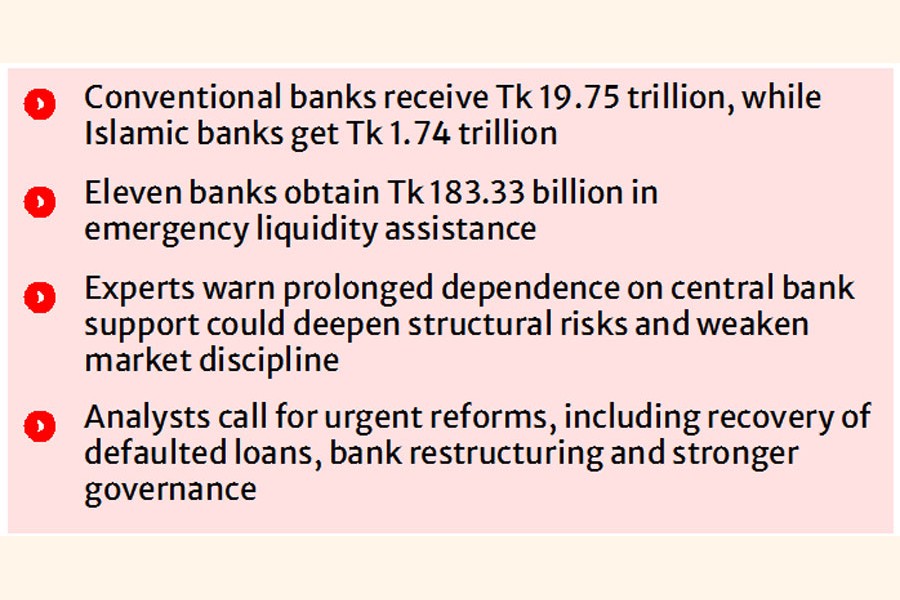
Bangladesh Bank (BB) injected Tk 21.68 trillion in liquidity support into the country's financial institutions in 2025 as mounting pressures continued to weigh on the banking sector despite improvements in some external economic indicators.
The support was extended to conventional banks, Islamic banks and finance companies through a range of liquidity facilities to help maintain their operations, according to the central bank's latest report.
According to the report, the central bank provided Tk 19.75 trillion in liquidity support to conventional banks and finance companies through regular instruments during 2025, a decline of 26.23 per cent from the previous year.
The liquidity was provided through Repo operations (59.11 per cent), Assured Liquidity Support (36.67 per cent), and the Special Liquidity Facility (4.22 per cent).
Islamic banks received an additional Tk 1.74 trillion through specialised windows. The Islamic Bank Liquidity Facility (IBLF) accounted for 89.93 per cent, followed by Special Liquidity Support (SLS) at 9.88 per cent, with the Mudarabah Liquidity Support (MLS) contributing a negligible amount.
Conventional banks absorbed 91.89 per cent of the liquidity support, while Islamic banks received the remaining 8.11 per cent.
In addition, 11 banks received Emergency Liquidity Assistance (ELA) amounting to Tk 183.33 billion during the year.
During the same period, banks deposited Tk 5.11 trillion with the BB in the form of the Standing Deposit Facility (SDF).
Banking sector analysts say the central bank's liquidity support may help maintain short-term financial stability, but it cannot serve as a permanent solution.
They caution that prolonged dependence on such support could create risk within the banking sector by encouraging weak institutions to assume that the central bank will eventually rescue them regardless of their management failures.
Experts have called for five urgent measures to strengthen the banking sector: stricter recovery of defaulted loans, restructuring of weak banks, stronger governance, rapid recapitalisation of under-capitalised institutions and enhanced regulatory supervision.
Dr Masrur Reaz, Chairman of Policy Exchange Bangladesh, said the scale of liquidity support highlights deep-rooted structural weaknesses within the banking system.
"Providing Tk 21.68 trillion in liquidity support in a single year is not a normal phenomenon. It is a clear indication of structural fragility within the banking system," he said.
"A number of banks have become increasingly dependent on the central bank rather than relying on their own liquidity management capabilities," he noted.
Dr. Reaz attributed the crisis to years of weak corporate governance, politically influenced lending, soaring non-performing loans, and a lack of accountability, which he said have significantly eroded depositor confidence and weakened the overall health of the banking sector.
Syed Mahbubur Rahman, Managing Director and CEO of Mutual Trust Bank, said "There are liquidity pressures in certain segments of the banking sector, but deposit growth has returned to double-digit territory, which is a positive sign."
He noted that a sustainable improvement in the banking sector would depend largely on reviving private-sector investment and restoring business confidence.
"What the economy needs now is an enabling investment climate. Higher private investment will stimulate credit demand, support business expansion and strengthen overall economic activity," Mr Rahman said.
Referring to the large volume of central bank liquidity support, he said such dependence cannot be viewed as a positive development for the economy over the long term.
Mr Rahman, however, noted that a significant portion of liquidity support received by banks was backed by government securities.
"In many cases, banks accessed liquidity facilities by repoing Treasury bills and Treasury bonds held in their portfolios. Therefore, the support should not always be interpreted as a sign of distress, although it does reflect tighter liquidity conditions in the financial system," he added.
Mr Rahman said restoring confidence, improving governance and creating a conducive investment environment would be crucial to reducing banks' dependence on central bank support and ensuring sustainable financial sector stability.
sajibur@gmail.com