
BB raises policy rate to tame inflation
• Monetary measure to manage high prices • Banks to borrow from BB at higher rate of 5.0pc
JASIM UDDIN HAROON | Monday, 30 May 2022
The Bangladesh Bank (BB) raises the benchmark interest rate, for the first time in nearly two years, signaling more actions to manage soaring consumer prices under impact of both local and global inflation.
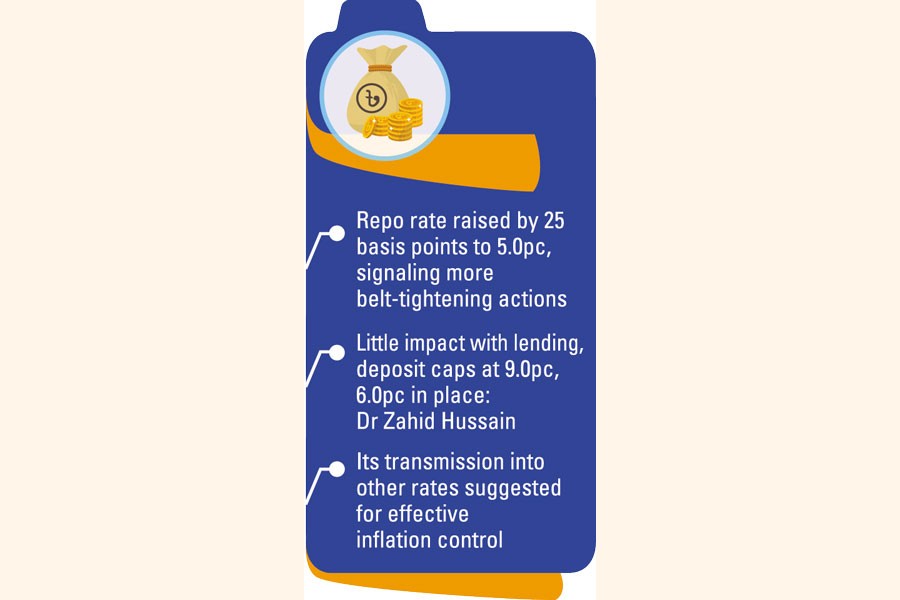
The central bank raised on Sunday the repo rate - at which it lends money to commercial banks - by 25 basis points to 5.0 per cent with "immediate effect".
Usually, central bank raises such policy rate in an attempt to rein in high consumer price, which has been creeping up as per official count. But public perception of inflation is much higher than the official measurement.
People familiar with the matter told the FE the decision came amid soaring prices of foods and other consumer items, with inflation climbing to an 18-month high and higher global prices filtering through into Bangladesh mainly because of the Russian war in Ukraine-the 'global breadbasket'.
The monetary policy committee of the central bank revised upward the policy rate in its meeting held on the day.
Chief economist of the BB Dr Habibur Rahman told the FE: "The main objective is to tame the inflationary pressures".
"This is a signal [to the financial market] that the central bank may take more such type of actions to rein the inflation [in future]". He said other rates like the call money rates may get a signal.
However, the BB has kept the reverse REPO rate unchanged at which it borrows from banks at 4.0 per cent, according to a press release issued on the day by BB.
In the meantime, economists view that the upward adjustment has no impact on the market as there is a cap on lending and deposit, 9.0 per cent and 6.0 per cent respectively.
They said this will raise the management cost for the banks which may impact their profitability.
They suggest such rates should be transmitted into other rates for effective control of inflation.
Inflation-sensitive items relevant to Bangladesh such as edible oils have soared due to the Ukraine war and export bans by key producers, including Indonesia. Once fertiliser prices increase, it will have a direct blowback impact on food production and price in Bangladesh.
Dr Zahid Hussain, a former lead economist at the World Bank, told the FE: "The spike in the policy rate hardly influences other rates as we have a cap on lending and deposits."
The economist, however, says at best this may give a signal to the market.
He thinks food inflation may remain high as spillovers from the global wheat market of Russia and Ukraine. But for lingering global headwinds and intensifying geopolitical headwinds, some economists argue, the repo variation may not work.
Dr Sajjad Zohir, an eminent economist, told the FE that the changes in the REPO may not work as desired.
He says the inflation in expectation is not domestic market-linked rather it is international market-linked.
The space for lending on some luxury goods has been reduced as a result of 75-percent LC-margin hikes.
"In my view, such variation of the REPO may not work to tame the inflation … ," says Dr Zohir, also executive director of Dhaka-based Economic Research Group or ERG.
jasimharoon@yahoo.com