
BB unveils \\\'investment-friendly, cautious\\\' monetary policy
FE Report | Tuesday, 28 January 2014
The central bank unveiled an 'investment-friendly, cautious' monetary policy Monday with an aim to achieve maximum economic growth by curbing inflationary pressure on the economy.
"We've sought cooperation from the stakeholders to help implement the investment-friendly, cautious monetary policy properly," Bangladesh Bank (BB) Governor Dr. Atiur Rahman told the newsmen while announcing the monetary policy statement (MPS) for January-June period of the current fiscal year (FY), 2013-14.
The BB's monetary and financial policies will remain supportive of investment and growth, while also being anchored to macroeconomic and financial stability, the central bank chief noted.
BB has also advised the big corporate houses and conglomerates to collect funds from the country's capital market instead of from banks for expediting their business activities.
Mr. Rahman said: "It will be desirable to see big corporate houses and conglomerates making greater access to equity and debt issues in the capital market instead of crowding banks, leaving more of banking system resources for smaller borrows."
He also said the latest MPS has been declared with a note of healthy optimism that the entrepreneurial zeal awakened in our population would not falter in their aspirations for stable, steadily accelerating inclusive growth towards rapid poverty eradication and eventual prosperity; resiliently carving out progress path around transient debacles and disruptions.
The MPS said the monetary stance in second half (H2) of the FY 14 takes these recent economic and financial sector developments into account.
It will target a monetary growth path that aims to bring average inflation down to 7.0 per cent, while ensuring that credit growth is sufficient to stimulate inclusive economic growth.
The central bank revised its growth projection to the range between 5.8 per cent and 6.1 per cent from the range between 5.7 per cent and 6.0 per cent earlier.
BB's current forecast is that output growth will pick up in H2 of FY 14, and this will partly make up for the losses faced in H1.
Its overall forecast for FY 14 ranges from 5.8 per cent to 6.1 per cent, and should there be no major disruption to the economy, output growth could be closer to 6.0 per cent, according to the MPS.
"The BB will update its forecasts on a regular basis during the course of the year, and the monetary programme will also be flexible to accommodate any significant change in these forecasts," it noted.
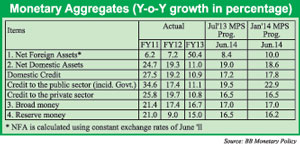
The private sector credit growth target remained unchanged at 16.5 per cent in the second half-yearly MPS of FY 14.
"The ceiling for private sector credit growth of 16.5 per cent has been kept well in line with the economic growth targets. This level is sufficient to accommodate any substantial rise in investment and trade-finance over the next six months," the central bank said.
In the MPS banks are advised to lend only to creditworthy clients for productive purposes, and whether this ceiling is reached or not depends ultimately on investors' appetite and the banks' assessment of project viability.
Under the new monitory programme, public sector credit growth is re-fixed at 22.9 per cent from 19.2 per cent earlier.
BB Chief Economist Dr. Hassan Zaman said the slightly higher credit growth to public sector figure in percentage terms for June 2014 in the current MPS is due to the fact that the first MPS of FY 14 was based on an estimated figure for June 2013 government borrowing, which turned out to be higher than the actual figure.
"As a result, due to the 'lower base effect' the public sector borrowing growth for June 2014 (22.9 per cent) in the current MPS is higher than the previous MPS (19.5 per cent) even though the amount in monetary terms (Tk 260 billion) remains the same," he explained.
About inflation, the MPS said reducing average inflation from its current 7.5 per cent level may prove challenging, especially as aggregate demand is likely to pick up in H2 of FY 14.
Besides, the recent rise in Indian inflation is also a risk for Bangladesh as shown by historical long-term trends.
The BB governor said the new MPS keeps unchanged the target of 7.0 per cent annual inflation on an average on the basis of consumers' price index (CPI) by June 2014.
"Monetary policies have limited influence on demand for the staple food items in the CPI basket, though BB's attention on farm credit promotion also makes some impact by helping augment supplies," Mr. Rahman noted.
The MPS, however, said the central bank will continue to focus on achieving its inflation target. It will also provide sufficient space in its monetary programme for lending to activities that support broad-based investment and inclusive growth objectives.
"The persisting inflationary pressures over the past few months with the risks ahead related to the inflation outlook imply that achieving the FY 14 inflation target of 7.0 per cent will be challenging," the MPS noted.
It also said the central bank will continue supporting a market-based exchange rate while seeking to avoid excessive foreign exchange rate volatility.
"We're now working to introduce pension scheme for bringing dynamism in the country's secondary treasury bond market," BB Change Management Advisor Allah Malik Kazemi said while replying to a query.
He also said such scheme will help create demand for the Bangladesh Government Treasury Bonds (BGTBs).
BB Deputy Governor S K Sur Chowdhury said the central bank has already taken different measures including relaxation of the loan rescheduling policy for the next six months to facilitate financing for the businesses, affected by political turmoil.
"We've advised the banks to diversify their loan portfolios to avoid concentration of loans and minimise risks," the deputy governor said, adding that the central bank will scrutinise the risk of big corporate and conglomerate loans.
Among others, BB Deputy Governor Abu Hena Mohammad Razee Hassan also spoke on the occasion.