
BCIM-EC to promote regional and sub-regional cooperation
M S Siddiqui | Tuesday, 4 November 2014
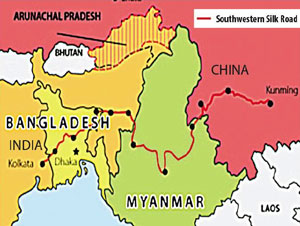
Regionalism and sub-regionalism are recent concepts in development economics. The enduring pursuit of regionalism and sub-regionalism has an underpinning thrust on peace, security and development through exploration, identification and gradual intensification of trade, economic and cultural ties among the geographically contiguous areas.
The idea of such regional and sub-regional co-operation developed in Development Economics with the success of existing growth zones -Mekong Sub-region (GMS) Growth Triangle, Southern China Growth Triangle and the Southern growth triangle (SIJORI) comprising the Johor State of Malaysia, Singapore and the Riau Islands of Indonesia.
The Southern Growth Triangle (SIJORI) was established in 1989 comprising Singapore, Johor state of Malaysia and the Indonesian island of Batam in the province of Riau. This growth triangle drew on the mutual complementarities of the three economies involved. Indeed, the factor that these three economies were at different stages of development helped them to gain from closer cooperation by enabling them to make best use of their complementarities. The growth zone allowed the three stakeholders involved to combine the competitive strengths of the three areas to make the sub-region an attractive destination for regional and international investors. Singapore provided an advanced infrastructure, financial resources and management expertise while Indonesia and Malaysia contributed natural resources and the needed workforce.
The member states took initiatives for integration of the regions. Many manufacturing enterprises of Singapore relocated their plants in the neighbouring areas of Indonesia and Malaysia, including in the industrial parks which were developed by property developers from Singapore in order to take advantage particularly of the cheap labour wages. Cross-border movement was facilitated to allow a large number of workers from Malaysia to move easily to Singapore to sell their labour services. Singapore companies also opened up different types of non-manufacturing businesses in two other locations. Other examples of integration include import by Singapore of a large volume of water from Johor and natural gas from both Malaysia and Indonesia through pipelines.
The Southern growth triangle (SIJORI) has been recognised as one of the most successful models of sub-regional cooperation for promoting trade and generating investment in the region. During its first five years it attracted $10 billion in private sector investments. Conducive investment incentives provided by the participating governments along with supportive measures for industrial establishments, contributed to the large flow of investment into the economies of the participating countries in the areas of manufacturing, trade and services, agribusiness, and tourism.
The Greater Mekong Sub-region (GMS) is a sub-regional development programme that was established under the initiative of the Asian Development Bank (ADB) embracing Yunnan province of China, the three Indo-Chinese states of Vietnam, the Lao People's Democratic Republic and Cambodia, along with Thailand and Myanmar. This initiative was designed to harness the economic complementarities of the entire Mekong delta region. The unifying feature of this project was the Mekong River which either borders or flows through the member countries. The entity covers considerable natural resources in the form of arable land, extensive forest and fisheries resources, and vast energy resources in the form of hydroelectric power, coal, oil and gas reserves.
GMS provides a unique opportunity to blend cooperation in trade, investment, transport and communication in a comprehensive manner and in a planned way. Major growth zones in this region are the South China Growth Triangle; Growth Triangle comprising the Johor state of Malaysia, Singapore and the Riau islands of Indonesia; the Greater Mekong Sub-region Growth Triangle, and the South Asian Growth Quadrangle.
The Kunming Initiative, which is currently known as BCIM-EC (Bangladesh-China-India-Myanmar Economic Corridor), a sub-regional idea came up to address the cost of doing business between the BCIM countries that increases when trade is conducted through the land borders. The sub-region has the prospects of cooperation by clustering parts or the whole of Bangladesh, China, India and Myanmar, specifically the land-locked frontier areas. This area has unique combination since China and India have comparatively better technology, more efficient labour force, and improved physical and commercial infrastructure. On the other hand, Bangladesh and Myanmar have unskilled and semi-skilled labour force, basic, and intermediate technology.
BCIM Economic Connectivity Forum for Regional Cooperation began its journey in August 1999 in Kunming, capital of China's south-western province of Yunnan. After 14 years of intense dialogue and cooperation, today BCIM Forum has become an important sub-regional cooperation mechanism in the region, aimed at greater integration of trade and investment between the four countries. The BCIM is for introducing a multimodal transport and a fast visa processing system to enhance intra-regional trade.
It has been mandated for the construction of Silk Road Economic Belt and the 21st Century Maritime Silk Road. It has proposed many projects of linking the fast-growing economies of East Asia, South East Asia and South Asia through mutual cooperation in the BCIM sub- region and has finally garnered the required traction. The idea came from the ancient Silk Route, a trade channel that connected China with the outside world via the Southern (South and Central) Asian route. In recent years, interest has emerged for exploring the historic links between the countries and peoples of South Asia and China.
The Forum, guided by UN-ESCAP and joined by experts from the relevant countries, agreed to suggest plans for the Asian economic corridors transport facility which can act as the basis for making financing products through bilateral research.
Apart from the economic factors, the strong cultural affinity, the closer geographical proximity and presence of a huge informal border trade among the BCIM countries also provide a strong optimism for forming a regional trading bloc. Again, BCIM cooperation is expected to help revive the centuries-old Silk Road running from Chittagong to Yunnan through Myanmar.
The first step was the setting up an organisation named "China Kunming International Logistics & Finance Association (ILFA)" with head office in Kunming and support of the Chinese government. ILFA has been established to facilitate and consolidate the process of regional economic cooperation and create cross-border trade and investment opportunities both at public and private sector levels. ILFA is working for the connectivity and cooperation issues covering Southeast Asia, South Asia and Indian ocean regions and also working towards infrastructure construction including roads, land and deep sea ports, significant projects, construction of industrial parks, free trade zones etc. Among other objectives, ILFA is also exploring the possibilities of creating platforms for international exchanges, researching on financial instruments, formation of international logistics organisations and regional financial organisation for ensuring financial inter-connectivity of the region.
BICM-EC signed Letter of Intent for "BCIM Economic Corridor interconnection and Interworking Formation Forum" on November 10, 2013 and MoU with the South Asian Federation of Exchanges (SAFE) in Dhaka on January 25, 2014. The forum reached a consensus to create a mechanism for financial cooperation for the BCIM economic corridor and enhance Asia-wide financial cooperation for operations at non-governmental level. It formed the "BCIM Exchanges Forum", a sub-forum of the BCIM main forum, to design and introduce innovative financial products under Chinese currency, the RMB settlement, clearing and similar issues. On final discourses, the SAFE, ILFA and other participating stock exchanges/institutions decided to organise the BCIM Exchanges Forum as the key platform for China-South Asia International Financial Opening Cooperation.
The Forum has agreed to support the suggested Pan Asia Stock Exchange, based in Kunming, China. It decided to organise the Joint Committee to investigate as to how to develop the stocks, bonds, futures, gold and other financial derivative instruments to be used for the construction of the BCIM and other Asian Economic Corridors (like railway, highway, river, and others) for the regional nations, the industrial construction (like Sonadia Port, Chittagong Port, Kyaukpyu Port and others), the energy development (like electric power, natural gas and others) and other infrastructural fields. All of these to be supported through international financing mechanism for infrastructure connectivity constructions possibly through cross border investments between Chinese investors and other enterprises/entities.
The Forum agreed that establishing the non-governmental financing mechanism would promote financial market and support commercialised services for the RMB Settlement and RMB Clearance programme cooperation, advance the mutual participations by banks, insurance and stock exchanges, build joint transactional credit assessment system, build risk monitoring and controlling platform, a common regulatory framework which shall cover all kinds of financial markets, organisations, products, instruments and settlements of transactions. It also agreed to put up joint efforts and work together to provide suggestions to all relevant governments to harmonise and improve legal policies, communications, codifications and cooperation between China and Asian countries to support and facilitate services for cross-border investment and financing.
But the bottlenecks for this initiative are politics, suspicion among neighbours, differential perception on security, state structure based on religion, ethnicity and language, unsettled boundary issues and trans-border migration. These issues will continue to influence the pace and scale of the BCIM Forum. Despite suspicion and confusion, the forum is moving forward.
The writer is a Legal Economist. shah@banglachemical.com