
BD alert to avert Lanka-like economic crisis: Hasina
‘Govt step helps tame prices of essentials’
Thursday, 7 April 2022
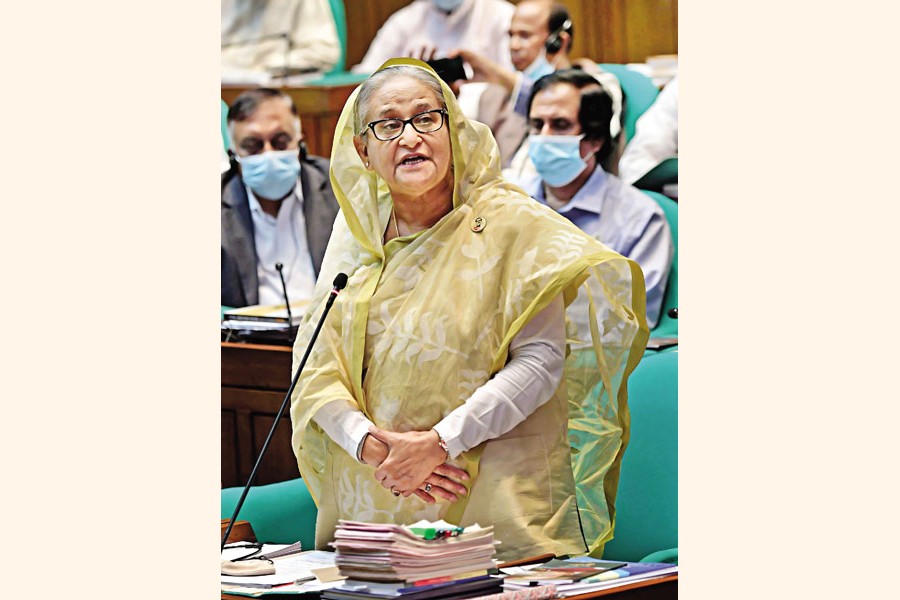
Bangladesh's economy is "robust" and the government has been exercising "extreme caution" so that the country does not face a crisis like that of Sri Lanka, Prime Minister Sheikh Hasina has said, reports bdnews24.com.
She made the remarks after Jatiya Party Chairman GM Quader expressed concern over the risks facing Bangladesh's economy in parliament on Wednesday. He fears Bangladesh may not also be able to repay loans if its economy suffers the way Sri Lanka has.
Hasina then said, "This [Sri Lanka's crisis] is real. But one thing I want to say to him is that we've repaid loans taken for development in time since we formed the government."
Quader said Sri Lanka's economy is based on tourism and agriculture. While tourism in the country was hit by the coronavirus pandemic, agriculture suffered due to wrong decisions by the government.
"They [Sri Lanka] borrowed billions of dollars in the name of development before collapsing under pressure of loans. Now they cannot repay," the Jatiya Party chief said.
If the three main planks of Bangladesh's economy-garment export, remittances and agriculture-take a hit like Sri Lanka's, Quader said he wonders whether Bangladesh will be able to repay the loans it is taking for development. "We can't say for sure whether our condition will not be like that of Sri Lanka," he said. Hasina said Bangladesh has "never been and won't be a defaulter because the base of our economy is very strong. And we're very much alert".
She also claimed her government is saving money in the development projects while the Jatiya Party and the BNP had taken away funds through corruption. "They showed twice as much the price for foreign goods and pocketed the extra money."
"I inaugurated a 1,320MW power plant in Payra some days ago. The work there ended eight months ahead of schedule and we saved about Tk 8 billion. We always finish all the jobs ahead of schedule and save money."
UNB adds: Prime Minister Sheikh Hasina also said on Wednesday that the prices of essential commodities have come down significantly due to the ongoing fair-price sale of these products by the state-run Trading Corporation of Bangladesh.
She said this while responding to a tabled question from ruling party MP Kazim Uddin Ahmed during PM's question-answer session in Parliament.
She said that prices of the essentials soared significantly all around the world due to the economic slowdown caused by coronavirus pandemic.
She also mentioned that Russia-Ukraine war pushed up the fuel price too.
"As a result, prices of essentials have increased in the world market," she said.
She, however, said that her pro-people government has taken immediate steps to control the situation and keep the prices under control and at a tolerable level.
"Due to various steps of the government prices of the essentials are now at logical level," she said.
She also hoped that prices of the essential items will remain at tolerable and affordable level during the holy month of Ramadan.
The prime minister said that one-litre bottle of soybean oil, selling at Tk 170 on March 1, was available at Tk 161.50 on April 5.
She said during this time the price of loose soybean oil came down to Tk 155 per litre from Tk 175, while the price of palm oil came down to Tk 142 per litre from Tk 158.
But the TCB during this time sold bottled soybean at Tk 110 per litre, she said.
The Leader of the House mentioned that lentil price came down to Tk 112.50 on April 5 from Tk 120 while TCB was selling at Tk 65 per kilogram.
Loose sugar was Tk 85 per kilogram on March 1 while it was Tk 78 on April 5. TCB is selling at the price Tk 55 per kilogram, she added.
Hasina said that the price of chickpeas was selling at Tk 72.50 on April 5 while it was Tk 77 on March 1. TCB is selling this item at Tk 50 per kilogram.
Regarding onion price, she said, on March 1 it was selling at Tk 60 per kilogram, while on April 5 the price fell to Tk 31.50. The TCB is selling it at Tk 20 per kilogram.