
Heat eats up 25m working hours in 2024
BD counts $1.78b in lost productivity
FE REPORT | Wednesday, 17 September 2025
Bangladesh counts US$1.78 billion in lost productivity in a year as rising temperatures ate up about 25 million working hours in 2024 through the heat impact on health, the World Bank reveals.
"The resulting economic losses are projected to be between $1.33 billion and $1.78 billion, which represents about 0.3 per cent to 0.4 per cent of Bangladesh's gross domestic product (GDP) in 2024," the Bank reported Tuesday.
Furthermore, when temperatures exceed 37°C, compared with days below 30°C, productivity loss among working-age individuals increases significantly, underscoring the urgency for effective interventions, says the WB report titled 'The Unsustainable Life: The impact of heat on health and the economy of Bangladesh'.
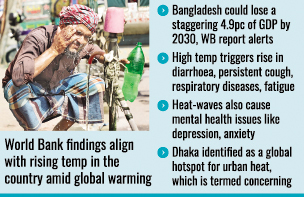
The Washington-based lender launched its report at a function in Dhaka that also said Bangladesh could lose 4.9 per cent of GDP by 2030.
Since 1980, Bangladesh's maximum temperature has risen by 1.1°C, while the "feels like" temperature has surged by 4.5°C, triggering a rise in health issues such as diarrhoea, persistent cough, respiratory diseases, and fatigue.
Heat-waves also caused mental health issues, including depression and anxiety, and lowered the productivity.
The report says the rates of cough, diarrhoea and depression are much higher in summer season compared to the winter in the country.
Dhaka is billed more vulnerable than other cities and rural areas in Bangladesh.
With rising temperatures-long reported under the impact of perilous global warming-Bangladesh is facing physical-and mental-health risks, along with declining productivity leading to economic loss, the WB says in its report.
The World Bank analyzed national temperature and humidity trends during 1976-2023 and drew from a new two-round 2024 household survey of more than 16,000 people.
"Health impacts are stark. In summer, cases of diarrhea and persistent cough double compared to winter. Women are more vulnerable to heat-induced illness such as exhaustion and heat stroke," the report reads.
"Depression and anxiety increase with heat and are more prevalent in summer. Depression progressively increases with age, while anxiety peaks around 50-65 age group. Productivity loss, due to increased physical and mental health conditions, are higher in summer than in winter," it adds.
The WB analysis shows measurable links between exposure to heat and poorer health outcomes, alongside substantial productivity losses. "Like many other countries, Bangladesh faces real risks of lost human capital and productivity," said Iffat Mahmud, Senior Operations Officer, World Bank, and co-author of the report.
The World Bank suggests evidence-based policies and targeted investment for better adaptation measures to improve wellbeing and livelihoods and secure a healthy future tomorrow.
It calls for urgent, coordinated action to protect people, livelihoods, and economy from escalating heat risks.
While Bangladesh ranks second globally in exposure to elevated temperatures, the case of the capital, Dhaka, identified as a global hotspot for urban heat, is particularly concerning.
The increase in the heat index for Dhaka is around 65-percent higher than the temperature increases recorded for Bangladesh as a whole.
Rapid urbanization, population growth, and unplanned development resulting in loss of green space and vegetation are some of the factors contributing to the "urban heat island" effect in Dhaka, the WB report says.
Among the surveyed population, persistent or chronic cough was the most frequently reported condition, affecting 6.0 per cent of the surveyed individuals in summer compared to 3.3 per cent in winter.