
BD denied GSP, dev funds over rights situation: US
Concerned about press freedom, envoy tells journos
FE REPORT | Wednesday, 1 June 2022
Washington has put a freeze on trade privilege under GSP and development funding for Bangladesh out of concern over rights situation, democracy, freedom of press, and labour conditions, says the US envoy.
"We are also concerned about insufficient labor rights and poor working conditions in Bangladesh. These concerns, unfortunately, cost Bangladesh access to the U.S. Generalized System of Preferences trade benefit, or GSP, in 2013," Ambassador Peter Haas told journalists in Dhaka on Tuesday.
The US envoy made his country's stand clear on these oft-raised issues while speaking at DCAB talks organised by the Diplomatic Correspondents' Association of Bangladesh.
They are also causing Bangladesh to miss out on funds from the U.S. Development Finance Corporation, a massive source of investment capital from the United States, he adds.
And when it comes to democracy and human rights, he says, the United States has raised concerns publicly and privately.
The US is concerned about press freedom, especially the Digital Security Act, and several draft laws and regulations that could inhibit press freedom, he notes.
"We are concerned about human rights abuses, including extrajudicial killings and enforced disappearances," the American diplomat told his audience.
"As I am sure you know, on December 10, 2021, Human Rights Day, the United States imposed sanctions on the Rapid Action Battalion and some of its officials based on credible evidence of serious human rights abuse," he mentions.
On a major matter of the day in politics, he said that the US wants to see a free and fair election in Bangladesh.
He notes that the role of an independent election commission and vigilant people, media are vital for holding a fair election of international standards.
He said at the upcoming two-nation economic dialogue in Washington he will tell his bosses in the State Department that the United States should remain the same steadfast partner to Bangladesh for the next fifty years as it has been over the past fifty years.
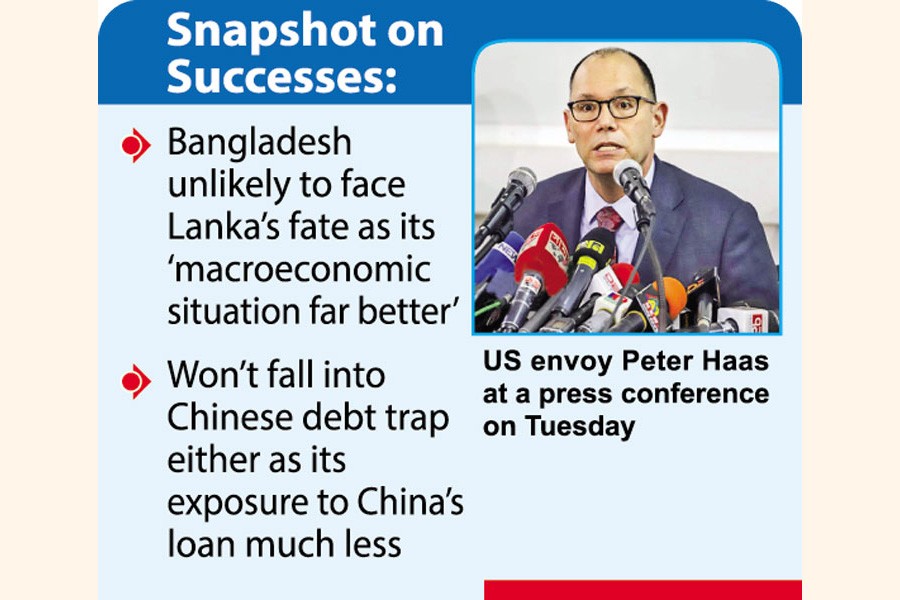
Responding to a question the US envoy said Bangladesh is unlikely to face the fate of Sri Lanka as he finds its macroeconomic situation far better.
He also brushed aside the idea that Bangladesh could fall into Chinese debt trap as its exposure to Chinese loan is much lesser than that of the World Bank, the ADB and Japan.
Mr Haas notes that Bangladesh's external-debt management is more prudent.
Billing Bangladesh's successes as 'real' he observed that from a newborn country devastated by conflict Bangladesh turned itself into a thriving country with one of the world's fastest-growing economies.
In 1972, Bangladesh's per-capita income was $94 in today's currency and now it is nearly $2,000, he mentions, adding that soon Bangladesh will graduate from least-developed-country status.
It is steadily progressing towards becoming a middle-income country.
"These accomplishments are real, tangible, and truly extraordinary."
On the Rohingya issue he said the continued presence of more than one million displaced people from Myanmar poses huge challenges.
"It is incumbent upon all of us to push Burma to create the conditions to allow a safe, voluntary and dignified return of Rohingya," the US envoy told the meet.
"In the meantime, we must all work together to ensure that the Rohingya refugees do not become a lost generation."
Terming the US as a formidable friend he said since 1972, the United States has provided $8.0 billion of assistance to Bangladesh.
"We continue to invest around $200 million each year towards development programs in health, agriculture, education, democracy and governance, climate change, and providing greater economic opportunities to the Bangladeshi people."
He mentions that members of the U.S. military conduct exercises with the Bangladesh military in Bangladesh to strengthen Bangladesh defence readiness, build operational interoperability, and reinforce the partnership between the two military forces.
The US is also providing training to Bangladeshi law-enforcement personnel and security services.
The US ambassador points out that Bangladesh and the US are already moving away from a relationship based on assistance to one that emphasizes mutually beneficial trade.
"I believe our greatest opportunity to deepen our relationship is in building our trade and investment relationship," he says.
DCAB President Rezaul Karim Lotus presided over the meeting moderated by its General Secretary AKM Moinuddin.
mirmostafiz@yahoo.com