
BD expects $3.0b dev funds during PM's China visit
No Teesta deal this time, but discussion to take place
Mir Mostafizur Rahaman | Sunday, 21 June 2026
Bangladesh is expecting roughly US$3.0 billion in development support and grants from China during Prime Minister Tarique Rahman's upcoming visit starting June 23.
Mr Rahman will be on China tour on June 23-26 attending the World Economic Forum's Summer Davos gathering in Dalian before holding talks in Beijing with President Xi Jinping and Premier Li Qiang. Senior officials concerned have said Dhaka expects substantial Chinese backing for a series of infrastructure, industrial and public-health projects, alongside investment commitments from Chinese private companies.
"It is not wise to mention the exact amount, but we are expecting substantial support for several projects, and there will be grants as well," Foreign Secretary Asad Alam Siam told The Financial Express.
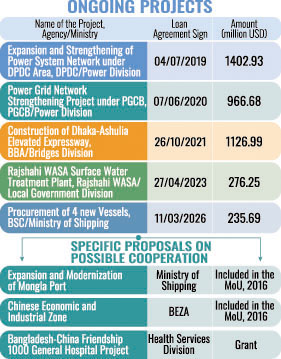
Officials say Bangladesh would seek Chinese financing for three new projects: the modernisation of Mongla Port, the establishment of a Chinese economic zone, and construction of a 1,000-bed hospital.
Among these, the Mongla seaport-modernisation project has long been under negotiation between the two countries but was stalled at the fag-end of the previous Hasina regime.
The project was supposed to be implemented under government concessional loan and its estimated cost was US$400 million. But now the project cost may be much higher, sources say.
The two sides are also expected to review progress on several large-scale projects already under implementation, including the $1.4-billion Expansion and Strengthening of Power System Network under Dhaka Power Distribution Company (DPDC), $966-million Power Grid Network Strengthening Project under Power Grid Company of Bangladesh (PGCB), $1.1-billion Dhaka-Ashulia Elevated Expressway, and $235-millio Rajshahi WASA Surface Water Treatment Plant.
The visit comes as Bangladesh seeks to revive investment inflows and accelerate infrastructure development amid persistent external-financing pressures and slowing industrial expansion.
Officials have described investment promotion as the central objective of the trip. "In fact, the main focus of this visit will be to attract Chinese investment, which is critical for economic growth," Mr Siam says.
The prime minister is scheduled to address a Bangladesh Investment Forum in Beijing and meet executives from several leading Chinese companies, including Chery Group and other major investors exploring opportunities in manufacturing, transport and logistics.
China has emerged as one of Bangladesh's most important economic partners, providing billions of dollars in infrastructure financing over the past decade while remaining the country's largest source of imports.
The two governments are expected to sign up to 17 cooperation instruments during the visit, including 13 memorandums of understanding, two formal agreements, an action plan and a protocol-related note.
Discussions will also cover water-resource management, including the long-discussed Teesta River Master Plan, although officials say no specific agreement on the project is expected to be signed during this tour.
"Integrated river management will be discussed in a broad and comprehensive manner. The Teesta issue will certainly be raised, along with wider cooperation on river management," Mr Siam says.
Another closely watched aspect of the visit will be Bangladesh's response to President Xi's signature international initiatives.
Dhaka is considering participation in one or more of China's four major global frameworks, including the Global Development Initiative (GDI), although officials stress that a final decision has yet to be taken.
"We are actively considering these initiatives. After the visit, we will be able to say whether we are joining any of them or not," Mr Siam says, adding that Bangladesh welcomes the broader vision behind the proposals.
Any decision to align more closely with Beijing's global initiatives would be closely monitored by regional and international partners as Bangladesh seeks to maintain a balanced foreign policy while expanding economic cooperation with China.
Mr Rahman will spend June 23-24 in Dalian, attending the World Economic Forum's Annual Meeting of the New Champions, known as Summer Davos. He is expected to participate in discussions on climate change and meet senior WEF officials and business leaders.
In Beijing, the prime minister will hold separate meetings with Premier Li Qiang and President Xi Jinping. He is also scheduled to meet Zhao Leji, chairman of the Standing Committee of the National People's Congress, alongside senior officials from the Communist Party of China, the China International Development Cooperation Agency and the Export-Import Bank of China.
The visit is expected to provide an early indication of how Bangladesh's new leadership intends to position the country within an increasingly competitive Asian geopolitical landscape while pursuing investment, trade and infrastructure partnerships essential for sustaining long-term growth.
mirmostafiz@yahoo.com