
BD gig workers need social safety nets, says WB
SAIF UDDIN | Saturday, 23 September 2023
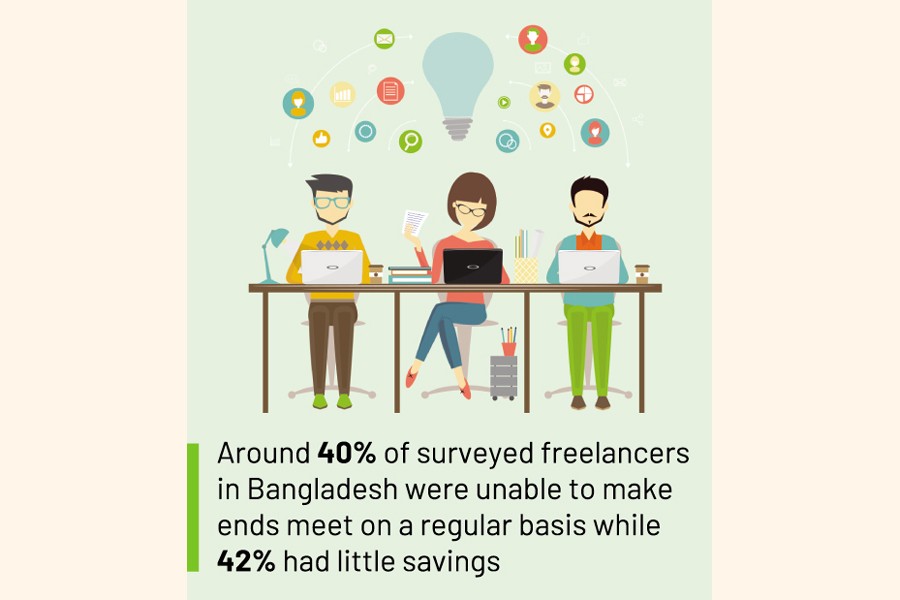
A good number of freelancers in Bangladesh and in other emerging economies do not have access to social safety nets despite their inadequate earnings, according to a World Bank study.
Around 40 per cent of surveyed freelancers in Bangladesh were unable to make ends meet on a regular basis while 42 per cent had little savings.
However, the remaining 18 per cent earned enough for their emergencies and savings.
The report styled 'Working without borders: The promise and peril of online gig work' has recently been launched by the global lender.
The specific type of gig discussed in the study is that mediated through internet platforms in which the worker is not an employee of the enterprise that operates the platform.
It said online gig work is not only a developed-country phenomenon, but is also becoming a popular source of employment in developing countries, with the emergence of many local gig platforms as well as increasing demand from the developing world.
On freelancers' social safety, the report said gig workers, like many other self-employed individuals, typically fall into a 'missing middle' when it comes to social insurance.
"They are sometimes not poor enough to be eligible for social safety net benefits and not well-off enough to be part of social insurance programmes mandated for the formal sector."
"In relatively lower-income countries, gig workers are likely to belong to households needing short-term consumption-smoothing support," said the report.
It suggested making innovative models of social insurance, especially those working with the private sector, and the platforms themselves can help expand the protection of workers in developing countries.
For example, it mentioned the Malaysian government's collaboration with Grab, a super-app for ride-hailing, food delivery and digital payments.
Despite some challenges, gig work is the main source of income for many people in lower-income countries.
Bangladesh's respondents to the study earned a significant share of their income from freelancing platforms, according to the WB.
"On average, online gig workers report earnings of Tk 82,943 per month (equivalent to $967) from freelancing platforms while average monthly household income is estimated at Tk 16,000."
However, gig work is becoming increasingly competitive as the supply of gig workers increases, the WB said, adding that the Covid-19 pandemic exacerbated some of existing trends in gig work and increased competition.
"In Bangladesh, respondents to the survey confirm that they were affected by Covid-19, primarily by an increase in competition," it said.
The survey respondents said proficiency in English language is a significant barrier in accessing online gig work opportunities for them.
The global supply of online gig work is dominated by workers of English-speaking countries, according to the report.
Three countries-India, Bangladesh and Pakistan-account for over 50 per cent of the supply of online gig work on the basis of data collected by the Online Labour Index.
It signals that workers from non-English-speaking countries are likely to face language barriers to enter the online gig work market, according to the report.
saif.febd@gmail.com