
BD moves eight slots up
Economists eulogise progress, call for easing land reg process
FE REPORT | Friday, 25 October 2019
Bangladesh has moved up by eight notches in the 'Ease of Doing Business' index, though it clinched the lowest position in South Asia, after Afghanistan.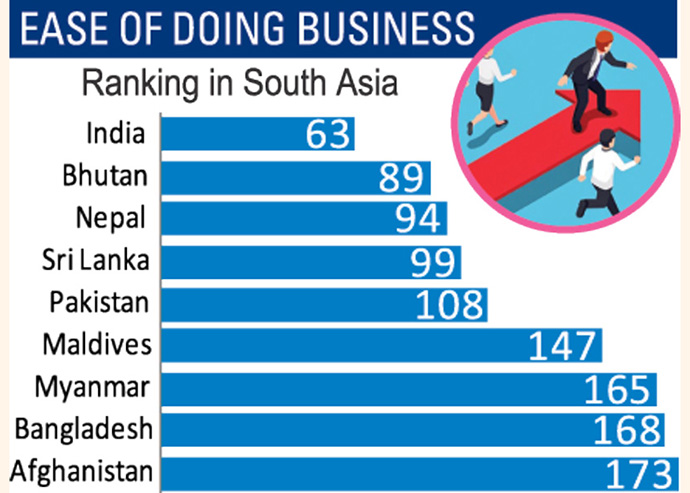 Bangladesh made some reforms in the past one year to April 2019 that, many believe, helped improve its ranking to 168th from 176th out of 190 nations.
The World Bank made the disclosures in its annual flagship report styled 'Ease of Doing Business 2020' revealed in Washington on Thursday.
In South Asia, Pakistan jumped by 28 places to 108th and India by 14 points to 63rd.
Nepal ranked 94th, Bhutan 89th, Sri Lanka 99th, the Maldives 147th, Myanmar 165th and Afghanistan 173rd.
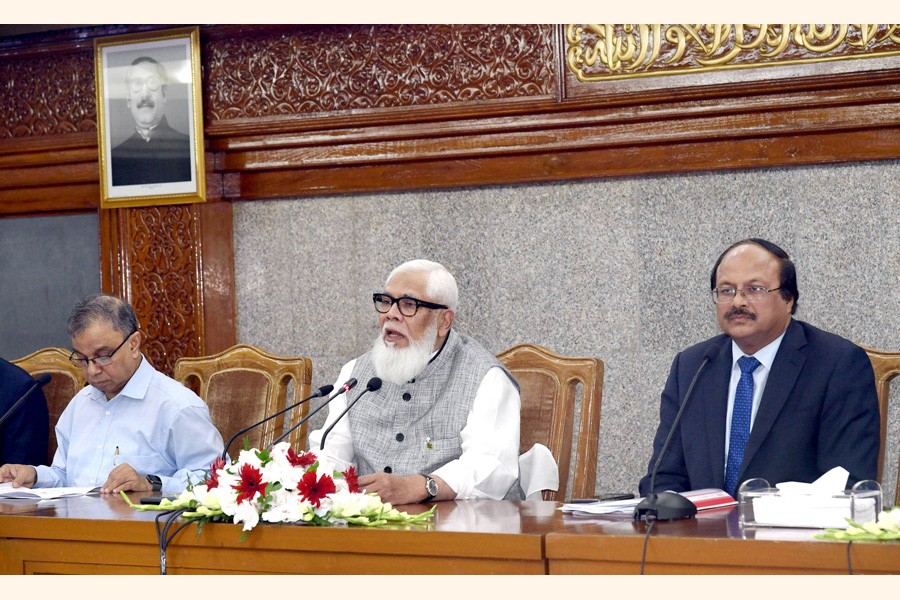
Bangladesh Investment Development Authority (BIDA), which coordinates countrywide reform programmes, hosted a briefing to apprise the media of the country's latest slot on the globally popular business climate index.
Adviser to the PM on private industry and investment Salman Fazlur Rahman was present as the chief guest at the function held at the Prime Minister's Office (PMO).
Principal secretary Nojibur Rahman, BIDA executive chairman Md Sirazul Islam, legislative affairs senior secretary Mohammad Shahidul Haque and finance secretary Abdur Rouf Talukder, among others, joined the event.
Abul Kalam Azad, chief coordinator for SDG affairs at the PMO, answered many queries from the media.
Bangladesh did well on three out of 10 major issues: It scored 82.4 on starting a business, 61.1 on dealing with construction permits and 60 on protecting minority investors.
It performed the worst by scoring 22.2 in enforcing contracts, 29 on registering property, 28.1 on resolving insolvency and 31.8 on trading across borders.
The index jointly prepared by two leading World Bank economists Simeon Djankov and Gerhard Pohl indicates better, usually simpler, regulations for businesses and stronger protection of property rights.
Bangladesh's performance report was based on surveys done in Dhaka and Chattogram and the results are based on reforms and other pertaining work done from November 2018 to April 2019.
Addressing the programme, Mr Salman F Rahman said this was a big achievement as Bangladesh had previously used to either jump or slip by one notch
"This is the first time Bangladesh has jumped by eight positions and this has been possible following some reforms undertaken in a very short span of time after the December 30 general election," he added.
"To my mind, this is a substantial improvement for the country that had never happened."
The prominent business personality said the country now wants to enter the double-digit zone in the index within the next couple of years.
Bangladesh is one of the key 20 nations that emerged as top improvers in terms of conducting reform programmes to enhance their business environment.
Mr Rahman, one of the founders of Beximco Group, a Dhaka-based multinational conglomerate, said Bangladesh has actually been working on the index over the past three to four years.
At the event, Mr Azad said Bangladesh has much scope to improve [its rankings]. "Actually, there are a total of 60 issues and we have scope to improve all."
"The Bangladesh Economic Zones Authority has launched one-stop service and others would do it, having a positive impact on the country's rankings [in future]."
Mr Azad, the former principal secretary, said the government led by Prime Minister Sheikh Hasina has planned to concentrate on other major indexes to improve the country's business climate.
Replying to a query on non-performing loan (NPL) in the banking sector, finance secretary Abdur Rouf Talukder said the actual NPL volume will be much low [than the existing accounting].
"We calculate principal, compound interest and other figures pertaining to the loans pushing the NPL figures up."
"We've appointed auditors for four state-owned commercial banks to ascertain actual NPL figures," Mr Talukder went on to say.
An official WB note said many South Asian economies kept up a solid pace of business regulatory reforms as both India and Pakistan earned spots among the world's top 10 most improved economies.
It said Bangladesh reduced name clearance and registration fees and abolished a fee for certifying digital certificates, thereby reducing the total cost of starting a new company from 21.2 per cent of income per capita to 8.7 per cent.
The authorities in Bangladesh facilitated access to credit information by expanding the coverage of the credit bureau.
In addition, Dhaka has cut the amount of security deposit required to obtain a new power connection, the WB note said.
However, New Zealand topped the list followed by Singapore. The African country Somalia is in the bottom of the 190 nations.
Hailing Bangladesh's improvement in ease of doing business index of the World Bank, economists and businesses on Thursday said the progress is encouraging but not enough to attain its growth trajectory.
To ensure consistent jump in the ranking, they called upon the government to pay serious attention to such areas as enforcing contracts, resolving insolvency, registering property and trading across borders.
The Policy Research Institute of Bangladesh (PRI) on Thursday said the country's development in the World Bank's Ease of Doing Business Index 2020 is not satisfactory.
"Bangladesh can do better. The country is capable of doing better in the Ease of Doing Business," Dr. Ahsan H Mansur, Executive Director of the PRI, said at its office in city on Thursday.
Mr Mansur said most of the neighbours of Bangladesh have done much better than Bangladesh.
The country needs coordinated efforts and regulatory reforms to improve the situation.
The entire bureaucracy - from top to bottom - requires working together for getting expected results in the index, he added.
Kazi Aminul Islam, former executive chairman of the Bangladesh Investment Development Authority (BIDA), said Bangladesh could have progressed more, if all the initiatives, taken during his tenure, were implemented.
He hoped that Bangladesh would be ranked below 100 in the index by 2021.
Zaidi Sattar, the PRI Chairman, said the country needs "deep reform" to improve its investment environment.
He also said inequality is rising in the country along with growth.
"It's not good, Bangladesh needs to address inequality," he added.
Distinguished fellow of the Centre for Policy Dialogue Professor Mustafizur Rahman termed the improvement in the index a "positive sign" for the economy.
"But it's not enough. More needs to be done in order to really attract large-scale foreign investments," he said.
Giving an example of electricity availability, he said Bangladesh has recently lowered the amount of security deposits for new connection, which might have reflected in the improvement, but getting power connection is still a pressing issue that needs to be addressed.
"We need to improve in each area so that the whole value chain cannot be hampered by a single factor," he added.
Analysing Bangladesh's previous positions in the ranking, former lead economist of the World Bank in Dhaka Dr. Zahid Hussain said Bangladesh's previous advancements were erratic.
"This time the country advanced by eight notches, which is very encouraging. But we still have a long way to reach the desired level," he said.
Mentioning various factors that helped the economy gain the improvement, the economist said India has lifted its position by 67 steps in the index over the last three years.
"So, a big jump is possible and we need such a leap to attain the government's double-digit growth target by 2021," he said.
Dr Hussain said the government should pay serious attention to the area of enforcing contract, where its score is not up to the mark.
"It takes much time in settling disputes due to many factors. We need to focus more on enhancing capacity of the settlement mechanism alongside exploring other options like ADR (alternative dispute resolution)," he said.
For more improvement, he suggested streamlining land registration process and bringing transparency in the deeds-registration activities.
Former president of Dhaka Chamber of Commerce and Industries (DCCI) Asif Ibrahim gave credit to the reforms made in the areas of protecting minority investors, starting a business, getting electricity and securing loans.
He said the government must work on improving the areas of enforcement of contract, bankruptcy law, companies act and commercial court for further advancement.
If significant reforms are made the country's ranking will improve further, said Mr Ibrahim, former chairman of the Business Initiative Leading Development.
Bangladesh Investment Development Authority (BIDA) must work in a collaborative manner with the key government agencies and the private sector for further improvement in the index, he argued.
jasimharoon@yahoo.com &
jubairfe1980@gmail.com
bdsmile@gmail.com