
BD ranked among 10 worst countries for 7th time
Sunday, 2 July 2023
MONIRA MUNNI
Bangladesh, for the seventh consecutive year since 2017, ranks among top 10 worst countries of the world where labour rights are not guaranteed, according to a global survey.
The Global Rights Index-2023, launched by International Trade Union Confederation (ITUC) on Friday, pointed out regressive laws, obstacles to union formation and police violence for the worst situation in Bangladesh.
Bangladesh's peers in the list are Belarus, Ecuador, Egypt, Eswatini, Guatemala, Myanmar, Tunisia, the Philippines and Turkey.
"Workers' rights in Bangladesh continued to be severely curtailed. Set up to attract foreign investment, the country's eight Export Processing Zones prohibit workers from forming a trade union or freely expressing their rights," read the report.
In the garment sector, which is the country's largest industry and employs more than 4.5 million workers, attempts at forming unions were ruthlessly obstructed, while strikes were met with brutality by the country's Industrial Police force, it added.
"The authorities also frustrated the establishment of unions by imposing a draconian registration process."
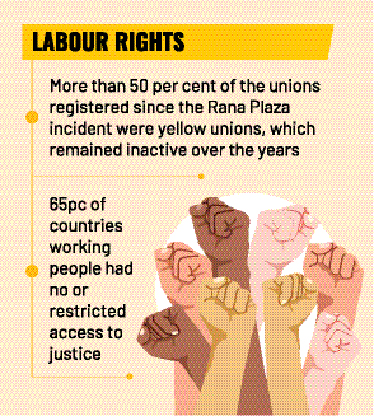
More than 50 per cent of the unions registered since the Rana Plaza incident were yellow unions, which remained inactive over the years, it said adding the labour department failed to register independent trade unions, while unions backed by factory owners proliferated in the sector.
"In Bangladesh, factory owners largely opposed trade unions and they forced workers not to join any union. In many cases, factory owners hired external forces to threaten workers who joined a union and used the police to harass union members."
When an active federation in a factory filed an application for registration, labour department officials often imposed conditions in addition to those specified by the labour laws and rejected the application, it added.
The 10th addition of the index ranks 149 countries in 1-5 categories assess where worker rights are best protected in law and in practice.
The ten-year data trends analysed in the 2023 Global Rights Index show that the global cost-of-living crisis has been met with a crackdown on the rights of working people in every region of the world.
Key measures tracking abuse of worker rights reached record highs, it said adding that 9 out of 10 countries violated the right to strike.
"Some 77 per cent of countries excluded working people from the right to establish or join a trade union. Migrant, domestic and temporary workers, those in the informal economy, platform workers and workers in special economic zones were denied the right to freedom of association."
The right to free speech and assembly was restricted in 42 per cent of countries, often resulting in protesting workers facing police brutality. In France, lawful protests were met with vicious police beatings, indiscriminate arrests and tear gas.
Seventy-three per cent of countries impeded the registration of unions or banned them, including Belarus, Myanmar, Hong Kong, Central African Republic and Guatemala.
Eight out of 10 countries violated the right to collective bargaining. Workers in the Netherlands, North Macedonia, Zimbabwe, Honduras, Indonesia, Montenegro and Serbia saw their rights to collective bargaining severely reduced.
Workers were arrested and detained in 69 countries, with prominent trade union leaders targeted in Myanmar, Hong Kong, Dominican Republic, India and Turkey.
In 65 per cent of countries working people had no or restricted access to justice.
The ITUC ranked Bangladesh with 34 other nations, including Cambodia, China, India, Pakistan and Thailand, in the fifth category.
The fifth category is a sign of "no guarantee of rights".
"While the legislation may spell out certain rights, workers have effectively no access to these rights and are, therefore, exposed to autocratic regimes and unfair labour practices."
According to the global index, 11 countries, including Afghanistan, Palestine, South Sudan, Syria, Yemen and Myanmar, scored even worse at 5+.
ITUC Acting General Secretary Luc Triangle said, "The 2023 ITUC Global Rights Index provides shocking evidence that the foundations of democracy are under attack. There is a clear link between workers' rights being upheld and the strength of any democracy. The erosion of one amounts to the degradation of the other.
"This is the 10th edition of the Index and the 2023 results demonstrate how necessary it is. Across both high-income and low-income countries, as working people have faced a historic cost-of-living crisis and spiralling inflation driven by corporate greed, governments have cracked down on the right to collectively negotiate wage rises and take strike action."
When asked, labour secretary Ehsan-E-Elahi said the report was not based on facts. "It is unfortunate that right information was not collected."
"Workers' rights situation has improved significantly since 2013. The labour law has already been amended twice -- in 2013 and 2018 while process is going on for further required amendments," he noted.
Regarding trade union registration, he said the requirement of workers' representation was reduced to 20 per cent from 30 per cent and the registration process was simplified and digitalised.
Responding to another question, he said workers have no right to vandalize or create obstacles to vehicular movement on the road. In such cases, police or other law enforcing agencies are instructed to disperse them.
munni_fe@yahoo.com