
BD ship recycling industry in doldrums
Our Chittagong Correspondent | Sunday, 30 November 2014
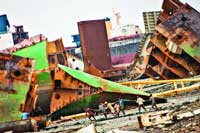
The ship breaking and recycling industry of the country is cautious in buying 'demolition' ships because of volatile international steel market as well as non-responsive domestic market.
The world steel market has been in doldrums for a couple of months. The prices of steel billets in last August and September were around US Dollar 520 per metric tonne and by November it has come down to US$ 460.
Similarly, the melting scrap price has come down to US$ 330 to 400 per tonne. The above has also affected the ship demolition market. Prices have fallen from $ 500 to $ 440 per tonne.
The continuation of global economic recession is bound to take its toll on every sector. Therefore, the financial institutions must adopt policies to cope with it and find ways to backup its clients with break even or minimal profit margin from their end by lowering the interest rates.
China is the biggest producer of steel and steel products. World's total production of steel stands to over 1500 million tonnes per year. China alone produces over 680 million tons per year. The second place is of Japan, making over 105 million tonnes per year. In recent times, China has exported huge quantity of their steel to India and other countries, thus destabilizing the regional market.
The ship breaking industry took off a few decades back and has emerged as the second largest employment generating sector next to the readymade garment (RMG) only. The industry dates back to 1961 when MV Clan Alpine arrived in Bangladesh by accident, when a violent storm left it grounded in the Kumira paddy land at the country's coastline at Sitakunda in Chittagong, an eye-witness Captain Shafi Chaudhury, then assistant harbor master of Chittagong Port Authority, said.
Without any prior experience the workers of Chittagong scrapped the ship which was almost impossible for a group of untrained natives. After long 11 years, Alhaj Sirajul Islam Chowdhury (now late), a local businessman, salvaged a number of ships including Pakistani ship MV Al Abbas, partly sunken, following bombing by the Indian Air Force during Bangladesh Liberation War in 1971 at New Patenga of Karnaphuli River. Scrapping of big ships however started in 1980.
There is no denying that ship breaking is an economic necessity in Bangladesh and as an industrial process it can leave a positive impact on the national economy with 0.3 million workers/people directly or indirectly involved with the industry.
Contributions of the ship breaking industry to the national steel production were 2.2 to 2.5 million metric tonnes last year, b) scrap steel from ship breaking was up to 1.5 to 2.00 million metric tonnes, c) number of re-rolling mills 500 plus, d) number of steel mills 35 plus, e) number of shipyards 125 (active 82) and f) annual turnover US$ 1.5 billion.
Thousands of small-sized backward linkage industries are directly dependent on the ship breaking sector as it meets the growing demand of those allied manufacturing units. But the unprecedented stalemate faced by the sector in the early 2011 had negatively affected this booming sector with a long term impact paving way for foreign steel products to capture the local market.
The scrap metal from ships has a contribution to the national economies of many Asian economies including those of China, Japan, Thailand, India, Pakistan, South Korea, Taiwan, Vietnam, the Philippines, Bangladesh and Turkey in Europe.
The environmentalists have raised their concern over the safety of workers and working environment in the shipyards following the import of a large number of old ships. The concern led to suspension of ship recycling activities in the country in 2010-11.
In the face of protests by the environmental lawyers, NGOs and obeying the court order, the government had suspended import of recyclable ships for one year. Later the government introduced new rules for ship breaking. The government also formed a cell in the Industries Ministry to implement the rules.
There is lack of workers' training, personal protective equipment, lack of skilled supervisors and compliance with the law that are responsible for deaths and injuries in the shipyards. The highest number of death of ship-breaking workers is 15 in the year 2012.
Ship breakers must build up one or two training institutes to formalize the training and recruitment of trained workers. A brief training can be provided to workers with the audio-video presentation on the safety of workers. The current practice of picking up workers from the street on contingency basis should be stopped. They must be provided with all personal protective equipment, have skilled supervisors compliance with the laws.
They said Bangladesh is a unique place for ship breaking as nearly cent per cent of products coming from the dismantled ships are being used locally. They said that the industry has improved safety standards for workers through various steps including training and environment awareness programmes.
They have alleged that the West has lost its business to the East. That is why certain western quarters have employed the environmentalist camps the NGOs (non-government organization). They are trying to improve the shipyards' environment although there were incidents of death of workers in the shipyards.
The country imported the highest number of scrap ships with iron plates weighing 2.86 million tons in the year 2012. About 260 ships were imported for scrap in that year, according to the NoC (no objection certificate) issued by the Ministry of Industries.
But import of scrap ships is falling gradually for the last two years mainly due to poor development works, volatile international steel market, growing demand for quality steel, eventually leading to closure of some shipyards. The shipyards owe billions of Taka as bank loan for years and some of the shipyards also have gone bankrupt.