
Betel leaf exporters may crack EU market, again
Yasir Wardad | Friday, 24 April 2015
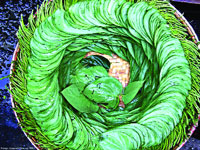
Bangladesh may begin exports of betel leaf to the European Union after a long two years, officials and businesses said.
Although there is no specific statistics on betel leaf exports, commerce ministry and exporters say the average annual shipment could amount to the EU, Middle East and US $31 million to the EU. The countries have where South Asian residents are the key consumers, according to the commerce ministry.
The leaf is exported as item under cut flower and foliage category of agricultural products defined by the Export Promotion Bureau (EPB).
Bangladesh exported agricultural products worth $615 million in the last financial year, of which cut flower and foliage was $39 million.
According to the Bangladesh Fruits, Vegetables and Allied Products Exporters Association (BFVAPEA), betel leaf comprises 90 per cent of the total earnings of cut flower and foliage sector.
In July 2013, the EU imposed a ban on imports of Bangladeshi betel leaf after detection of Salmonella, a bacterium that is hazardous for health.
The EU released an action plan on it which included contract framing, stopping fake phytosanitary certificates, developing inspection facilities and collection of laboratories equipment.
However, both the government and the private sector worked a lot on it for last one and half years in Bangladesh.
A betel leaf cultivation monitoring committee was formed just after the EU ban.
Vice-chairman of Export Promotion Bureau (EPB) Shuvashish Bose told the FE that they were expecting betel leaf export will start from July.
"We've fulfilled almost all criteria suggested by the EU. Betel leaf cultivation monitoring committee under the agriculture ministry ensured harmful bacteria-free production," he said.
He said the EU is likely to remove the ban from July.
Hortex Foundation assistant general manager Mitul K Saha said the monitoring committee was formed in 2013 which developed a very scientific cultivation process and found out a long-term method for producing safe betel leaf in a bid to satisfy the EU authorities.
He said the government also completed tendering process of new building, which is going to be set up at Fatulla, Narayanganj where all the betel leaves will be packaged in the unit before shipment.
He said from September, 2014, the government started contract farming to produce salmonella-free betel leaf in Narsingdi and other few districts as the EU formulated four time-bound action plans to ensure the entry of bacteria-free farm products including betel leaf into its market.
Bangladesh Fruits, Vegetables and Allied Products Exporters Association (BFVAPEA) president SM Zahangir said a betel leaf consignment will be sent on a trial basis to the US in a few days.
He expressed the hope that the outcome would be positive.
He added removal of the EU ban depends on it.
However, in February last, the directorate of health and food safety and food and veterinary office of the European Commission (EC) had a video conference with the Bangladeshi officials, according to the ministry of agriculture.
EPB, agriculture ministry, and BFVAPEA representatives took part in the conference.
They told the EC officials that Bangladesh has been successful in producing salmonella bacteria-free betel leaf.
In the conference, Bangladeshi officials referred to a method developed by Prof Bahanur Rahman of Bangladesh Agricultural University.
Prof Rahman, a teacher at Department of Microbiology and Hygiene in BAU, is heading the betel leaf cultivation committee.
He expressed the hope that the export will cross $50 million in the next financial year with the removal of the ban.
tonmoy.wardad@gmail.com