
Better price draws farmers back into ginger farming
Yasir Wardad | Monday, 2 June 2014
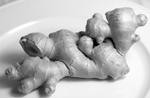
Peasants are increasingly cultivating ginger this season encouraged by higher price of the spice, farmers and officials said.
Production of ginger has been waning in the last four years, resulting in soaring import cost of the item that reached Tk 4.8 billion in 2013 financial year, officials said.
Increased cost of inputs and a lack of government initiatives to promote farming have forced the farmers to shift from ginger cultivation to other crops, said experts.
Bangladesh Bureau of Statistics (BBS) deputy director (Agriculture Wing) Bidhan Baral told the FE that the country produced 74,380 tonnes of ginger on 9, 120 hectares in Fiscal Year (FY)'11, which came down to 69,508 tonnes on 8,900 hectares in FY'13.
"Production on 8407 hectares of land was 72,084 tonnes in FY'12. Ginger producing lands are shrinking as farmers are shifting to other crops," he added.
An official at the field service wing under the Department of Agriculture Extension (DAE) said that production also fell in FY'14.
"The target was fixed at 0.072 million tonnes on 9,050 hectares but ginger was cultivated on 8,800 hectares. The production might have fallen in FY'14 compared to that of FY'13," he said.
According to the Department of Agricultural Marketing (DAM), the prices of the spice reached a record high of Tk 220-260 (local-imported) per kg in April, which is now Tk 150-180 per kg in the city kitchen markets.
Farmers across the country, specially in the ginger growing hubs, are moving into ginger cultivation following spiralling prices.
"I've got 75 maunds (1maund =40 kg) of ginger from three 'done'(per done=30 decimal in the area) of land this season (in December-January) and have sold at Tk 2,650 per maund," Tomiz Uddin Mian, a farmer at Ramnagar Union under Nilphamari Sadar upazila told the FE.
He said: "We have sold ginger at Tk64-65 per kg against the production cost of Tk 43-45 per kg this year."
"My fellow farmers including me are expanding cultivation this year. I'm preparing seven 'dones' of land for next season," said Mr Tomiz.
Ginger is cultivated in April-June and harvested in November-January in Bangladesh.
Deputy Director of DAE Nilphamari district FM Sirazul Islam told the FE that they were expecting to revive the lost glory of ginger production in Nilphamari.
"Once the area would meet 60 per cent of the country's ginger demand on nearly 5000 hectares of land, which shrank to just 1000 hectares a few years back", he said.
He said the condition is improving as the acreage increased to nearly 1800 hectares in the outgoing financial year (FY'14).
"We have targeted 21,930 tonnes of ginger on 2,150 hectares in FY'15. Nearly 80 per cent of targeted acreage has been achieved by Thursday," he said.
Agriculture expert Dr M A Sobhan told the FE that Bangladesh's main ginger growing districts were Nilphamari, Rangpur, Dinajpur, Khagrachari, Mymensingh and Rangamati.
"The price of the produce is now very high but it was not the same a decade ago. Years of price deprivation forced farmers to shift to other crops," he said.
"Ginger takes at least six months to give yield. Farmers can get two crops now during the period which is also responsible for the reduction in ginger acreage," he pointed out.
"Providing necessary incentives, a farmers-friendly marketing policy, easy term loans for the peasantry can boost ginger farming which will help the country cut import costs," he said.
Ginger production is also gradually shifting to the hilly areas of the country from the plains.
According to the Department of Agriculture Extension, Rangamati district was top producing area with 1457 hectares of land in FY'12 followed by Nilphamari where 1052 hectares of land were cultivated. This year the hilly district is in second position.
According to the Directorate General of Food (DGoF) and DAM, the country's annual demand for ginger hovers between 0.15-0.182 million tonnes of which only 0.07 million tonnes are met from domestic sources.
The organisations' data revealed that the demand is soaring by 6-7 per cent annually.
According to the data available from Bangladesh Bank (BB) and Trading Corporation of Bangladesh (TCB), import of ginger soared to around 80,000 tonnes, the value of which was Tk4.8 billion in FY'13.
However, import was 53,000 tonnes worth Tk2.65 billion in FY'10, BB data showed.
Bangladesh imports ginger mainly from China and Nepal, the second and third largest producers in the world.