
Bhubaneswar Declaration proposes setting up an IORA regional bank
Rahman Jahangir in Bhubaneswar, India | Tuesday, 24 March 2015
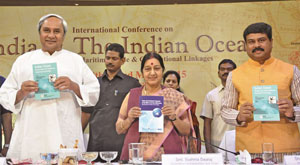
The three-day international conference of experts on the Indian Ocean, held in Bhubaneswar, Odisha, India concluded on Sunday with the adoption of 'Bhubaneswar Declaration'. The Declaration calls for the creation of a special fund of the Indian Ocean Rim Association (IORA) to support key sectoral cooperation projects of the 20 member states of the association. Bangladesh is a member of the IORA.
The three-day international conference on "India and the Indian Ocean: Renewing the Maritime Trade and Civilisational Linkage" under the auspices of the Indian Ocean Rim Association (IORA) was inaugurated by Indian External Affairs Minister Sushma Swaraj on Friday.
The Declaration says, the Indian Ocean rim is a biodiversity-rich region. Institutional majors may be involved for sustainable resource utilisation in accordance with global agreements like Nagoya Protocol. This would involve conservation and utilisation of medicinal plants.
It says, energy security, especially inventory stockpiling of crude oil as an intervention, may be explored whereby countries of the region may share technological strength for storage of hydrocarbons.
The Declaration proposes to set up an IORA regional bank which will provide low-cost funds to its 20 member-states including Bangladesh. It focuses on new areas of sectoral cooperation.
The three-day conference sought greater linkages amongst IORA countries and also in different sectors with an action plan.
Officials said, historically the Indian Ocean found preeminence in world politics. The resurgence of the IOR was notable given its economic dynamism, huge markets and rich natural resources, most significantly, energy. The growing geostrategic and geo-economic salience of IOR makes it only more than palpable that there should be greater regional collaboration between the stakeholders to jointly address and contest non-traditional security threats such as maritime terrorism and piracy, trans-national crime, environment and natural disasters.
The Bhubanenswar Declaration calls upon the Head of States of IORA member states to participate once in two years in summits like the Asia-Pacific Economic Cooperation (APEC). A summit on climate change may urgently be held. The declaration says institutional tie-ups need to be upgraded and expanded.
The Indian Ocean is a vital transit route between the Pacific region, Africa and Europe, with vast cargoes passing through the region. The world's most important oil and gas routes traverse the Indian Ocean, with roughly 55 per cent of known oil reserves and 40 per cent of gas reserves. This only makes it imperative to ensure keeping the oceans open and safe. This is vital to the global economy.
The Declaration says the aim of such a maritime security framework should be to encourage capacity-building to deal with maritime security threats, most significantly terrorism and piracy, while keeping commercial shipping, marine installations and critical infrastructures safe.
Officials pointed out that the Indian Ocean region occupies a central position in the global strategic landscape. The changing security environment of the IOR reflects the interrelated geopolitical dynamics of different regional subsystems comprising the continental-maritime interface. These encompass an interregional strategic landscape spanning the rim perimeter from the African and West Asian littorals and hinterland of the western ocean into its eastern rim extending into the Indo-Pacific.
An understanding of the interactive geopolitical dynamic between the Indian Ocean and the Western Pacific is critical in assessing the strategic future of Asia's maritime spaces. The rapidly growing interface between the Indian Ocean and the Western Pacific, underscores the need for an inherent Indo-Pacific framework. India has pivotal role and responsibility in this regard along with other regional countries, officials pointed out.
arjayster@gmail.com