
BIAC signs MoU with Bhutan ADR Centre
Friday, 7 April 2023
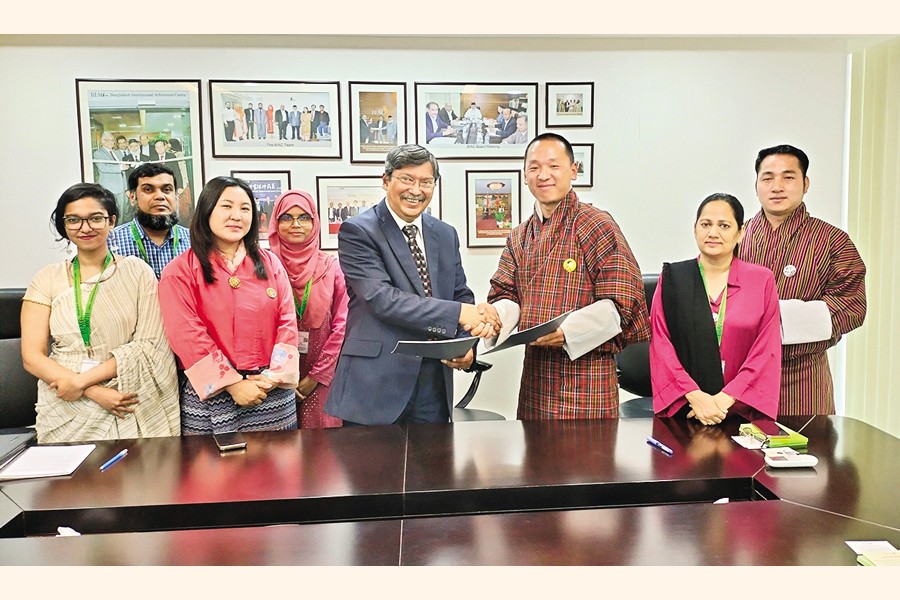
Bangladesh International Arbitration Centre (BIAC) and Bhutan Alternative Dispute Resolution Centre (Bhutan ADR Centre) signed a Memorandum of Understanding (MoU) in Dhaka recently.
Chief Executive Officer of BIAC Kaiser A Chowdhury and Chief Administrator of Bhutan ADR Centre Chimi Dorji signed the MoU on behalf of their respective organisations at the BIAC office.
BIAC has become the first international institution to sign the MoU with the Bhutan ADR Centre, says a press release.
The MoU is intended to explore areas of co-operation in respect of the use of facilities and services of both the centres on alternative dispute resolution (ADR), training and seminar programmes, knowledge sharing and other related issues.
Chimi Dorji appreciated BIAC for taking the initiative towards concluding the signing of the MoU and helping both the countries to work together for the promotion of ADR mechanisms as a means of peaceful settlement of international commercial disputes.
Tashi Dema, Legal Officer, and Suba Dhan Rai, Senior Accounts Officer of Bhutan ADR Centre, and Mahbuba Rahman, General Manager, Khushnuma Khan, Assistant Counsel, and Sal Sabil Chowdhury, Assistant Counsel, from BIAC were also present at the signing ceremony.
As part of their visit, the delegates from Bhutan ADR Centre met with Mahbubur Rahman, Chairman of BIAC and President of International Chamber of Commerce - Bangladesh, in Dhaka on April 4.
At the meeting, Mahbubur Rahman detailed the existing scenario of ADR and the role of BIAC to establish good practice of institutional arbitration in Bangladesh.
The delegates also met with Sameer Sattar, President of Dhaka Chamber of Commerce & Industry.
Bhutan enacted the Alternative Dispute Resolution Act of Bhutan 2013 (ADR Act 2013) and as a result, Bhutan ADR Centre was established on May 15, 2018 as an independent body.
Bhutan ADR Centre is a distinct legal personality, and capable of doing all commercial-related dispute through arbitration and negotiation. It carries out administrative and secretarial functions for the dispute resolution proceeding, provide expertise and training in alternative dispute resolutions, certify and accredit arbitrators, facilitate negotiated settlement, create awareness and liaise with International Alternative Dispute Resolution bodies.