
Biden, Modi and G20 unveil project
Building rail and shipping corridor linking India with Middle East, Europe aimed at
Monday, 11 September 2023
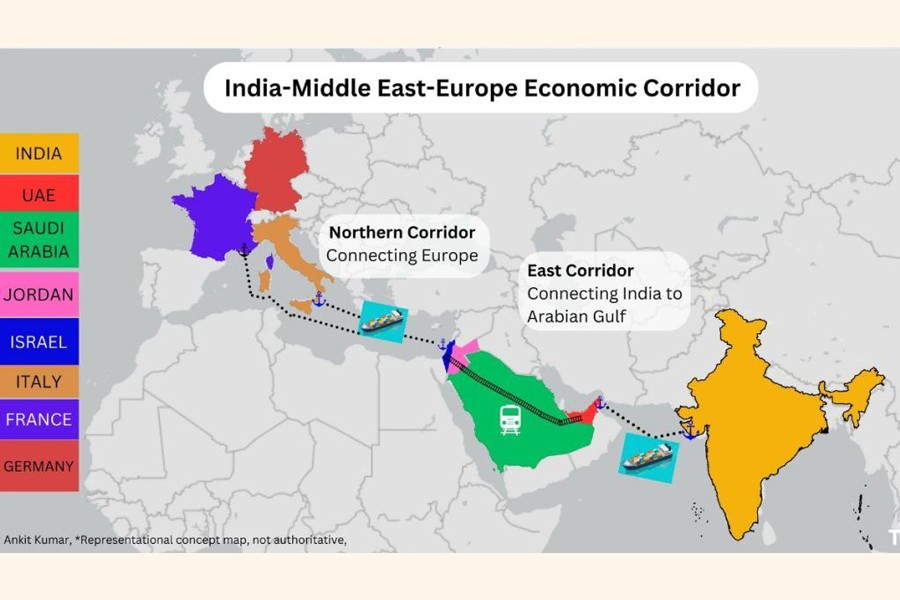
NEW DELHI, Sept 10 (AP): President Joe Biden and his allies on Saturday announced plans to build a rail and shipping corridor linking India with the Middle East and Europe, an ambitious project aimed at fostering economic growth and political cooperation.
"This is a big deal," said Biden. "This is a really big deal."The corridor, outlined at the annual Group of 20 summit of the world's top economies, would help boost trade, deliver energy resources and improve digital connectivity. It would include India, Saudi Arabia, the United Arab Emirates, Jordan, Israel and the European Union, said Jake Sullivan, Biden's national security adviser.
Sullivan said the network reflected Biden's vision for "far reaching investments" that come from "effective American leadership" and a willingness to embrace other nations as partners.
He said the enhanced infrastructure would boost economic growth, help bring countries in the Middle East together and establish that region as a hub for economic activity instead of as a "source of challenge, conflict or crisis" as it has been in recent history.
Indian Prime Minister Narendra Modi, European Commission President Ursula von der Leyen and other leaders from around the world participated in the announcement.
"Enhancing connectivity with all regions has been a key priority for India," said Modi, speaking through a translator. "We believe that connectivity is a means to not only increase mutual trade between different countries but also increase mutual trust."
The rail and shipping corridor would help physically tie together a vast stretch of the globe, improving digital connectivity and enabling more trade among countries, including with energy products such as hydrogen. Although White House officials did not set a timeline for its completion, the corridor would provide a physical and ideological alternative to China's own nation-spanning infrastructure program.
The White House gave no details on the project's cost or financing, though Saudi Arabia's Crown Prince Mohammed bin Salman mentioned a figure of $20 billion during the announcement. It was unclear if that sum applied solely to the Saudi commitment.
After the announcement, Biden greeted the crown prince with a hearty handshake, a friendlier exchange than when they last met, in Jeddah, Saudi Arabia, just over a year ago. At that time, Biden, who had harshly criticized Prince Mohammed over the kingdom's human rights record, awkwardly greeted him with a fist bump, a moment roundly criticized by rights activists.
Von der Leyen described the project as a "green and digital bridge across continents and civilizations." She added that it includes cables to transmit electricity and data.
She also announced a "Trans-African Corridor" connecting the Angolan port of Lobito with landlocked areas of the continent: the Kananga province in the Democratic Republic of Congo and the copper-mining regions of Zambia.
Speaking of the African project, Biden called it a "game changing regional investment" and said "both of these are huge, huge steps forward."
Amos Hochstein, Biden's coordinator for global infrastructure and energy security, laid out a rough timeline for the project over the next year.
In the next 60 days, working groups will put together a fuller plan and set timelines. The first phase will involve identifying the areas that need investment and where physical infrastructure can be connected between countries. Hochstein said the plans can be put into place over the next year so that the project can move onto setting up finances and construction.
Sullivan said the project started coming together after Biden visited Jeddah, Saudi Arabia, in July 2022, where he emphasized a need for greater regional economic integration.
In January, the White House started having conversations with regional partners about the concept. By spring, maps and written assessments of existing rail infrastructure in the Middle East were being drafted. Sullivan, and senior White House aides Hochstein and Brett McGurk, traveled to Saudi Arabia in May to meet with their Indian, Saudi and UAE counterparts.
All sides have worked since then to finalize details of the agreement announced Saturday.