
BIG-B prospects in the context of Vision-2021
Mizanur Rahman | Tuesday, 15 July 2014
Prime Minister Sheikh Hasina began her second term in 2009, with a landslide electoral victory. Her party, Bangladesh Awami League, had then won 230 out of 300 seats and secured 48 per cent votes in the Ninth National Parliamentary Election. A cornerstone of her election manifesto was to transform Bangladesh into a middle-income country by 2021. It came to be known as the Vision-2021.
The country will mark the 50th anniversary of its independence in 2021.
AN INCREASING INTEGRATION WITH THE WORLD ECONOMY: In the early days, critics labelled the Vision-21 as a wishful thinking and unattainable. Their argument was based on two assumptions. One is that a persistently low investment-GDP (gross domestic product) ratio would not drive capital accumulation to a level which would be necessary for achieving the target. The other is that a persistent trade imbalance of more than 9.0 per cent of the GDP would be unsustainable in the long run.
What critics missed in both the cases is that Bangladesh has experienced an increasing integration with the world economy, and that a surging flow of inward remittances and rising export earnings have laid a basis for a long-run macroeconomic stability. This article makes an evaluation of Bangladesh economic growth over the last 30 years.
A future outlook of Bangladesh is being contemplated in a framework of South Asian economic regionalism, called the Bay of Bengal Industrial Growth Belt (BIG-B). It is argued that Bangladesh has enormous potential to evolve as a 'node & hub' in the latest phase of globalisation in which the gravity of the world economy is moving away from the Asia-Pacific region to the Indo-Pacific one. In this emerging trend, Bangladesh will likely represent an economic region that stretches far beyond its national border and might emerge as a gateway to the land-locked Nepal, Bhutan and India's seven North-Eastern states.
ACCELERATING ECONOMIC GROWTH: Bangladesh, following the reforms of 1991, entered a path of accelerating economic growth. The beginning of the 1990s saw the launch of a comprehensive programme of macroeconomic reforms, which coincided with a transition to parliamentary democracy from a semi-autocratic presidential system. Successive governments largely maintained the momentum of reforms in the areas of agriculture, enterprises and international integration. A policy regime has been in place enabling exporters to have a duty-free access to intermediate inputs and capital machinery. Market access opportunities in the United States and European Union proved crucial for the early generation of exporters.
Meanwhile, globalisation of production has led multinational corporations (mainly global apparel retailers) to outsource labour-intensive production in low-wage locations including, notably, Bangladesh. An elaborate process of knowledge diffusion began from both multinational buyers and East Asian suppliers to local entrepreneurs. Bangladesh has rapidly gained its market share in the global apparel exports. Bangladesh is now the second-largest apparel exporter in the world after China.
The macroeconomic impact of an outward policy regime has been remarkable. Over the last three decades, Bangladesh economy has grown four-fold. The ten-year average of GDP growth rate accelerated from 3.74 per cent in 1984/85-1993/94 to 5.17 per cent in 1994/95-2003/04, and then to 6.31 per cent in 2004/05-2013/14. Our per capita GDP has almost tripled during the period. Per capita GDP growth rate observed a faster acceleration from 1.66 per cent in 1984/85-1993/94 to 4.82 per cent in 2004/05-2013/14. A declining population growth rate combined with a rising GDP growth rate is indeed indicative of a deeper socio-economic transformation in Bangladesh.
GROWTH ACCELERATION: An enquiry into the sources of growth acceleration is further revealing. A careful analysis of the national income accounts data of Bangladesh Bureau of Statistics (BBS) indicates that the manufacturing sector appears to be the most dynamic source of growth acceleration. Its share in the incremental GDP of 1994/95-2003/04 relative to 1984/85-1993-94 was 16.9 per cent, which then observed a faster acceleration to 30.7 per cent of the incremental GDP of the latest ten-year period, i.e., 2004/05-2013/14 relative to 1994-95-2003/04. The service sector remained vibrant and continued to account for 48 per cent of incremental GDP in the latter two ten-year periods. Agriculture (broadly defined to include crops, animal farming, fisheries, forestry and related services) observed a declining share in the growth acceleration. Its share has declined from 17.2 per cent to 8.9 per cent.
The country has also deeply integrated with the world economy in this period. Trade-GDP ratio increased from less than 20 per cent to about 55 per cent. Trade gap though widened, it did not cause any serious macroeconomic imbalance. An increasing flow of inward remittances helped meet this gap. This is a remarkable development. Jim O'Neill and Anna Stupnytska of Goldman Sachs in 2009 thus labelled Bangladesh as one of the New 11 (N-11) emerging economies. O'Neill and Stupnytska argued that the group of N-11 and the BRIC countries (Brazil, Russia, India, and China) would be driving the global growth in the next 50 years. Experts further believe that Bangladesh, like China, might emerge as a centre of global production in the 21st century.
ECONOMIC REGIONALISM: Prime Minister Sheikh Hasina appears to have envisioned this dynamism. A major component of her foreign policy has, therefore, been to pursue economic regionalism. The recent 'Look-East Policy' of her government is an attempt to this end. The policy shift is intended to circumvent financing constraints and to embark upon several mega infrastructural set-ups in order to transform Bangladesh into a middle-income country.
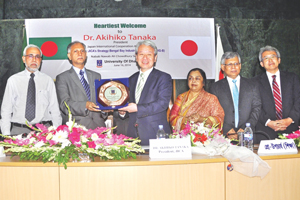
JICA'S VIEW: Japanese Prime Minister Shinjo Abe and Prime Minister Sheikh Hasina during their summit in Tokyo on May 26, 2014, proposed the Bay of Bengal Industrial Growth Belt (BIG-B) initiative. The initiative appears to be a catalyst to this end. In a recent lecture at the University of Dhaka, Dr. Akihiko Tanaka, president of Japan International Cooperation Agency (JICA), gave his account of this grand design.
BIG-B is a design for regional economic transformation in South Asia. Tanaka argued that globalisation of the world economy in the last quarter of the 20th century progressed with the centre of gravity moving away from the Atlantic to the Pacific. But now in the first quarter of the 21st century, the world economy was shifting its centre from the Pacific to a much broader area called the Indo-Pacific region. While the Pacific continues to play an important role, the world economy will be increasingly integrated with the emerging economic powers along the Indian Ocean Rim from Southeast Asia to South Asia, and to Africa. Mr Tanaka argued that the Bay of Bengal was centrally located in this tectonic change and that Bangladesh would transcend its national border to become a 'node & hub' of this emerging regional economy.
The JICA president said that achieving the middle-income status by 2021 was an attainable challenge for Bangladesh. The planned BIG-B could be a catalyst of this development.
BIG-B comprises three pillars. The first pillar is industry and trade and consists of constructing a long-awaited deep-sea port at Sonadia. It is located in the eastern coast of Bay of Bengal, 60 kilometre (km) south of Chittagong city and along the Chittagong-Cox's Bazar highway. It is predicted that it would offer Bangladesh an important trade gateway to the rest of Asia and beyond.
The second pillar is energy. The Matarbari Island can be developed into a massive supply base of primary energy (such as coal, LNG and oil).
The third pillar of BIG-B is transportation. Akihiko Tanaka envisioned that to enable greater industrial, trade and energy production, the Dhaka-Chittagong-Cox's Bazar transport artery would be strengthened and even extended to the neighbouring countries. He suggestd that more and better national highways and railways are absolute prerequisites for accelerating the movement of goods and people across the belt.
JICA and the Government of Bangladesh have already reached a loan agreement to bring BIG-B to fruition. A flagship project called "Matarbari Ultra Super Critical Coal-Fired Power Project" is in progress. The project has two key components, including a deep-sea port, 18m in depth, for importing coal, and a coal-fired power plant with an electricity generation capacity of 1,200 MW. The deep-sea port will enable 80,000-tonne-class ships to directly enter the port for coal unloading. The JICA president predicted that the construction of the power plant will be completed in 2020 and should start commercial production in 2022 or earlier.
Environmental impact of the power plant has been carefully envisioned. It is well-equipped with state-of-the-art Ultra Super Critical (USC) technologies. The USC technologies to be used in the Matarbari plant will ensure stellar thermal efficiency (45 per cent). Dr Tanaka argued that it would drive down NOx and SOx emissions to 10 times below the prevailing levels of these emissions in the USA and France, respectively. It is noteworthy that the Matarbari Coal-Fired Power Project has a flexible structural design to accommodate growing electricity demand through further expansion.
It is expected that power demand in Bangladesh will surge to the level of 40,000 megawatt (MW) in 2030. It is a four-fold increase from the current level. Thermal coal-based electricity generation is expected to meet 50 per cent of this predicted demand.
Dr Tanaka envisioned that the Matarbari plant could eventually incorporate a coal centre to service other coal-fired power plants and even a construction of an LNG terminal.
According to the Power System Master Plan, Bangladesh will have to depend on increased LNG imports for meeting a large portion of its future power demand. The Matarbari area is poised to become the country's energy hub. The JICA president hinted that the Government of Bangladesh and JICA were discussing a comprehensive master plan for the area, including Cox's Bazar, for materialising the BIG-B.
ECONOMIC OPPORTUNITIES: BIG-B is expected to create a number of economic opportunities. First, the initiative is essentially a set of basic infrastructural units that will significantly reduce both production and transportation costs. An accelerating economic growth over the last two decades occurred with no comparable progress in transport, energy and port infrastructure. A widening gap has thus evolved between demand and supply of infrastructure. A country of less than 150,000 square kilometre (sqkm) landmass is largely disjointed and disintegrated. Free flow of goods and labour is hugely impeded. Power supply is uncertain and intermittent. The BIG-B transport infrastructure will likely establish connectivity for more than half of the 150 million people. Its energy infrastructure would free up the existing national capacity to power the country's north-western region. The initiative will likely cause a quantum jump in labour productivity.
The expected cut in production and transportation costs will have several long-run implications. One immediate effect is that supply schedules of firms will shift to the right and upward. A sustained reallocation of labour will take place from low-productivity agriculture and manufacturing to high value-added and outward-oriented export-related production.
To the extent global organisation of production concentrates in the Dhaka-Chittagong-Cox's Bazar industrial zone, it would accompany foreign direct investment (FDI) and transfer of critical skills and technologies. As an outcome, the long-run economic growth is likely to accelerate from an average of 6.0 per cent to a double-digit rate.
The second opportunity is Bangladesh's deeper integration with the world economy. What Dr Tanaka argued to be the 'node & hub' may imply that Bangladesh is likely to emerge as a platform of final stages of assembling and exporting to the world. That essentially indicates that multinational corporations (MNCs) around the world would redirect foreign direct investment (FDI) and know-how to this economic region. Bangladesh can potentially be a part of global organisation of production.
Dr Tanaka suggested that Bangladesh should be a partner in economic regionalism and should join, for example, the Regional Comprehensive Economic Partnership (RCEP). RCEP is currently being negotiated among ten ASEAN countries, Japan, China, South Korea, Australia, New Zealand and India.
The third economic opportunity of the BIG-B initiative is a substantial expansion of aggregate demand. Aggregate demand would mainly increase via rise in net foreign spending on home goods from an untapped market. This untapped market consists of the land-locked Nepal, Bhutan, and India's seven North-Eastern states. It is noteworthy that it represents a population of more than 70 million.
Akihiko Tanaka pointed out that Bangladesh possessed a strategic location in South Asia. It is a country between the Indian Ocean and the Asian continent and a country between Southeast Asia and South Asia. He observed that Bangladesh could provide the gateway to the Bay of Bengal for the South Asian hinterlands that are landlocked, but share a common border with Bangladesh.
Last but not least, an economic regionalism in the Bay of Bengal bears enormous potential for mitigating regional problems like cross-border terrorism and refugee crisis. A relatively free flow of goods and other factors of production will create economic incentives for aborting militancy and cross-border terrorism. Economic integration will cause political reconciliation in South Asia not the vice versa.
The writer is Associate Professor of Accounting and Public Policy at the Department of Accounting, Dhaka University.
mizan@univdhaka.edu