
Billions go unspent as health ministry's ADP failures persist
FHM HUMAYAN KABIR | Saturday, 1 August 2026
The health ministry has historically anchored in the bottom tier of Bangladesh's Annual Development Programme (ADP) spending, failing to utilise even one-third of its development budget in the fiscal year 2025-26, analysts say.
While overall national development spending plummeted to record-low averages amid broad political transitions and government reviews, the health ministry's persistent expenditure paralysis has baffled the state authorities and public health experts alike.
Even as state medical facilities experience severe shortages of basic drugs, working equipment, and manpower, allocations of billions of taka continue to be surrendered annually due to structural inefficiencies, bureaucratic inertia, and a heavily centralised management pattern.
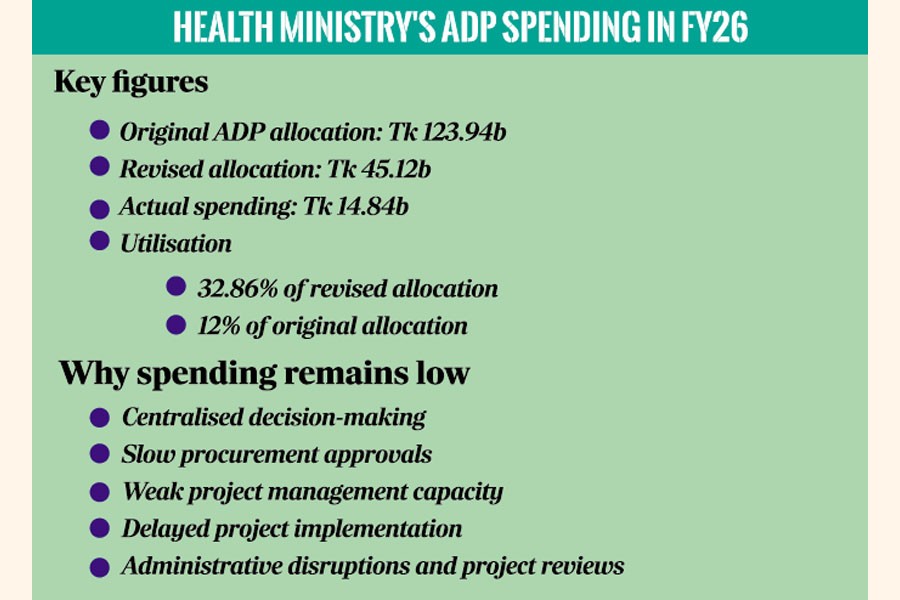
According to the Implementation Monitoring and Evaluation Division (IMED), the Ministry of Health and Family Welfare spent only Tk 14.84 billion, 32.86 per cent of the revised allocation of Tk 45.12 billion, in FY26.
The expenditure was only 12 per cent of the original Tk 123.94 billion outlay.
Following a very dismal picture, the government revised down the ministry's development allocation from Tk 123.94 billion to Tk 45.12 billion in FY26 - a cut of about 63 per cent.
But despite the reduced allocation, the ministry spent only Tk 14.84 billion, according to official data.
In FY25, the Health Services Division executed only 21 per cent of its ADP outlay, while it was 15 per cent for the Medical Education & Family Welfare Division.
Earlier in FY24, the Health Services Division executed only 62.7 per cent of its ADP outlay, and the Medical Education & Family Welfare Division 59.4 per cent.
Official metrics from the IMED show these two divisions stood as the two biggest laggards in the state's public investment portfolio.
IMED officials said despite receiving billions of taka in allocations under the initial and revised fiscal budgets, the health authorities routinely fell short of reaching project milestones.
In the first 10 months of FY26 alone, the two divisions managed to deplete less than 10 per cent of their allocated development budgets, forcing dramatic last-minute adjustments and funding surrenders.
This historic spending failure directly shifts the financial burden of medical care onto ordinary citizens.
Public health surveys show that out-of-pocket (OOP) expenditure in Bangladesh has climbed to a staggering 67-73 per cent of the total healthcare costs, making it the highest across South Asia.
As public project executions fail, everyday patients are forced to finance their own diagnostic tests and medical supplies at private facilities.
Analysts say the systemic paralysis of health sector development stems from long-entrenched administrative barriers and operational bottlenecks.
According to system experts, it takes the health ministry or its agency officials four to five months to get procurement plans for different development projects passed due to the ministry's heavily centralised nature.
This sluggish operational environment delays the baseline startup phases for multi-year infrastructure and hospital upgrades, leaving minimal time for actual project implementation before the financial year closes.
A senior official of the Directorate General of Health Services said, "Local hospital heads and development managers routinely demonstrate a strong reluctance to utilise allocated funds."
"Because budget consumption triggers stringent institutional audits, many administrators intentionally stall domestic asset procurement, preferring to rely on external supply chains or decentralised distribution channels to avoid financial accountability procedures," he added.
In addition, a severe deficit in specialised project managerial skills of project directors, mainly from physicians, often lack advanced technical knowledge regarding land acquisition, procurement guidelines, and international grant protocols, resulting in poor development works.
Economics experts further emphasise that "these difficulties also exposed deep-rooted deficiencies in project design, procurement, institutional coordination, and execution".
The national administrative disruptions, interim government transitions, and comprehensive project reviews that defined late 2024 and through 2025 crippled momentum, a senior health ministry official said.
Numerous private contractors and project leads abandoned their stations during regime shifts, leaving a massive execution backlog that the newly formed government failed to absorb or accelerate in early 2026, he added.
Public health activist Dr Rashid-e-Mahbub told the FE that the lack of comprehensive and need-based development plans of the government was the key reason for the consecutive failure in the health sector's development under the ADP.
"Some politically motivated people and influential quarters in society always pursue the government to procure some equipment or build health infrastructure. But they never think about the improvement of service delivery. Thus, quality development in the health sector is absent," he added.
On the other hand, people's out-of-pocket expenditure was going up day by day, he said, adding the government should implement the projects that would benefit the general people instead of facilitating contractors or politically motivated people.
The continuous inability of the health ministry to execute its budget blocks structural changes in public welfare. While strategic infrastructure sectors manage to register moderate execution rates, social service divisions consistently flounder, said a senior IMED official.
Financial analysts warn that merely inflating budgetary numbers will yield zero tangible public benefit unless the state enforces radical decentralisation, establishes a pool of permanent financial health managers, and strengthens basic institutional accountability across the ministry.
kabirhumayan10@gmail.com