
BIMSTEC: Learning from SAARC experience
Syed Ejaz Ahsan | Saturday, 15 March 2014
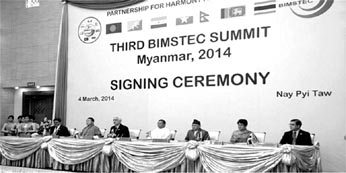
On June 06, 1997, a new sub-regional grouping was formed in Bangkok and named BIST-EC (Bangladesh, India, Sri Lanka and Thailand Economic Cooperation). Myanmar attended the inaugural meeting as an observer and joined the bloc as a full member at a Special Ministerial Meeting held in Bangkok on December 22, 1997. Then the grouping was renamed BIMST-EC (Bangladesh, India, Myanmar, Sri Lanka and Thailand Economic Cooperation). Nepal was granted the observer status by the second ministerial meeting held in Dhaka in December 1998. Subsequently, the full membership was granted to Nepal and Bhutan in 2004. In the first summit on July 31, 2004, leaders of the grouping agreed that the name of the grouping should be BIMSTEC (Bay of Bengal Initiative for Multi-Sectoral Technical and Economic Cooperation).
The uniqueness of BIMSETC is its multi-sectoral approach compared to other Asian blocs. This creates another platform of cooperation to ensure quicker integration. It started initially with six sectors-trade, technology, energy, transport, tourism and fisheries. These are extremely important sectors of this sub-region. Later other areas have also been included in it such as agriculture, environment, culture, public health, people-to-people contact and counter-terrorism.
The BIMSTEC has fourteen priority sectors covering all areas of cooperation. They include:
n Trade and investment, led by Bangladesh.
n Transport and communication, led by India.
n Energy, led by Myanmar.
n Tourism, led by India.
n Technology, led by Sri Lanka.
n Fisheries, led by Thailand.
After the 8th ministerial meeting in Dhaka on December 18-19, 2005, a number of new areas of cooperation emerged. The priority sectors of cooperation increased from six to 13. The seven new sectors were discussed in the 1st BIMSTEC summit and there have been different activities to enhance co-operation in those sectors. The sectors are as follows:
n Agriculture, led by Myanmar
n Public health, led by Thailand
n Poverty alleviation, led by Nepal
n Counter-terrorism and transnational crime, led by India
n Environment and natural disaster management, led by India
n Culture, led by Bhutan
n People to people contact, led by Thailand
n Climate change, led by Bangladesh.
Let us have a look at the prospects of BIMSTEC and Bangladesh. Trade and economic blocs are nothing new. Every now and then countries are trying to form regional trade blocs to enhance economic cooperation. Though a number of areas of cooperation between BIMSTEC countries have been identified, but the most important issue is the regional connectivity that would allow the member countries to establish direct road connectivity, initially the road connection involving India, Bangladesh, Myanmar and China. Recent developments show these countries are eagerly waiting for regional connectivity and using Bangladesh sea ports for their imports and exports. The land-locked eastern states of India, popularly known as seven sisters, are interested to use Bangladeshi ports as well as the land routes for road connectivity. The case is same with south China and the Chinese Ambassador to Bangladesh echoed the similar views recently. According to him, Bangladesh should take right steps to get a proper share of China's massive outbound investments and imports in the coming years to lessen Dhaka's trade deficit. He also observed that Bangladesh could be a great business hub, once the BCIM (Bangladesh, China, India and Myanmar) economic corridor is effectively implemented because of its key geographical location that connects South and Southeast Asia. It is projected that in the coming five years, China's import will reach about US$ 10 trillion and outbound investments will reach US$ 500 billion and the number of its tourists may well exceed 400 million. "What I'm interested in most and working hard for is that Bangladesh deserves to have a proper share," the Chinese envoy said.
Our experience in the case of SAARC (South Asian Association for Regional Cooperation) is not so exciting. SAARC is focussed on so many areas of cooperation, but hardly succeeded to reap any benefit yet. One reason is the political rivalry and mistrust, along with long-lasting bilateral disputes, among the member countries, such as India-Bangladesh water sharing, the Tamil issue involving India and Sri Lanka, Kashmir issue between India and Pakistan and so on. If political disputes are not narrowed down, then it is difficult to develop and increase economic and trade relations between the countries. Even in the event of free trade under the umbrella of SAPTA (South Asian Preferential Trade Agreement) little progress has been made so far. We can see that in more than three decades the progress in SAARC or SAPTA is negligible.
Similarly, when it comes to BIMSTEC, Bangladesh, India and Myanmar have some long-lasting and complicated issues to be settled. The most important is the Rohingya refugee issue between Myanmar and Bangladesh. The Rohingyas are fighting for self-rule in Myanmar. The separatist movement in the eastern part of India restricts free movement and connectivity between these countries. For a long time Myanmar was detached from the outside world, even from its neighbours, but now they are interested in improving trade relations and exploring their untapped resources for faster economic growth. Due to domestic and international pressure, Myanmar is gradually heading towards a democratic society. Myanmar is enriched with natural and mineral resources. Utilisation of these resources will enhance the pace of economic development of the country.
The land-locked eastern Indian states are eagerly looking for an agreement to use Bangladesh territory for carrying goods. Bangladesh has already allowed India to carry heavy machinery and equipment for a power plant project in Tripura state, from which they have agreed to supply 100 MW power to Bangladesh. We have a lot of areas, where proper connectivity between the neighbouring nations would immensely benefit the peoples of the area. Especially there is every possibility that Bangladesh becomes the important regional hub of trade, industry and communication. The connectivity of South Asia and South East Asia through Bangladesh would allow the countries to explore new opportunities. But for turning these prospects into reality, political commitment and an amicable solution to long-standing disputes between the countries is needed first. By leaving these issues unresolved, it would be difficult to achieve any breakthrough.
Compared to the European Union (EU), achievements of all other economic groups are very negligible. They have failed to meet the expectations of the peoples concerned. In this connection it is needed to mention that trading blocs and economic groups have different stages. Primarily they start with free trade areas and then gradually develop to common markets before turning into economic unions finally. It is mentionable that only the EU has reached the stage of economic union, where all the policies-monetary and fiscal-are unified. When it comes to an economic grouping the EU is considered a model.
By judging from our SAARC experience, it is better for BIMSTEC countries to primarily focus on connectivity through road and sea routes and then gradually move to other areas of cooperation instead of following a long list of issues, which are difficult to be implemented. Normally successful implementation of one project automatically leads to other areas of cooperation.
The EU example is there in front of us. What the meaningful cooperation and commitment from the leadership can do! At the same time we have the examples that show efforts for many regional cooperation blocs have proved futile. Still a handful of economic groupings are going on. We do not know how many of them will be successful. Let us forget about what we failed to do in the past. Rather lets us hope and pray for a better tomorrow for the peoples of member countries of the BIMSTEC grouping.
It is difficult to include all aspects of cooperation in a limited span. Lots of unexplored opportunities are remaining out of sight and successful utilisation of those could bring immense benefits and welfare for the peoples of these countries. For these, only formal meetings, suggestions and high expectations would hardly yield any result. What is needed is the positive attitude of political leadership. The focus should be on peoples' welfare, not communality, and there should be a long-term vision to improve the quality of life in this part of the world, which is no doubt compared to an unpolished diamond.
The writer is a PhD researcher at the Department of Marketing, University of Dhaka. seahsan@gmail.com