
Bipartisan politics augurs well for Bangladesh democracy
Hasnat Abdul Hye | Tuesday, 28 April 2026
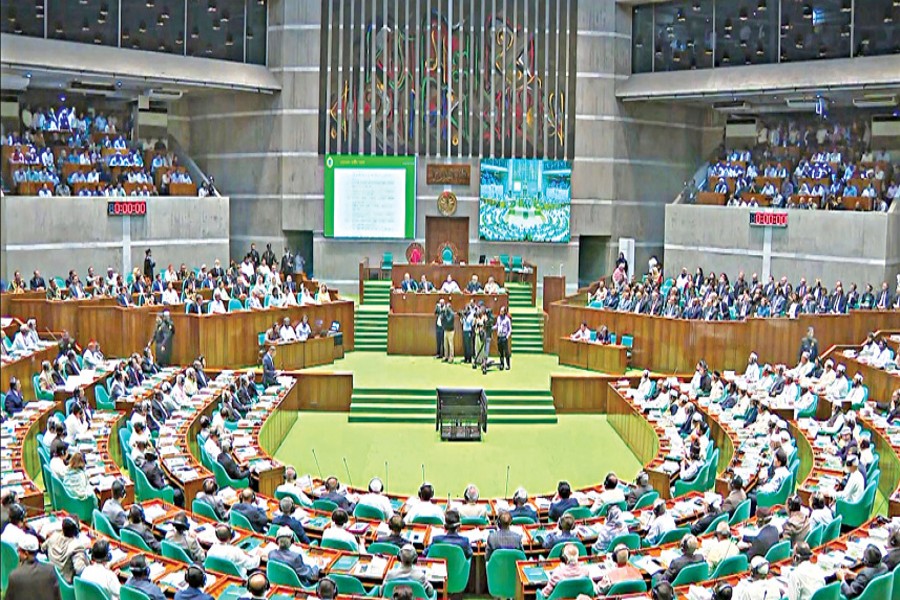
Democratic culture, practised in Bangladesh since inception, has been marked by marginaisation of opposition. Towards the end of the autocratic rule that ended in a violent overthrow in July movement in 2025, the main opposition was completely throttled, its leaders either behind bars or on the run to avoid arrests.
The tradition of autocratic rule was established at the birth of Bangladesh when instead of a national government one party took the helms of state power. The defeat of the few opposition parties' candidates at the first general election in1973 strengthened autocratic rule in the country. The last nail on the coffin of multi- party democracy was struck when one party rule was introduced through BAKSAL. Succession of army rule that followed the overthrow of BAKSAL government did little to contribute to the promotion of democratic culture. The democratic dispensation that followed the end of Ershad regime held hope of full blossoming of multi- party democracy in the country. But after a promising beginning the hopes for a fully-fledged democratic polity were dashed by autocratic tendencies by parties in power. The worst of autocracy unfolded during the period 2010-2025 when the party in power refused to give any space to the opposition parties to hold meetings, bring out processions and take part in election with a level playing field. The genuine demand of the opposition parties to hold election under caretaker government, an agreement reached by all parties after the anti- autocratic rule of late Eighties and early Nineties, was spurned by the party in power with disdain. In a blatant mockery of multi- party democracy the party in power even anointed a pliant opposition party to be both in opposition and in the cabinet. For its highhandedness in governance, murderous policies to suppress dissent and stifling of every form of freedom of speech the party of autocratic rule had its comeuppance in the 'July Movement' of 2025.
It is natural to expect that political parties that are now active in national politics would take lessons from the past mistakes and excesses committed. The paramount lesson in democratic governance is to recognise the legitimate role of the opposition, particularly in the Jatiya Sangsad and allow it necessary space to perform adequate role in opposition. It is high time for major political parties to realise that party/parties in opposition play an important role in the democratic governance of the country when they are allowed to play it in the Jatiya Sangsad and outside of it. The higher step beyond this is to invite the opposition to take part in the governance of issues of national importance as partners with the party in power. There are many such areas where bi- partisan policies can be taken in greater public interests. Though such practices are known to prevail in mature democracies no party in power in Bangladesh has given any attention to this. It is no excuse to say that a large majority of fledgling democracies belong to this category and therefore Bangladesh should not be singled out for this failure.
It is in the above backdrop that the news about formation of a joint committee by the incumbent government with the opposition party on the issue of energy crisis appears as a happy augury for the future of multi- party governance. In times of emergencies such an issue - specific coalition is urgently called for. It is most encouraging that the present government is cognisant of this fact and has extended its hands to the opposition for co-operation. The response of the opposition to work together with the government to tide over the energy crisis is very timely and appropriate, deserving appreciation.
The government has very rightly prioritised energy crisis for bi-partisan policy making. If the war in the Middle East continues for some time, Bangladesh, like any other energy import- dependent country in the world, will face an economic crisis the like of which has not been seen in the past. Economic crisis will engender political crisis and this in turn may lead to unforeseen geo-political entanglements making the future of the country uncertain. There is no scope to understate and belittle the enormity of the energy crisis. By any measure, this the greatest challenge faced by the country since its inception. It is in this context that the overture of the government to bi-partisan policy making assumes great importance. It could not have come at a more momentous time.
Having taken the plunge for bi-partisan policy making on energy, the government is now poised to go for similar collaboration on other issues as well. If this becomes the norm and standard practice of the party in power then not only crisis management but also day to day governance will undergo a makeover for the better. It will be a sea-change in the practice of democratic culture.
To be pragmatic, both the party in power and the opposition should sit together to identify the issues of public interest that call for band are amenable to bi-partisan policy making. This joint exercise will build trust between the government and opposition, narrowing their differences in many respects. In the process a giant step will have been taken in democratic governance in the country. Political parties will cease to see each other as adversaries, locked in horns on every issue. Politics will come of age and with it 'the greatest good of the greatest number', the hallmark of social contract, will take centre stage.
A bold initiative has been taken. Mutuality of interests has been identified. Now is the opportune time to build up momentum.
hasnat.hye5@gmail.com