
BNP unveils ambitious digital economy plan
FE Report | Sunday, 1 February 2026
The Bangladesh Nationalist Party (BNP) has set out an expansive vision for transforming the country's digital economy, promising one million new jobs, affordable internet access for nearly the entire population and a cloud-first strategy to safeguard national data.
Framed as a cornerstone of future economic growth, the proposed ICT policy aims to reposition technology as a key driver alongside traditional sectors.
The plan was unveiled at a seminar in Dhaka on Saturday, where BNP leaders and industry experts outlined a roadmap to lift the ICT sector's contribution to gross domestic product (GDP) up to 10 per cent by 2036.
The Nationalist ICT Forum organised the seminar titled "The Role of the ICT Sector and the Way Forward in Building Tomorrow's Bangladesh".
Seven-point ICT roadmap
Joining the programme virtually, BNP's Information and Technology Affairs Secretary AKM Wahiduzzaman outlined seven core priorities of the party's digital strategy.
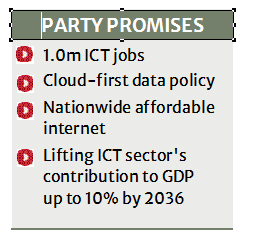
These include universal internet access, a cash-light digital economy, the creation of one million jobs and the establishment of the country's first AI-driven data centre campus.
He said the BNP aims to bring 95 per cent of the population under high-speed internet coverage and launch a national e-wallet within 180 days of forming the government.
"Our target is to ensure that the ICT sector contributes between five and 10 per cent of GDP by 2036," he said.
He added that the party plans to create 200,000 direct jobs in areas such as cybersecurity, business process outsourcing (BPO), artificial intelligence and semiconductors, alongside 800,000 indirect jobs through freelancing and content creation.
He also said the BNP would prioritise locally managed cloud infrastructure, including Tier-3 and Tier-4 data centres, to protect citizens' data and reduce dependence on foreign platforms.
Citizen-centric digital services
According to the proposed policy, the BNP plans to introduce a range of AI-driven public services, including farmer cards, family cards prioritising women, health cards, connected learning systems, automated land and tax management, and digital emergency and security services.
The party also intends to promote a cash-light economy through a national e-wallet, integration with international payment platforms such as PayPal, and targeted support for freelancers and digital entrepreneurs.
Free internet and digital inclusion
Dr Mahdi Amin, spokesperson of the BNP's Election Management Committee, said the party would ensure affordable internet access for all citizens and gradually introduce free institutional internet services if it comes to power.
He said schools, colleges, universities, offices, rural digital centres, hospitals, railway stations, airports and other public spaces would be brought under free internet coverage in phases.
He also highlighted plans to strengthen the global branding of Bangladeshi digital products and services under labels such as "Made in Bangladesh", "Assembled in Bangladesh" and "Service in Bangladesh".
Criticism of current digital governance
BNP Standing Committee member Dr Moyeen Khan criticised what he described as systemic failures in digital governance over the past decade and a half, arguing that technological initiatives had often failed to translate into better public services.
"The main purpose of ICT is to make people's lives easier," he said, adding that technology should serve public welfare rather than create harassment. He also alleged widespread corruption in the implementation of digital projects.
ICT as an economic pillar
Journalist and policy analyst Maruf Mallick said the ICT sector could emerge as a major pillar of Bangladesh's economy alongside garments and remittances if clear targets are set and implemented effectively.
He said ambitious ICT export goals could help offset potential declines in traditional industries and diversify the country's growth drivers.
bdsmile@gmail.com