
Bogura roadside banana mkts cornerstone of rural economy
OUR CORRESPONDENT | Wednesday, 1 April 2026
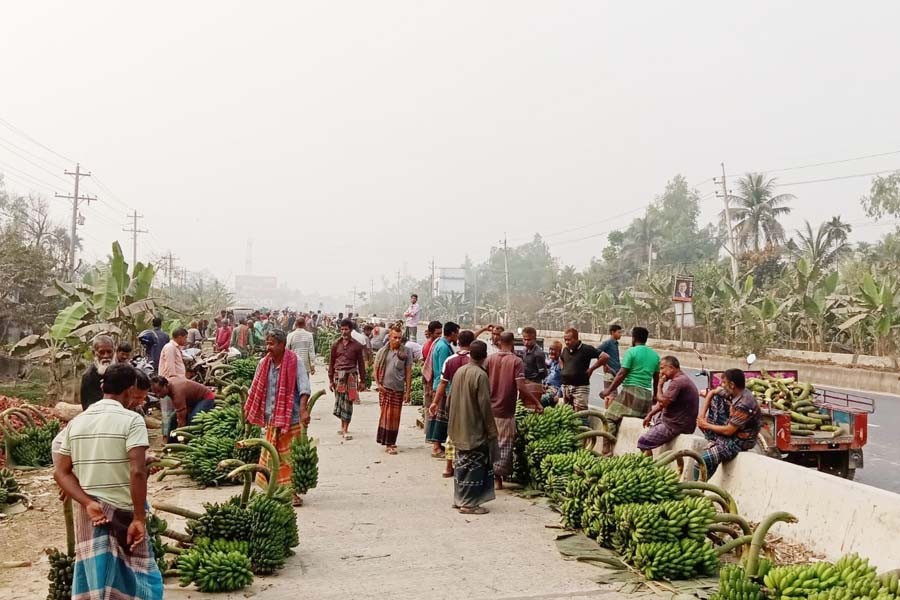
BOGURA, Mar 31: In the northern district of Bogura, roadside banana markets sell produce worth millions of taka each week, giving farmers steady income and supporting the rural economy.
But these markets are mostly informal and unplanned, creating risks that could limit their growth and deter their long-term sustainability.
The most popular twin markets of Chandihara and Fashitola, located along the Bogura-Rangpur highway in Shibganj Upazila, operate twice weekly and together form the largest banana trading hub in the country's northern region.  On each market day, more than 60 truckloads of bananas are dispatched to destinations across the country with the total value of transactions exceeding tens of millions of taka .
According to the Department of Agricultural Extension (DAE), Bogura's banana markets rank first in northern Bangladesh in terms of both volume and turnover.
The markets are dominated by the locally popular "Champa" variety, while the second-largest hub is located in Kaharole upazila, known nationwide for its "Meher Sagar" bananas.
Officials say banana cultivation in Bogura has expanded steadily, driven by favourable prices and rising demand both in urban and rural areas.
Although Bangladesh grows 40 to 50 varieties of banana, farmers in the district primarily cultivate Anupam, Sagar, Sabri, Bichi and Champa.
"Farmers have exceeded this year's cultivation targets," said Md Abdul Wadud, a deputy assistant director at the Department of Agricultural Extension.
"Favourable weather conditions have resulted in strong yields, and banana farming now continues year-round."
This season, bananas were cultivated on around 1,100 hectares in the district, with an average yield of 19 tonnes per hectare, bringing total production to an estimated 20,900 tonnes.
A visit to Chandihara market on a recent Saturday morning showed farmers arriving from dawn with banana-laden vans and small motorised vehicles.
Bunches are unloaded, arranged in rows, and quickly attract clusters of wholesalers negotiating prices.
As the morning progresses, the market becomes increasingly crowded, with trading continuing until midday.
Traders then consolidate purchases and load them onto trucks bound for major urban centres, including Dhaka, Chattogram and Sylhet.
Farmers say the business remains profitable despite rising costs.
"Banana prices are good, which is why more growers are entering the sector," said Patu Mia, a farmer from Sonatola.
On average, 20-25 trucks depart from Chandihara and 30-35 from Fashitola on each market day, he added.
However, traders point to thin margins due to high transport costs.
"Each truck carries bananas worth Tk200,000 to Tk300,000, but rising freight charges are eating into profits," said Rashid Talukdar, a wholesaler from Dhaka.
Prices currently range between Tk700 and Tk1,200 per bunch for Anupam banana, Tk500 to Tk700 for Champa, and Tk500 to Tk650 for Sagar varieties.
Despite the scale of activity, infrastructure remains underdeveloped.
With no designated marketplace, trading takes place along both sides of the highway, creating congestion and safety risks.
Local stakeholders also said that while the markets generate substantial annual revenue, there has been little reinvestment in facilities by the authorities concerned.
Another concern is the widespread use of artificial ripening methods, including chemical treatments, with naturally ripened bananas becoming increasingly rare.
Local authorities acknowledge the need for reform. "The markets are currently held along the roadside for ease of truck loading," said Ziaur Rahman, the executive officer of Shibganj.
"We are considering alternative locations to improve conditions."
For now, Bogura's banana markets remain a vital-if imperfect-link in Bangladesh's agricultural supply chain, balancing strong commercial demand with persistent structural shortcomings.
sajedurrahmanvp@gmail.com