
BoI-PC merger soon to gear up investment
FE Report | Friday, 5 June 2015
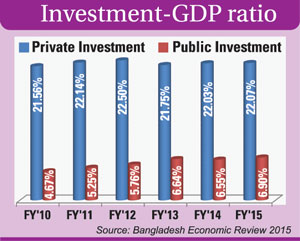
The government in the new budget has presented a blueprint for augmenting overall investment by raising it to 24.0 per cent of GDP from the private sector and 7.8 per cent from public purse in the medium-term (2016-18).
To make it happen, the investment-promotion machinery will be geared up through the merger of the Board of Investment (BoI) and the Privatization Commission (PC) alongside other reforms.
At present the investment as percentage of GDP hovers around 28 per cent on an average, with the private investment standing at about 22 per cent of GDP (gross domestic product), which is considered far below the mark.
The inflow of foreign direct investment (FDI) has not been increasing despite good incentives, being offered by Bangladesh to investors from abroad.
The country received FDI worth US$1.6 billion or slightly more than 1 per cent of its GDP in 2013, and $1.52 billion in 2014, which was less than 1 per cent of the GDP worth $170 billion.
According to economists and various development-research organizations, to achieve 7.0-8.0 per cent GDP growth, the investment-GDP ratio should be around 32 per cent.
Such an ideal investment scenario marks a substantial increase in the volume from the present state of stagnancy.
But the investment - both public and private - is not getting momentum because of lack of investors' confidence mainly due to political instability, accompanied by infrastructure constraints, efficient governance, and delays in project implementation.
Finance Minister AMA Muhith, in his budget speech in parliament on Thursday, admitted to having the impediments and also identified the bottlenecks hindering investment, both local and foreign.
"We are aware of the slow pace of private investment, and continuing with our effort to improve it. I believe implementation of ongoing infrastructure projects, establishment of economic zones, execution of institutional reforms, and expected political stability will bring significant changes to investment climate in the coming days and boost up private investment," he said.
Businessmen and economists have long been demanding removal of the problems of electricity and gas supply to industries, land availability and transport infrastructure, sluggish progress of reform in financial, institutional and administrative sectors and political uncertainty.
These they identified as major hurdles to boosting the sagging investment confidence.
"Our path towards achieving higher growth is replete with numerous obstacles. We have diagnosed these problems and identified the major drivers of growth, such as increased investment and its enhanced productivity," said the finance minister while placing the national budget for fiscal year 2015-16.
According to the minister, over the last ten years, the total investment in terms of GDP has increased to 28.9 per cent from 25.8 per cent. During this period, although public investment rose to 6.9 per cent from 5.5 per cent, private investment was hovering around 21 to 22 per cent of the GDP.
To remove the obstacles the government plans to allocate more resources for development of physical and social infrastructure in sectors like power, energy, communications, transportation, port development, education, health, and ICT.
mzrbd@yahoo.com