
Boost fuel storage, ease barriers for renewable shift: Speakers
FE REPORT | Friday, 10 April 2026
Speakers at a programme on Thursday called for enhancing fuel storage capacity and mainstreaming renewable energy to build a sustainable economy and tackle present and future energy crises.
They identified bureaucratic complexity as one of the key obstacles to doing business and finding solutions, citing issues such as high import duties on renewable energy-related materials like solar batteries and lengthy approval processes.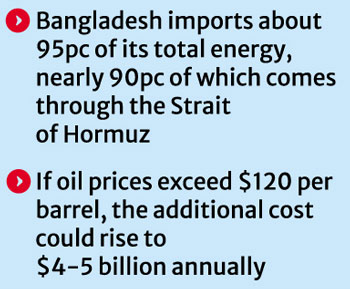 They made the remarks at a discussion titled "Navigating the Global Energy Shock: Impact on Bangladesh and Way Forward".
The Dhaka Chamber of Commerce and Industry (DCCI) organised the event in collaboration with Bangladesh Sustainable and Renewable Energy Association (BSREA) and Infrastructure Development Company Limited (IDCOL) held at the DCCI auditorium.
DCCI President Taskeen Ahmed moderated the event.
Md Obaidur Rahman, Secretary, Ministry of Industries, attended the programme as the chief guest while Md. Abdur Rahim Khan, Administrator, FBCCI, and retired Brig Gen Md Shahid Sarwar, Member (Power), Bangladesh Energy Regulatory Commission (BERC) were present as special guests.
In his paper presentation, the DCCI President said that Bangladesh imports about 95 per cent of its total energy, nearly 90 per cent of which comes through the Strait of Hormuz.
He noted that every $10 increase in global oil prices adds approximately $1 billion to Bangladesh's annual expenditure. If oil prices exceed $120 per barrel, the additional cost could rise to $4-5 billion annually (around BDT 610 billion), increasing government losses and significantly raising industrial manufacturing and business operating costs, he said.
He added that due to the energy crisis, production capacity in the RMG sector has declined by nearly 50 per cent, cement production cost has increased by Tk 25-30 per bag.
In addition, container freight cost has increased 20-40 per cent resulting in the entrepreneurs incurring additional cost of USD500-4000 per container.
Speaking on the occasion, Md Obaidur Rahman said that although the country requires 600,000 metric tons of fertilizer by June, there is currently a shortage of 400,000 metric tons due to disruption in production and situation in the Middle East.
He stated that the government is taking strict measures to reduce bureaucratic delays.
In his speech, the FBCCI Administrator emphasised the need for accurate and reliable data to formulate and implement effective strategies.
Shibir Bicitro Barua, Additional Secretary, Ministry of Commerce, said that there are gaps in taking effective initiatives and implementing measures to ensure energy security.
He also mentioned that his ministry will propose to the National Board of Revenue (NBR) to increase duties on the import of electric vehicles in order to encourage the use of renewable energy.
Zahidul Alam, Senior Vice President, Bangladesh Sustainable and Renewable Energy Association (BSREA), said that currently, there is 27-30 per cent duty on imported equipment for the solar power sector, which is a major obstacle to its progress.
Md. Serajul Mawla, President, Bangladesh LPG Autogas Station & Conversion Workshop Owners' Association, observed that due to LPG supply shortages, many stations in the country have already shut down. He laid stress on a long-term master plan and diversification of import sources in this sector.
Mohammed Nurul Absar, Additional Chief Engineer, Commercial Operation, Bangladesh Power Development Board (BPDB), said that in the 2024-25 fiscal year, BPDB subsidies totaled nearly Tk 630 billion.
The main reason for this huge amount of subsidy was the high cost of energy production, he said, urging greater emphasis on renewable energy to address this situation.
nsrafsanju@gmail.com