
Boro procurement deadline extended to collect 0.2m tonnes more
YASIR WARDAD | Tuesday, 5 September 2023
Despite the country successfully meeting its domestic procurement target for the key rice variety Boro, the government has extended the collection deadline by half a month to buy an additional 0.2 million tonnes of the food grain.
This decision is aimed at securing a strategic buffer stock in response to the surge in global food prices, concerns over a possible reduction in Aman rice output, and India's recent imposition of restrictions on exports of the food staple, according to officials.
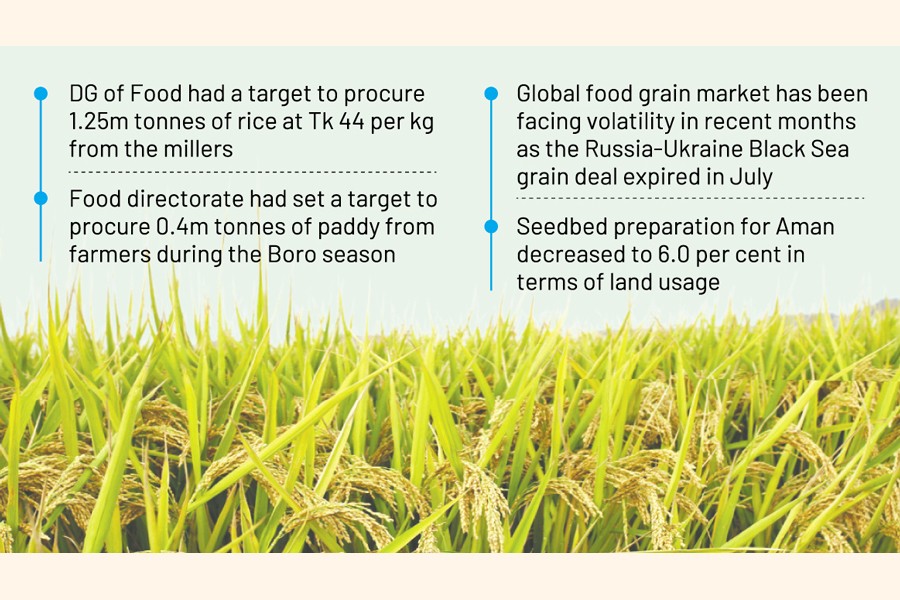
This year, the Directorate General of Food had a target to procure 1.25 million tonnes of rice at Tk 44 per kg from the millers.
The directorate has already bought 1.26 million tonnes of rice by the August 31 deadline - 10,000 tonnes more than its target.
Additional Director of the Food Directorate (Procurement) Md Zahirul Islam told the FE that they have extended the procurement period to September 14 to acquire another 0.2 million tonnes of rice, even though the rice collection target has already been fulfilled.
He mentioned that the price in the domestic market is currently lower than the import price.
Regarding the public warehouses - which currently hold a substantial 1.7 million tonnes of rice and wheat - the government aims to maintain a strategic buffer stock due to the rising trend in food grain prices in the global market and potential climate issues in the ongoing Aman season, he explained.
He also said the food directorate had set a target to procure 0.4 million tonnes of paddy from farmers during the Boro season, with only 50 per cent of it achieved.
The additional rice might help compensate for the shortfall in paddy procurement, he added.
The global food grain market has been facing volatility in recent months as the Russia-Ukraine Black Sea grain deal expired in July, followed by India's export bans on wheat and rice.
On July 20 of this year, India unexpectedly implemented an export ban on widely consumed non-basmati white rice in an effort to control rising domestic prices.
This decision came after a ban on broken rice exports was enforced last year. Besides, India has recently imposed restrictions on basmati rice shipments, according to Indian media reports, contributing to remarkable fluctuations in the international grain market.
These moves by neighbouring India, a major rice producer, led to a significant surge in global rice prices, reaching a 12-year high in July 2023, as indicated by the FAO All Rice Price Index, which reached 129.7 points during that month.
Meanwhile, a report from the United States Department of Agriculture (USDA) for the previous month noted that reduced rainfall from April to July could result in lower Aman and Aus rice outputs in the current fiscal year.
The report highlighted that seedbed preparation for Aman decreased to 6.0 per cent in terms of land usage, while Aus rice output might decline to 2.4 million tonnes in FY24 from 2.7 million tonnes in FY23.
Officials from the food directorate said their primary goal is to procure a minimum of 0.5 million tonnes of rice from global sources in FY24, with the private sector also expected to bring in 1.0-1.5 million tonnes.
Economist and value chain expert Prof Dr Rashidul Islam said that while the government currently maintains a substantial rice stock, the existing volatility in the international market and potential declines in local production due to unusual weather patterns could alter the situation.
He underscored the strategic importance for the government to maximise procurement from domestic sources and encouraged the private sector to import rice, wheat, and other essential food items at competitive prices from various global sources to ensure a stable market.
He further suggested that the government should negotiate with India to utilise its quota facility for wheat and rice, emphasising the importance of sound market practices.
tonmoy.wardad@gmail.com