
BRAC Bank creates 2.0m SME entrepreneurs in 25 years
FE REPORT | Sunday, 28 June 2026
Breaking the barriers of yesteryear, a banker to the umpteen unbanned, namely BRAC Bank, has helped create more than 2.0 million entrepreneurs over the past 25 years through its pioneering work in cottage, micro, small and medium enterprise (CMSME) financing. The innovative banking has cemented its position as Bangladesh's largest provider of collateral-free loans to small businesses.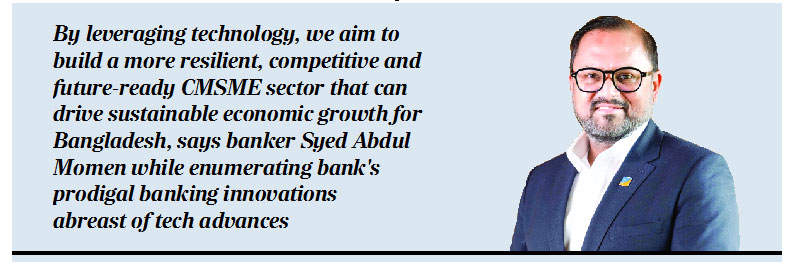 Founded in 2001 with a vision to serve Bangladesh's "missing middle"-small and medium entrepreneurs who had long remained beyond the reach of conventional banking-BRAC Bank has played a transformative role in expanding access to formal finance, particularly in rural and semi-urban areas where obtaining credits was once extremely difficult.
In an interview with The Financial Express, Syed Abdul Momen, Additional Managing Director and Head of SME Banking at BRAC Bank, has said the institution was established based on the vision of its founder, Sir Fazle Hasan Abed, who believed that sustainable economic development required bringing grassroots entrepreneurs into the formal financial system.
"Our visionary founder, Sir Fazle Hasan Abed, envisioned taking formal banking services to the country's 'missing middle' - small and medium entrepreneurs who had long remained outside the reach of conventional banking," Momen recalls.
Over the past quarter-century, BRAC Bank has evolved into the country's largest collateral-free CMSME lender. To date, it has disbursed more than Tk 2.0 trillion in CMSME loans to over 2.0 million customers across the country. More significantly, over 85 per cent of these loans have been extended without requiring collateral, allowing thousands of entrepreneurs to access financing who would otherwise have remained excluded from formal banking channels.
The impact has gone beyond the direct borrowers. Momen says the bank's SME-financing activities have touched the lives of nearly 20 million people, making a meaningful contribution to Bangladesh's socio-economic development. For BRAC Bank, however, financing represents only one part of the broader entrepreneurial ecosystem it seeks to build.
Among its flagship initiatives are Uddokta 101 and Amrai TARA, emblematic programmes that equip entrepreneurs with practical business knowledge, management skills and growth strategies.
Innovation has also been central to BRAC Bank's SME journey. Over the years, the bank has introduced a range of digital lending solutions, including Shafollo and Jibika, alongside Swabalombi, a product specifically designed to encourage inward remittance and strengthen financial inclusion among underserved entrepreneurs.
While proud of its achievements, the bank acknowledges that the journey remains far from complete.
Momen believes technology will play a critical role in addressing this challenge. The bank has invested substantially in digital infrastructure, including its Astha digital-banking app, the automated loan-origination platform e-LAP, the SME transaction- banking-platform BizPay and a growing portfolio of digital loan products.
To further accelerate innovation in the sector, BRAC Bank recently launched Bangladesh's first SME Innovation Lab. The initiative is expected to serve as a platform for developing next-generation financial solutions and introducing products and services that respond to the evolving needs of entrepreneurs.
SME banking remains the cornerstone of BRAC Bank's long-term growth strategy.
The bank currently allocates nearly 47 per cent of its total loan portfolio to the SME sector, which has recorded close to 20-percent growth over the past few years. According to Momen, the sector's performance demonstrates both the resilience of small businesses and the strength of BRAC Bank's business model. As of December 2025, BRAC Bank's SME loan portfolio stood at Tk 349.11 billion, while its SME deposit portfolio reached Tk 189.87 billion. The two portfolios recorded year-on-year growth of 14 per cent and 33 per cent respectively despite a challenging economic environment.
Today, BRAC Bank accounts for approximately 22 per cent of the total SME financing provided by the country's private commercial banking sector. The bank expects this market share to grow significantly over the next five years.
Its confidence emanates from what Momen describes as the country's most extensive SME-banking ecosystem, supported by deep customer relationships, a nationwide distribution network, strong digital capabilities and increasingly sophisticated data-driven lending systems.
Digital transformation is expected to be one of the key drivers of future growth.
While banking digitisation in Bangladesh initially focused on retail and corporate clients, SME banking presented a more complex challenge due to the fragmented nature of the sector and the varying levels of technological readiness among small businesses.
BRAC Bank has sought to address this gap through a series of digital initiatives aimed at simplifying banking for entrepreneurs.
One of the bank's major achievements has been the introduction of a fully digital onboarding process for business- account opening. Over the past year alone, more than 50,000 SME entrepreneurs opened their business accounts digitally.
The Astha app has become an increasingly important channel for SME customers, now handling more than 65 per cent of all SME transactions.
The bank has also launched BizPay, a dedicated SME-transaction banking platform that offers businesses a more efficient way to manage their finances. Through the platform, customers can conduct bulk payments, make e-challan payment, settle utility bills, disburse salaries with a single click and execute high-value transactions digitally.
Meanwhile, the automated e-LAP platform has transformed the SME loan-processing journey. By digitising loan applications and approvals, the system has improved productivity, enhanced operational efficiency and substantially reduced turnaround times.
Financial inclusion remains a central objective of these initiatives. Through Bangladesh's first document-less, real-time SME e-loans-Shafollo and Jibika-the bank has enabled many first-time borrowers to gain access to formal credit without the burden of extensive documentation.
The past year has seen the introduction of several new products designed to support different segments of the SME market.
Among them is Torongo, a specialised financing solution developed for large vessel owners. The product is intended to strengthen Bangladesh's inland water-transport ecosystem by facilitating vessel financing and supporting business expansion in a sector that plays a critical role in the country's logistics-and supply-chain infrastructure.
Another notable innovation is Swabalombi, a real-time financing solution tailored for remittance-backed micro-entrepreneurs. Alongside this, the bank has expanded digital collection systems and QR-based payment facilities for cottage and micro-enterprises, helping them become more integrated into the digital economy.
Over the past year, BRAC Bank's e-loan programme alone has enabled more than 23,000 previously unbanked micro-entrepreneurs to access financing through a seamless and paperless process.
Looking ahead, the bank plans to leverage artificial intelligence and advanced data analytics to redefine SME banking.
Its future lending model will increasingly rely on data-driven credit assessment, analysing entrepreneurs' cash flows and digital-transaction histories to determine creditworthiness instantly. The goal is to make lending decisions faster, smarter and more inclusive while expanding access to finance for underserved entrepreneurs.
The bank's innovation roadmap also includes expanding green-financing initiatives, strengthening its TARA portfolio for women entrepreneurs and developing next-generation digital supply-chain finance solutions through the SME Innovation Lab.
Momen believes these initiatives will shape the future of SME banking in Bangladesh by delivering intelligent, customer-centric financial solutions while supporting sustainable economic growth.
"Our vision is clear: to modernise SME banking through digital transformation by reimagining both products and processes, delivering customer-centric innovations, and expanding supply-chain-finance solutions," he says. "By leveraging technology, we aim to build a more resilient, competitive and future-ready CMSME sector that can drive sustainable economic growth for Bangladesh."
bdsmile@gmail.com