
BRICS: Opportunities and challenges
Syed Munir Khasru | Sunday, 7 December 2014
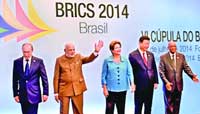
Rarely has been a case that a mere acronym has led into reality. BRIC -- coined by Jim O'Neill of Goldman Sachs in 2001 in the context of forecasting global economic trends -- has actually brought together leaders from disparate countries- Brazil, Russia, India, China and South Africa to form a global alliance of emerging economies. Unlike other trade blocs or multilateral groupings, BRICS nations visibly have little in common. They do not share the same geographical location, not even same political system. They differ in economic size, growth, trade, demographic trends etc. However, their common aspiration for greater representation, influence and leadership in international economic, financial and political forums and institutions like IMF or the World Bank has motivated them to form a multilateral alliance of the next big economies.
BRICS represents the biggest and most potential countries among the emerging economies. BRICS countries contain more than 40 percent of the world's population, compared to other regional trading blocs like ASEAN's less than 9% and EU's less than 8%. BRICS also cover nearly 30% of land mass and account for a quarter of the world's economy. BRICS has witnessed immense growth in national GDP, contribution to world GDP and contribution to world trade. Starting with a share of a little over 10% in world GDP and 4% in world trade in 1990, currently BRICS contributes about 25% of world GDP and 15% of World Trade. The increasing trend of growth signifies the economic importance of these countries in international trade and economy.
BRICS countries realize the necessity of complementarity rather than head to head competition. Following the principle of "More Cooperation, More Growth", BRICS is strengthening intra-BRICS cooperation to transform their individual comparative advantages into international competitive advantage to influence the future political and economic structure of the world. The major areas of BRICS cooperation includes: Economic growth and development through enhancing intra-BRICS trade and investment, energy cooperation, infrastructure development, research and knowledge sharing, cultural exchange and tourism etc.
Trade and Investment: Deepening trade and investment relations is one of the priority areas of the BRICS nations to seize the advantage of the opportunities brought in by complementarity of the BRICS economies to achieve a sustainable and comprehensive development. Though statistics show that intra-BRICS trade constituted 8.5% of total trade of these countries in 2011, the trend is increasing at a quick pace with a fast growing middle class. Undeniably, China is the largest trade partner for each of the other BRICS with a trade share ranging between 72% and 85%, followed by India with a share ranging between 8% and 26%. South Africa's share is the smallest in each of the other BRICS markets. Although bilateral FDI stock among BRICS countries continue to be limited, it has been growing fast over the past decade, from USD 260 million in 2003 to USD 29 billion in 2011. China is the largest investor among the BRICS countries, with a total of nearly $425 billion in FDI stock worldwide. However, China's FDI to other BRICS countries is only 2.2% of the total. South Africa and Russia have been important targets of outward FDI from China with less share for neighbouring country India. What remains to be seen is how much tangible change happens through the recently adopted proposals for a "BRICS Economic Cooperation Strategy" and a "Framework of BRICS Closer Economic Partnership" to promote intra-BRICS economic, trade and investment cooperation.
Infrastructure development: The BRICS nations share a common challenge of infrastructure deficiency. The key areas of infrastructure development are in energy, telecommunication, transportation and access to improved water and sanitation, etc. As infrastructure development is the key to economic development, all the BRICS countries are undertaking long term strategies to address the deficit. For example -- China spent on infrastructure development projects worth USD 621.73 Billion which is 9% of China's total GDP. India has devoted 8% of its GDP to infrastructure development projects like constructing new ports and airports, subways, freight rail, power generation and tolled the highways to address the deficits. Countries like Russia, Brazil, and South Africa are also deploying significant portion of resources in infrastructure development. However, financing the infrastructure project has been a key concern for all the developing countries including BRICS. To foster greater financial support and development cooperation among the five emerging markets, the New Development Bank, formerly referred to as the BRICS Development Bank, is formed -- focusing on the major needs in infrastructure and more sustainable development.
Research and knowledge sharing: As the member countries are at different stage of economic development, cross country knowledge and experience can assist other countries in adopting necessary measures for boosting economic development. China and India are quite at an advance stage of development and invested a lot in R&D. Both the countries are excelling in Nano-technology, energy efficiency, renewable energy, modernizing agricultural, efficient manufacturing and distribution etc. and can render such expertise to other BRICS countries.
Cultural exchange and tourism: Culture and tourism has been a weak link in the overall cooperation and collaboration between the BRICS countries. Cultural exchange, youth exchange, people to people connection are soft areas which will not only boost BRICS's individual economies but also strengthen ties among the countries. The recent visit by Xi Jingping in India has mobilised the process where leaders declared 2015 as the "Visit India Year" in China and 2016 as the "Visit China Year" in India.
Challenges: The BRICS nations are experiencing profound internal transformation as they represent the fastest growing economies of the world. Their growth potential, however, may not be fully tapped due to common domestic socio-economic challenges -- poverty, unemployment and income inequality, corruption and bureaucracy, political stability, inadequate access to healthcare, education, sanitation and drinking water etc.
A productive Sino-India relationship will be critical for BRICS as these two countries are spearheading the future of the grouping. Unresolved border disputes, China's political and military support for Pakistan, and China's perception of India's support for Tibet are some of the major issues that require immediate long-term peaceful solution.
The five countries represent widely differing political systems: China -- a one-party socialist state; Russia -- highly centralised, Brazil India and South Africa are democracies with significant corruption and/or ethnic strife to be dealt with. On the other hand, the democracies of BRICS formed another alliance under IBSA (India, Brazil and South Africa- IBSA was established in June 2003). The forum provides the three countries with a platform to engage in discussions for cooperation in the field of agriculture, trade, culture, and defence etc. With such parallel grouping already at work, a major challenge for BRICS is to neatly manage the overlap in mandates that can arise in such situations.
BRICS cooperation is moving forward with an ambitious agenda encompassing a lot of socio-economic and security aspects that can help transform the future of the world. Currently, BRICS countries are envisaging more 35 areas of potential cooperation. Whether such wide ranging vast agenda will be productive and instrumental to strengthen ties among the nations by mitigating the will only be known in the upcoming years.
............................................................................
The author is a Professor at the Institute of Business Administration (IBA), University of Dhaka. He can be reached at: munir_iba.du@egen.com.bd