
BSEC greenlights intra-day trading, cautions bourses on risks
FE REPORT | Wednesday, 15 July 2026
The securities regulator on Tuesday approved the introduction of intra-day trading on the country's stock exchanges in a landmark reform aimed at revitalising the country's capital market by boosting liquidity and bringing the trading framework closer to international standards.
The Bangladesh Securities and Exchange Commission (BSEC) on Tuesday at a commission meeting asked the Dhaka Stock Exchange (DSE) and Chittagong Stock Exchange (CSE) to formulate detailed operational guidelines, including risk management measures before rolling out the facility.
"The commission has formally allowed the country's two stock exchanges to introduce scrip netting, or intra-day trading, subject to all necessary operational, technological and risk-management preparations," said BSEC Executive Director and spokesperson Md Abul Kalam.
The intra-day trading facility will allow investors to buy and sell the same security within a single trading session, giving active investors more flexibility and potentially increasing market turnover.
The regulatory approval came days after BSEC Chairman Masud Khan told journalists that there was a plan to introduce day netting for selected quality stocks as part of a series of reform measures to improve liquidity and attract more investors to the secondary market.
He said the proposal for day netting had been submitted by the DSE Brokers Association of Bangladesh. However, the facility should not be implemented for all listed securities under the current market conditions, he said at the CMJF Talk last week.
"We are considering introducing day netting initially for quality companies. The facility may begin with 30 fundamentally strong stocks," Mr Khan said.
Market operators said the move is expected to enhance market liquidity, improve price discovery and increase trading efficiency.
Under intra-day trading, investors will be able to buy and sell the same stock within a single trading session without waiting for settlement. The move represents one of the most significant changes in Bangladesh's equity trading framework since the introduction of the automated trading system.
Intra-day trading is already widely followed in developed and emerging markets.
The regulatory decision comes as efforts are on to boost market turnover, regain investor confidence and increase institutional participation.
Brokerage houses are expected to be among the immediate beneficiaries as higher trading activity is likely to increase commission income. Stock exchanges, clearing institutions and other market intermediaries may also benefit from increased transaction volumes.
The facility could attract a new class of investors, particularly experienced traders, institutional investors and foreign portfolio managers who are accustomed to similar trading mechanisms in developed and emerging markets, said a stockbroker.
Saiful Islam, president of the DSE Brokers Association of Bangladesh, said intra-day trading could encourage greater participation from active investors by providing more flexibility in executing trades and responding to market developments.
"Intra-day trading is a globally accepted practice that generally increases market depth and liquidity when supported by proper surveillance and risk management," he added.
The decision is also viewed as an important step toward modernising Bangladesh's capital market infrastructure and making it more competitive within the region.
However, some market experts caution that without robust surveillance and risk controls, it could also encourage excessive speculation and market manipulation.
Technology readiness will be another critical factor. Stock exchanges, Central Depository Bangladesh (CDBL), clearing and settlement systems and brokerage firms will need to upgrade their technological infrastructure to handle a substantial increase in trading volumes without system disruptions.
The BSEC chairman recently said the commission had already delegated greater regulatory authority to the stock exchanges, enabling them to take immediate action against abnormal price movements and suspicious trading without prior regulatory approval.
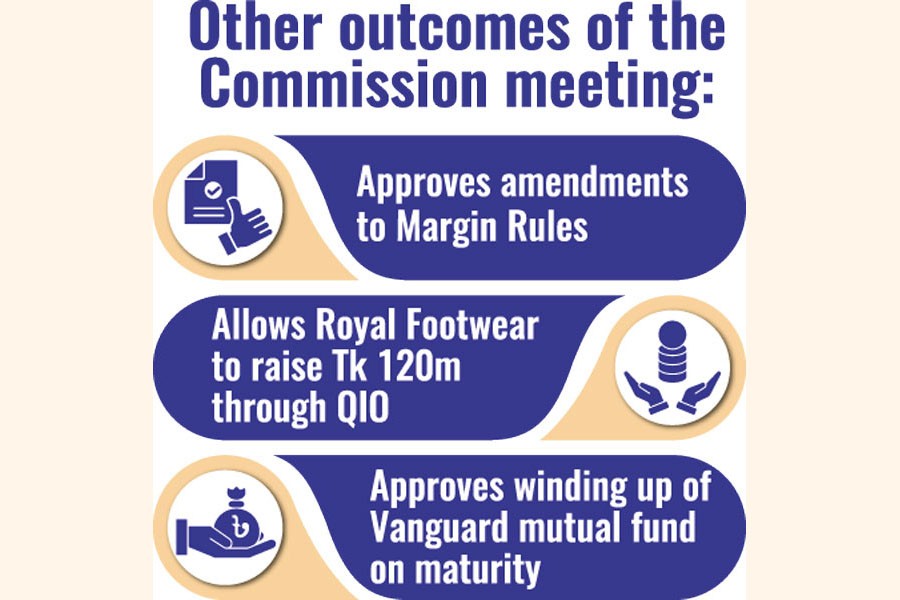
At Tuesday's meeting, the commission also approved proposed amendments to the Margin Rules, 2025, for public opinion.
In another major decision, the regulator also approved Royal Footwear's proposal to raise Tk 120 million through a Qualified Investor Offer (QIO) by issuing 12 million ordinary shares at a face value of Tk 10 each.
This is the first QIO approval under the Masud Khan-led BSEC commission, signalling the regulator's intention to encourage alternative fundraising avenues for eligible companies.
In another decision, the regulator approved the proposal to wind up Vanguard AML BD Finance Mutual Fund One following the expiry of its 10-year tenure.
babulfexpress@gmail.com