
Revenue, foreign borrowing shortfalls
Budget deficit may swell to Tk 4t: RAPID
Global foreign aid flows have fallen to $153b in 2026 from $232b in 2023
FE REPORT | Friday, 19 June 2026
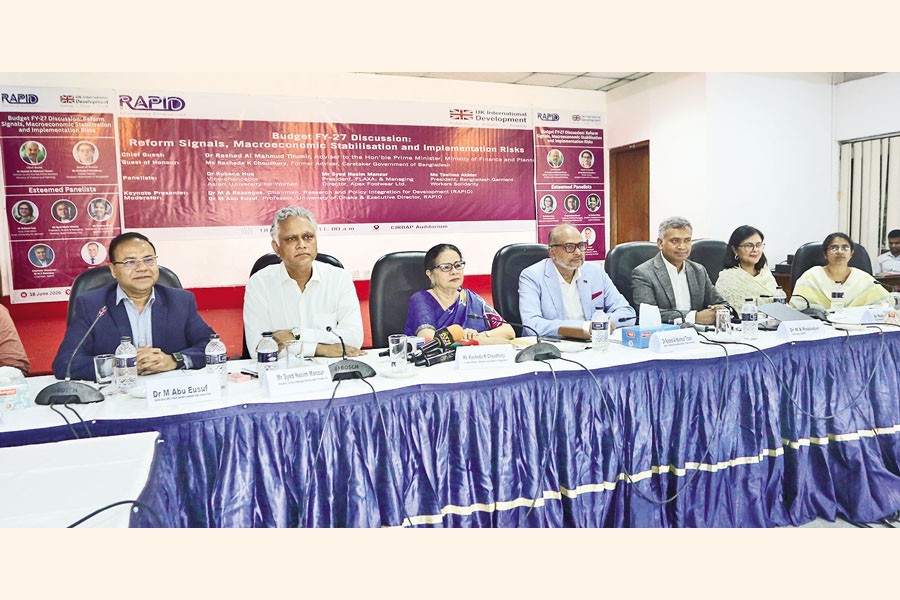
The actual budget deficit may rise to about Tk 4 trillion in the 2026-27 fiscal year, as revenue mobilisation by the National Board of Revenue (NBR) and foreign borrowing are likely to fall significantly short of targets, according to projections by the Research and Policy Integration for Development (RAPID).
The NBR revenue collection target for the upcoming fiscal year has been set at Tk 6.04 trillion, while the revised target for FY'26 stands at Tk 5.0 trillion.
"If the revised target for FY '26 is achieved, there will be a gap of around Tk 1.0 trillion compared to the NBR target for FY '27," said RAPID Chairman Dr MA Razzaque, adding NBR's recent collection trends show a consistent failure to meet ambitious targets.
He made the observations while making his keynote presentation on 'Budget FY 2026-27: Navigating Economic Headwinds' at a dialogue organised by RAPID at CIRDAP auditorium in the city on Thursday.
Besides, the FY '27 budget relies more heavily on external financing at a time when global aid flows are declining sharply, Mr Razzaque said, adding global foreign aid flows have fallen to $153 billion in 2026 from $232 billion in 2023.
The government in its proposed budget announced on June 11 plans to finance the deficit through net foreign borrowing of Tk 1.09 trillion.
He estimated a Tk 500 billion shortfall in foreign borrowing due to the country's limited absorption capacity.
So, if the proposed Tk 9.38 trillion budget is implemented, the actual deficit could reach about Tk 4.0 trillion--much higher than the government's projection of Tk 2.43 trillion, said the RAPID chairman.
The government's pursuit of high economic growth without ensuring economic stability could further fuel inflation, he warned, noting that low-income people have already been bearing the brunt of elevated inflation over the past several years.
He stressed the need for economic stabilisation for the successful achievement of the 3R framework-Recovery, Restoration and Reconstruction.
Speaking at the dialogue, Rashed Al Mahmud Titumir, adviser to the prime minister for finance and planning, said the government has undertaken initiatives to boost revenue collection by expanding production and economic activities rather than raising tax rates.
"We have moved towards a new model--from investment to production, production to employment and employment to increased domestic resource mobilisation without raising tax rates," he said, terming the move a significant departure from previous approaches.
Citing recent global disruptions, including the COVID-19 pandemic and geopolitical tensions in the Middle East, he said the government is promoting production-oriented industrialisation through country specific strategies to strengthen economic resilience and help the country cope with emerging global uncertainties and economic challenges.
Highlighting reforms in the energy sector, the adviser said they are based on five key priorities which include ensuring a livable planet for future generations by gradually shifting from fossil fuels to renewable and nuclear energy, while keeping energy affordable and within the purchasing capacity of consumers.
He said several initiatives are underway in this regard and the outcomes will be visible in the coming years.
Gas exploration and extraction activities had been neglected in the past and the government is now working to accelerate both onshore and offshore exploration and production, he said, laying stress on developing domestic capacity in renewable energy production, particularly solar power.
He expressed the hope that these initiatives would strengthen the country's productive capacity, create employment opportunities and contribute to sustainable economic growth.
Describing women and workers as 'contributors rather than beneficiary', Rasheda K Chowdhury, former adviser to a caretaker government, underscored the importance of sustaining existing employment along with creating new jobs and female-friendly transportation and housing facilities.
She further laid emphasis on good governance in the distribution of family and farmers' cards.
Syed Nasim Manzur, president of Footwear Leathergoods and Accessories Exporters Association (FLAXA), said one-third of people having TIN numbers did not submit tax returns despite four-time extension, mainly because of a lack of trust as to whether what services taxpayers receive in return.
While welcoming some of the budgetary measures, he requested the government to reduce the corporate tax rate, describing Bangladesh's rate as excessively high. He also proposed fixing two to three VAT rates instead of 15 per cent for all, reducing the source tax on exports to 0.5 per cent, and extending the existing 1 per cent machinery import duty facility enjoyed by the textile sector to all export-oriented industries to support export diversification.
Mr Manzur also proposed a special allocation and developing institutional capacity for trade negotiations related to LDC graduation and the signing of FTA with EU, involving all relevant stakeholders.
Dr Rubana Huq, Vice-Chancellor of Asian University for Women, said businesses are worried over post- LDC period as to what would happen once Bangladesh graduates from the category.
Terming the current period 'time for preparation', the former president of Bangladesh Garment Manufacturers and Exporters Association (BGMEA) said the government should take the lead to sign a free trade agreement with the European Union.
Munni_fe@yahoo.com