
Predictable policies, improved liquidity flows among ends
Budget focuses on economic recovery, restoring investor confidence
Dr Rashed Al Titumir, Prime Minister's Adviser on Finance, tells FE
DOULOT AKTER MALA | Monday, 1 June 2026
Predictable policies, improving liquidity flows and rebuilding investor confidence dominates the upcoming national budget as Bangladesh navigates a challenging economic landscape marked by inflation, sluggish investment and financial-sector vulnerabilities.
Talking to The Financial Express, days before the new government's maiden budget lands in parliament, Dr Rashed Al Titumir also explains that the government's economic strategy is built around a five-year framework of "recovery, restoration and reconstruction for acceleration".
"The budget size remains relatively small compared to the size of our economy and the financing needs in health and education," he says, stressing the need to increase public spending to reduce high out-of-pocket healthcare expenditures and build a skilled workforce through the promotion of technical education.
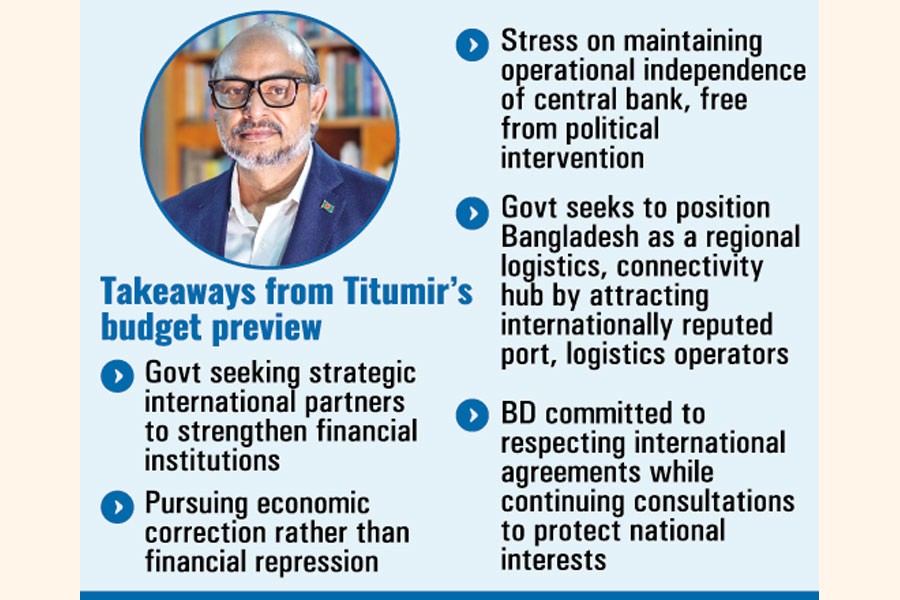
Asked about amendments to the Bank Resolution Act and efforts to address the banking-sector crisis, Dr Titumir says the government has adopted a diversified approach and is seeking strategic international partners to strengthen financial institutions.
"Bangladesh must better integrate with international banking standards and explore opportunities in the global Islamic finance market to benefit depositors, trade financiers and the broader economy."
The government is also focusing on improving liquidity flows within the financial system.
"We must ensure the flow of liquidity. This requires proper incentives to increase the velocity of money. Banks holding excess liquidity should play a greater role in supporting productive investment," he says.
While acknowledging the current stagflationary pressures, the professor of development economics emphasizes that the government is pursuing economic correction rather than financial repression.
"We do not want financial repression. Our objective is to correct distortions and ensure that investors have access to funds without facing excessive financing costs."
Dr Titumir stresses coordination between fiscal and monetary policies while maintaining the operational independence of the central bank, free from political intervention.
On relations with the IMF, he says Bangladesh would continue discussions with the Fund to ensure that future policy commitments reflect the country's economic realities.
Describing the previous Hasina administration as "debtholic," he argues that the government had accepted several IMF conditions under the bailout programme that may not fully align with Bangladesh's current economic context.
"We will continue negotiations based on our own policy priorities and development needs."
Emphasizing the urgency of restoring international confidence as a prime objective, he notes that Bangladesh's debt-risk rating by the IMF from low to medium was a "hemorrhage" for the country's ability to access concessional financing.
"Lower international ratings affect investment, financing costs and market access. Consistent policies, macroeconomic stability and stronger institutions are essential for rebuilding credibility."
The government is also seeking to position Bangladesh as a regional logistics and connectivity hub by attracting internationally reputed port and logistics operators.
"We want to build Bangladesh into a logistics hub and create a benchmark that attracts internationally reputed operators through an inclusive and competitive process."
He says the government has already initiated investment discussions with stakeholders from Singapore, Saudi Arabia, the UAE, Denmark and Japan, particularly regarding opportunities around the Chattogram Economic Corridor.
Projects may be implemented through public-private partnerships, although other investment models are also being explored to ensure trade and economic benefits for Bangladesh.
Dr Titumir highlights the importance of multimodal transport systems and stronger regional connectivity with Nepal, Bhutan, China, Myanmar and ASEAN economies.
Regarding state-owned enterprises, he says public resources should be concentrated on essential public services such as education, healthcare and social protection.
The government is considering leasing closed factories under BJMC and BTMC through a transparent and competitive process, he adds.
The adviser strikes a note of optimism about restoring confidence in Bangladesh's capital market, noting that BNP-led governments had not experienced major stock- market scams.
"Investors have repeatedly suffered from market manipulation and weak enforcement. Restoring trust requires stronger governance and regulatory oversight," he says.
On evolving trade issues with the United States, Dr Titumir says Bangladesh remains committed to respecting international agreements while continuing consultations to protect its national interests.
"The US situation is evolving too as tariff issues go to Supreme Court."
There are issues that require consultation and dialogue.
Despite current challenges, Dr Titumir remains cautiously optimistic about Bangladesh's prospects.
"We are pursuing a strategy of recovery, restoration and reconstruction. With policy consistency, institutional reforms and renewed confidence, Bangladesh can unlock its growth potential and strengthen its position in the regional economy," he says.
doulotakter11@gmail.com