
Building human capital of poor remains a priority
Sadiq Ahmed | Sunday, 7 December 2014
The substantial reduction in poverty in Bangladesh since independence is a cause for celebration. A major reason for this decline in poverty is the rising per capita income, growing from less than 2% per year in the 1970s to around 5% per year in the 2000s. Yet, it is worrisome that an estimated 47 million people were below the national poverty line in 2010. Continued rapid growth in per capita income will help reduce poverty further, but the ability of higher growth to lower poverty is hampered by growing income inequality. High inequality also creates social tensions and tends to contribute to social and political instability.
This article looks at the income inequality phenomenon in Bangladesh and seeks to provide some suggestions how the inequality challenge could be addressed.
Growth, inequality trade off?
The relationship between growth and inequality has been well researched. The seminal empirical investigation of this relationship was undertaken by Nobel Laureate Simon Kuznets in1955. He found the following relationship between per capita GNP and income inequality: during the early stages of development characterised by low per capita GNP, income inequality is low, but it then tends to increase with higher growth; as development proceeds, this rising inequality is arrested and eventually reversed at higher levels of per capita GNP. Kuznets rationalised this result by arguing that during the early stages of development, a typical low-income country is heavily dependent on agriculture and other rural low-income activities. As development proceeds, there is a transfer of activities and employment from the agro-rural economic base to an urban-industrial economic set up where income tends to be higher because of higher value-added activities. As a result, the gap between the average income in the agrarian rural economy and the average income in the urban-industrial complex grows, contributing to increasing income inequality. Eventually, more and more people transfer to the urban-industrial economy, thereby tending to equalise incomes. This inverted U-Shaped curve relationship between inequality and per capita GNP, known as the Kuznets hypothesis, dominated the literature for some time.
Many researchers sought to test this hypothesis with increasing sophistication and better data. The evidence casts doubt on the universal validity of the hypothesis that income inequality is a necessary consequence of higher growth in low income economies. Indeed, evidence indicates that policies that reduce income inequality could also contribute to higher growth. Policies that could contribute to both lower income inequality and higher growth include interventions to correct distortions in the financial markets, income redistribution through public expenditure policies and programmes, rural development policies and programmes, and social protection programmes. The debate has therefore shifted to finding out how to make growth more pro-poor.
Bangladesh income inequality
in the global context
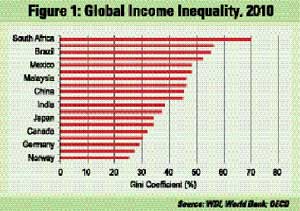
Income inequality is a global phenomenon. Both developed and developing economies experience income inequality in varying degrees. Some countries have made good progress in reducing income inequality over time and keeping this at a socially and politically stable level. Others have experienced growing and large income inequality that has been an important contributor to political instability. A commonly used measure of inequality is the "Gini Coefficient". The Gini coefficient of income distribution for selected countries is illustrated in Figure 1. On average, African and Latin American countries tend to exhibit relatively more unequal income distribution than in other regions of the World. On the other hand, income inequality tends to be low for most European countries, especially for the Scandinavian countries. In contrast, USA exhibits much higher income inequality. Recent evidence shows that income distribution has sharply worsened over the longer term in USA, whereby the Gini coefficient has grown from 39% in 1968 to 48% in 2011. Income inequality is also large and growing in China.
In South Asia comparable income distribution data are not available for all countries except India and Bangladesh. They show that income inequality in Bangladesh is substantially higher than in India. Also, inequality is falling in India. The Gini coefficient declined from 37.7% in FY2010 to 33.4% in FY2012. On the whole, while income inequality tends to be higher in Latin American and African countries, the level of income inequality found in Bangladesh is quite large relative to Asian and European countries and the magnitude is large enough to create cause for concern.
Trends in income inequality
in Bangladesh
Income inequality data are estimated from the various Household Income and Expenditure Surveys (HIES). The trend in income inequality is shown in Figure 2. From the long-term perspective, income inequality is on an upward trend at all levels: national, rural and urban. The value of the Gini coefficient at the national level has increased from 0.36 in 1984-85 to 0.46 in 2010, showing the large increase in national income inequality. Urban inequality has increased faster than rural inequality. One piece of good news though is the significant reduction in urban income inequality between 2005 and 2010. In view of the fragility of the income data reported in the 2010 HIES, it is appropriate to wait for the next round of HIES to confirm the sustained nature of this positive development. Overall, the trend in rising income inequality is a source of concern and needs careful monitoring and efforts to reverse the trend.
Another dimension of the inequality problem is provided by the respective income shares of the bottom and top 5 and 10 percentiles of the population (Figure 3). The income share of the bottom 5 percent of the population fell from a 1.2% in 1983/84 to 0.8 % in 2010. As compared to this, the income share of the top 5 percent has grown from 18.3% to 24.6% over the same period. As a result, the already yawning gap between these two income groups widened further over the years. Thus, the relative share of the bottom 5% was a mere 6% of the income share of the top 5% in 1983-84, indicating the wide magnitude of the income gap between the bottom 5% and the top 5%. This relative share declined further over time, falling from 6% in 1983-84 to a mere 3% in 2010. A similar picture emerges when one compares the relative shares of the bottom 10% and the top 10%. This growing and large concentration of income at the top decile is a source of concern. The income gaps seem to have widened particularly sharply since the 1990s, a period of growth increase. In addition to the adverse implications for poverty reduction effort, the growing concentration of income presents a social challenge of relative deprivation. History is replete with examples of social and political unrest in environments where huge differences in the standards of living of citizens prevail for an extended period and the scope for social mobility is limited.
One positive development, however, is that the distribution of consumption expenditure exhibits substantially lower inequality. This is largely explained by the various forms of income transfers at the family level and consumption smoothing through use of credits that tend to protect the consumption of the poor and thereby partly insulate the adverse effects of rising income inequality for poverty reduction. Figure 4 shows the results for the distribution of consumption expenditure. The Gini coefficient showed an upward trend between 1985-86 and 1995-96, but it fell in 2000 and has remained flat since then. Importantly, the current magnitude of consumption inequality (0.32) is much lower than the magnitude of income inequality (0.46). Additionally, the relative gap in consumption expenditure distribution between the lowest 10% and the top 10% is significantly smaller than in the case of income distribution (Figure 5). Thus, in 2010 the consumption ratio of the poorest 10% to the richest 10% was 14.5 %, while the corresponding income ratio was only 5.6%.
Factors contributing to income inequality
Understanding the sources of income inequality is not a rocket science. In all countries the most commonly known and powerful factor is the inequality of the initial distribution of wealth and human capital. Studies have shown that children born in wealthy families have a huge starting edge in both wealth and human capital that tend to have multiplier effects over time. As a result the social climbing opportunities for the poorer segment of the society tend to be much more limited than for the rich. This initial bias is a powerful barrier to social mobility for the poor. Overcoming this bias requires a long-term commitment from the government to a range of policies that tend to equip the poor with human capital while improving the opportunities for them to engage in economic activities. Indeed, the experience of the European countries, especially in the case of Scandinavian countries, shows how public finance policies (taxation and expenditure) can be a powerful source of lowering income inequality. These countries tend to tax the rich heavily while using the resources to finance a range of social spending on health, education and social protection (income transfers) for the poor and vulnerable.
In the case of Bangladesh, development experience shows that despite good progress with human development indicators, income inequality has increased as growth has increased (Table 1). This suggests that the initial conditions have not been reversed. The government, the academics and civil society leaders have often expressed concern over this development. Yet a coherent strategy and the sustained implementation of underlying policies are yet to emerge. Despite the populist stance of many policy decisions of the various governments, the end results in terms of income distribution remain unhelpful.
Notwithstanding all the progress being made on the education front including better gender balance, Bangladesh is still at the very early stages of social transformation. Education quality is low and the transition from primary and secondary education to tertiary education is still very limited. Importantly, the 2010 labour force survey shows that some 40% of the workforce has no education; some 23% have only up to primary education; and less than 4% have tertiary education. The training programmes for labour force are inadequate. Similarly, while there has been progress with basic health indicators, there is still a long way to go to ensure much better health standards and services for the citizens. Lack of health insurance exposes the poor to huge health expenditure related shocks that contribute to poverty and income inequality.
A major problem in Bangladesh is the very low levels of public spending on human development. Public spending on education is a mere 2.4% of GDP. As compared to this, Argentina and South Africa each spend 6.0% of GDP on education, while Malaysia and Indonesia spend 5.8% and 4.6% of respective GDPs (Figure 6). Scandinavian countries like Sweden and Norway spend even higher (6.8% and 6.5% of GDP respectively). Public spending in Bangladesh on health is similarly very low (only 1.1% of GDP). Additionally, various researches have shown that there are substantial issues with the quality and equity aspects of public spending on health and education.
Another factor that has contributed substantially to better income distribution in European countries is the spending on social protection. On average, they tend to spend 12-19% of GDP on social protection, mainly in the form of income transfers to the poor and vulnerable families (Figure 7). In Bangladesh social protection spending is 2.2% of GDP; if civil service pensions are excluded, then this amounts to a mere 1.6% of GDP. Furthermore, there are serious concerns about the quality and effectiveness of this spending.
A primary factor why public spending on education, health and social protection are so low in Bangladesh is the low levels of revenues due to low tax effort. The European countries have revenue to GDP ratios in the range of 35-45%. In Bangladesh it is a mere 12% of GDP (Figure 8). This is one of the lowest revenue mobilisation efforts even among developing countries. A major reason for low government revenue is low tax collection from personal income taxes. Bangladesh collects a mere 1% of GDP from personal income taxes, while the top 10 percent of the population owns 36% of the total national income. This yields an effective income tax rate of 3%, which is very low. While efforts are underway to improve income tax collection, the effort is concentrated on fixed income earners. Personal income from business, capital gains, stocks and the like tend to escape substantially their fair share of taxation. Similarly, there is minimal tax effort at the local government level. Remarkably, there is no effective property tax collection system. Capital gains from land transactions and stock ownership mostly escapes taxation with a nominal levy. At the present time, the absence of a modern universal personal income tax is a major contributor to the ineffectiveness of fiscal policy to lower income redistribution.
A major weakness in current Bangladesh development policy framework that contributes to income inequality is poor governance and the absence of strong institutions. There are plenty of examples of how these contribute to income inequality but some important examples will suffice to illustrate the point. It is well recognised that corruption is a serious problem in Bangladesh and measures of international comparison (such as Transparency International Corruption index) amply reflect this development challenge. Research on the sources of corruption will likely show that 4 major sources stand out: land transactions; public banking; taxation; and public procurement. Much of the gains from corruption accrue to the rich. In particular, the poor tend to lose most from land transactions conducted by rich and powerful real estate business. As urbanisation spreads and land values grow, many influential real estate enterprises tend to acquire large tracts of agricultural land from the farmers at very low prices. While corruption involving public banks, public procurement and taxation does not incur any direct loss to the poor, it does help the rich to accumulate huge amount of resources that contributes to income inequality. More generally, the rents from access and influence at the political level tend to be unduly large in Bangladesh and have enabled a few powerful people to accumulate substantial amount of wealth within short periods of time. The adverse consequences of these rent seeking behaviour for income inequality is obvious.
Towards a strategy for better income distribution
Land redistribution: There are some proponents who believe that the income inequality problem can only be addressed through policies that seek to change the initial unequal distribution of wealth and assets. At one extreme, the economic philosophies of communism and socialism are based on the premise of redistributing income directly through public rather than individual ownership of wealth and assets. In market economies as in Bangladesh, a programme of redistribution of existing wealth and assets is not a realistic option.
Even the more limited effort of trying to redistribute land is not a pragmatic policy option. International experience of land redistribution in market economies is fraught with disappointing performance. The success of the oft-quoted experiences of Japan and Korea are really special cases. Furthermore, in Bangladesh, the average size of land-holdings is very small. Individual ownership of large land holdings is very limited. The government is the biggest land-holder and some redistribution has been attempted from time to time with limited success owing to severe governance problems including the political clout of professional land grabbers.
More importantly, there is an important need to strengthen the land administration regime and related land projects through a range of institutional, regulatory and fiscal policy reforms. These reforms include proper land ownership surveys and land titling; computerisation of land records; simplification of land transactions and land registration; and streamlining of land transaction fees. Such reforms will protect the poor farmers from the clutches of the predatory land grabbers and will be an important deterrent to accumulation of windfall gains from land transactions. A proper capital gain tax on land transactions will be another important way to reduce windfall capital gains; it will also help to stabilise land prices by discouraging land speculation and provide important revenue earnings to the government for spending on social services.
Fiscal policies: The dynamic redistribution of wealth, assets and income through policies, regulations and institutions that seek to increase human capital and earnings capabilities of the poor citizens hold much better promise and prospects. Access to better education and healthcare is a fundamental right of the Bangladeshi citizen and requires utmost attention of the government. A strong social protection system is another instrument. These policies have worked in Western Europe to contain and lower income inequality. There is no reason why they should not work in Bangladesh.
Clearly, a major way that the government can help improve income distribution is by making faster progress in building up the human capital of the poor. This will equip the poor to get better and higher paying employment. An educated and healthy labour force can also help increase the rate of growth of GDP while improving income distribution. The policy implication of this strategy is illustrated in Table 2.
The top most policy priority is to raise the share of public spending on education and health to at least 3.5 and 2 percent of GDP respectively. In addition, major improvements in the delivery of public education and health services through education policies, governance and institutional reforms are necessary.
A second area where public spending has to increase concerns rural infrastructure--rural roads, rural electricity, irrigation and flood control. Past government spending in this area has helped increase farm productivity and food production. The near food self-sufficiency of Bangladesh despite rapid population growth is a testimony to the success of this policy. Yet, much of the labour force remains engaged in low productivity and low earnings agriculture. There is a need both to diversify agriculture into higher value-added activities and to help transfer surplus labour from agriculture to non-farm activities in rural and urban areas. This transformation will support GDP growth and also income distribution by helping increase average labour productivity in the economy. An additional spending of 1% of GDP on rural infrastructure will be helpful.
In addition to public spending on rural infrastructure, availability of rural credit is an important determinant of this transformation. The micro-credit revolution pioneered by Bangladesh is to be celebrated. Evidence suggests that microcredit has helped lower poverty by building up the assets of the poor and by supporting the smoothing of their consumption. Yet, the average loan size is small and the interest cost is high in relation to formal sector credit. The scaling up of formal credit to the rural economy remains a huge challenge.
A third area where public spending has to grow is on social protection. Presently the government spends 1.6% of GDP on social protection excluding government service pensions. This is too small. This should grow to at least 2.6% of GDP over the next 3-5 years. There are also important concerns about the quality and targeting of this spending that needs urgent review and reform. The new draft National Social Security Strategy prepared by the government develops a solid reform programme for implementation over the next 5 years. This strategy needs to be quickly adopted and implemented.
The total additional spending on social services amounts to 4.0% of GDP, which is a seemingly tall order in the present environment of public resource constraint. However, as Table 2 shows, a strategy to mobilise this additional funding is certainly within the reach of public policy.
In the first place, the government spends some 3.3% of GDP on subsidies, of which 2% of GDP is on energy. The energy subsidy can be cut by a half through price increases and diverted to the above mentioned more socially responsive spending.
Secondly, a major reason for the resource constraint is low tax collection, especially from personal income taxes. As noted earlier, the effective income tax rate of 3% is very low. Increasing the effective income tax rate to even 10% to the top 10 percentile who own 35% of the national income will yield personal income tax revenues of 3.5% of GDP. This will require closing of loopholes that lets capital gains escape the tax net, introducing a modern property tax system, and improving tax administration and compliance. Improving the efficiency of the VAT and the introduction of the property tax can yield an additional 2.3% of GDP in tax revenues.
Together, this combination of expenditure reallocation (1% of GDP) and additional tax effort focused on personal income, VAT and property taxes (4.8% of GDP) can provide additional resources of 5.8% of GDP. This can be used to finance the additional 4.0% of GDP required to fund critical social programmes and it will leave a surplus of 1.8% of GDP for additional spending on infrastructure. This fiscal policy package can be a powerful instrument for improving income distribution as the incidence of this tax and expenditure package is likely to be highly progressive.
Better governance and institutions: In addition to a more effective fiscal policy, the government can also help improve income distribution through better governance. This requires rule of law, proper regulations and letting institutions grow and work. Rent seeking behaviour through discretionary access to public bank loans, non-repayment of these loans, insider trading and other manipulations in stock markets, evasion of taxes, corruption in public procurement and public spending, and illegal land grabbing including of public land are all examples of how massive income transfer has happened to the top 10% of the population based on political patronage in different periods. Improved governance that makes key public institutions like the Central Bank, public commercial banks, public enterprises, the Tax Department, the Rajuk, the municipalities, the Land Administration etc. work on the basis of defined rules of business and accountabilities rather than through political directives is likely to help Bangladesh achieve a better income distribution than presently.
..........................................................
Sadiq Ahmed is Vice Chairman of the Policy Research Institute of Bangladesh (PRI).
He can be reached at: sadiqahmed1952@gmail.com