
CA vows to defend democratic transition
Also calls on political parties to exercise restraint
FE REPORT | Wednesday, 17 December 2025
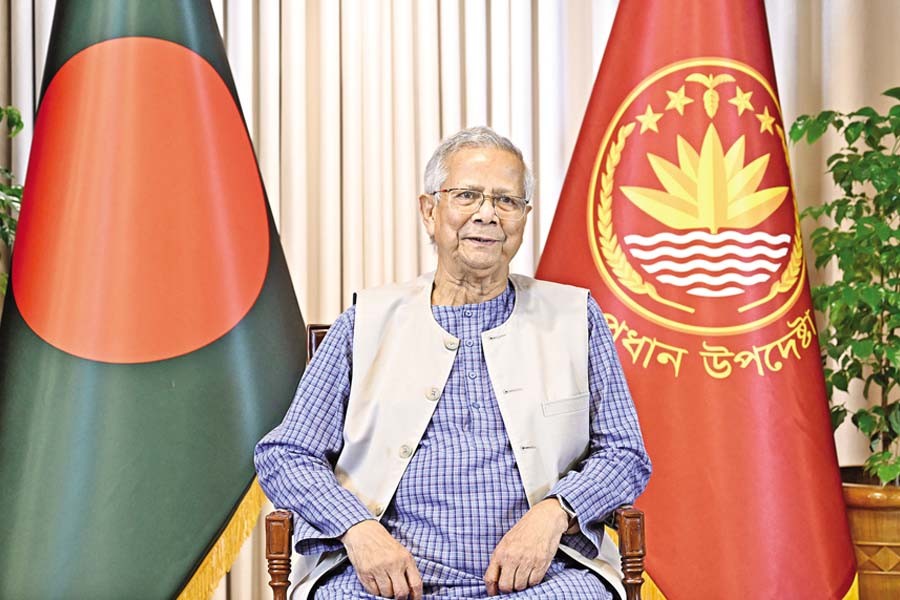
As Bangladesh heads towards a landmark general election combined with constitutional referendum, scheduled for February, the head of interim government asserts that all "ill attempts of defeated forces" will be foiled to execute the country's post-uprising democratic transition.  In a nationwide address marking the Victory Day Tuesday, Professor Muhammad Yunus painted a picture of a country standing at a decisive crossroads, balancing the legacy of its 1971 liberation with the unfinished struggle to dismantle authoritarian rule.
His speech took on a tough tone coming against the backdrop of a violent attack on Sharif Osman Hadi, a prominent youth leader and spokesperson for the Inqilab Mancha, who played a frontline role in the July mass uprising that toppled the previous government.
The chief adviser likened the shooting of Osman bin Hadi to "an attack on Bangladesh itself", and on the country's democratic pathway.
Hadi remains in critical condition and has been transferred to Singapore for advanced medical treatments. The government, he said, had identified suspects and would ensure that all those involved were brought to justice, "wherever they may be".
Without naming specific groups, the interim leader accused "defeated forces" linked to the former regime of attempting to destabilise the country through fear and targeted violence ahead of the election.
"No one will be able to stop Bangladesh's democratic march through terror or bloodshed," the Nobel laureate for peace vows, urging citizens to remain calm and resist rumours and disinformation.
The address underscores the central role of young people in the July uprising, portraying them as both the engine of political change and a primary target of intimidation. The chief adviser warns exiled political actors are seeking to weaken youth mobilisation before polling day, adding that protecting young activists is essential to protecting the nation itself.
Bangladesh is set to hold a general election on February 12, alongside a nationwide referendum on the July National Charter, a reform framework introduced by the interim administration. The charter proposes sweeping constitutional and institutional changes aimed at ensuring judicial independence, administrative accountability, police reform and the protection of human rights.
"The referendum will determine the character of the new Bangladesh," the chief adviser said, describing the vote as more than a routine electoral exercise. "It is the people's signature on the future of the state."
The interim government, installed after months of protests and deadly unrest last year, has placed three priorities at the centre of its agenda: accountability for killings during the July-August uprising, structural reforms to dismantle authoritarian governance, and the organisation of a free and credible election.
At a highly charged moment of truth, the chief adviser mentions that the International Crimes Tribunal had sentenced former prime minister Sheikh Hasina to death for her role as the principal architect of the violent crackdown on protesters. The government has formally requested India to extradite Hasina, who fled the country during the uprising, along with her home minister, also convicted in the case.
The speech also addresses the health of former prime minister and BNP chairperson Khaleda Zia, who is currently hospitalised.
Acknowledging her place in Bangladesh's political history and public life, the interim leader says, the government has declared her a "very important person" and is providing full support for her treatment, including the possibility of care abroad.
Seeking to bolster confidence in the electoral process, the interim administration has announced several reforms designed to prevent interference and restore trust in state institutions. These include the creation of a separate administrative secretariat for the judiciary, aimed at shielding judges from political pressure, and the introduction of a Police Commission Ordinance to curb abuse of power within law enforcement.
A restructured National Human Rights Commission has also been established, replacing a body widely criticised for failing to act independently under the previous government.
For the first time in the country's history, millions of expatriate Bangladeshis will be able to vote by postal ballot---a move the interim leader describes as a long-overdue recognition of the diaspora's role in national struggles, from the 1971 war of independence to last year's uprising.
Calling on political parties to exercise restraint, the chief adviser urges leaders to treat rivals as competitors rather than enemies and warns that voter intimidation or ballot stuffing would be treated as an assault on citizens' rights. "Those who steal votes steal the future," he says-reminiscent of alleged wanton rigging in some past polls.
As Bangladesh marks Victory Day, the speech seeks to link the sacrifices in the 1971 Liberation War with the demands of the present, framing the upcoming election as another defining moment in the country's long fight for democracy.
"We stand at the threshold of a new history," the chief adviser states in his address to the nation. "This state belongs to its people, and its future will be decided by their votes."
mirmostafiz@yahoo.com