
Money market gets volatile again
Call money hotter amid banks' liquidity stress
Short-term interbank lending rate rises to 7.48pc
JUBAIR HASAN | Monday, 16 October 2023
Liquidity stress on the money market builds up again mainly because of policy interventions by the central bank to contain high inflation, stoking borrowing costs, sources said.
And this belt-tightening has led to a record rise in interbank call- money rate in borrowing by banks for meeting their short-term needs, according to bankers and officials concerned.
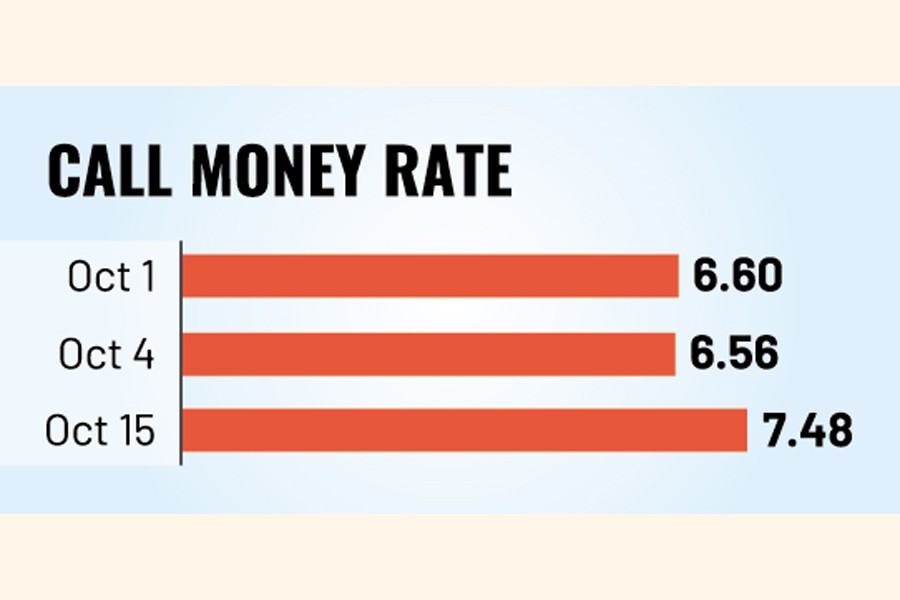
The rate was 6.60 per cent on October 1st, 2023 and it continued soaring to reach a record-high 7.48 per cent on October 15, according to Bangladesh Bank (BB) data.
Even on October 4, the rate was 6.56 per cent but boiled up sharply the following day after the BB raised policy rate by 75 basis points to 7.25 per cent from 6.5 per cent in a bid to tackle inflationary pressure on the economy and resultant price rises.
Weighted average interest rate of the short-term or overnight loan from one bank to another to meet an urgent requirement is called call-money rate.
Bangladesh Bank, the country's central bank, in recent inflation-checking measures curtailed the flow of liquidity support to the commercial banks. At the same time, it stopped supplying 'high-powered money' to meet government budget-financing shortfalls. The two-pronged tightening builds up pressure on banks' liquidity situation, BB sources said.
The call money-rate has been surging since March 21, 2022, when it was 2.05 per cent.
Following the Russia-Ukraine war and the volatility on the foreign-exchange market coupled with mass withdrawal of funds from the banks amid rumours of liquidity shortfall, the demand for the short-term interbank loans kept rising and the rate hit a record high at 7.0 per cent on January 25, 2023.
Banks usually choose the emergency loans to fill the asset-liability mismatch, comply with the statutory CRR and SLR requirements and to meet any sudden demand for funds.
Seeking anonymity, a BB official says the rate has not increased substantially due to the indiscriminate liquidity support to the banks by the central bank through various instruments in the recent days. The instruments are repo, liquidity-support facility, Islami Bank Liquidity Facility (IBLF) and Mudaraba Liquidity Facility (MLS).
As the country goes through a higher inflationary regime, the BB has been curtailing the liquidity support to banks since later last month. "So, the banks are getting 80 per cent of their liquidity requirements,,,," the official says, adding that the recent rise in policy rate also played a major role behind the upward trend in call-money rate.
As the country's commercial banks have been facing difficulties in carrying out regular banking operations amid liquidity dearth mainly because of buying too many US dollars from the central bank to settle their overseas transactions due to persisting forex shortfalls, the BB met major share of government bank-borrowing requirement through supplying the print money to lessen pressure on banks, another central banker said, on condition of anonymity.
But the BB switched over its policy on injection of high-powered or print money into government accounts to rein in growing inflationary pressure.
"So, the issue of government bank borrowing is now completely passed on to the commercial banks and these puts more pressure on the banks' liquidity situation, which is contributing to the rise in call-money rate," he further explains.
When contacted, managing director and chief executive officer of Pubali Bank Limited Mohammad Ali said banks are going through liquidity tightness because of multiple factors, like rising policy rate and no 'devolvement' by the central bank in auctions of government securities.
"As the liquidity requirement is rising because of the fund deficit, the demand for interbank lending keeps increasing," the experienced banker said.
Managing Director and CEO of Mutual Trust Bank Limited (MTB) Syed Mahbubur Rahman says banks would invest more in government securities as this is more secure and effective return is higher, which will reduce lending capacity of the banks.
Also, because of higher returns, institutional and individual investors have already started diverting their funds into the government treasury instruments. At the same time, banks have to buy dollars from BB to meet their import liabilities.
"So, liquidity will be a serious issue in the banking sector in coming days," the banker forecasts, saying that drying out the money market through raising the rates is one of the objectives of the government to control inflation and that is happening now.
According to the BB data, the volume of excess liquidity in the country's banking industry reached Tk 1.80 trillion as of August 2023. It was Tk 2.0 trillion in June 2022.
jubairfe1980@gmail.com