
Call to present common front on arsenic fight
FE Report | Friday, 17 April 2015
Experts have recommended that the government treat the arsenic problem as a multidisciplinary one in a bid to check its adverse health effects and ensure safe drinking water.
They have also urged the policymakers, international development organisations, non-governmental organisations (NGOs) and academics to address the arsenic contamination with due priority as like as disaster management and climate change adaptation.
Experts, researchers, academics and representatives of different organisations made a set of recommendations including those at a consultation on 'linking arsenicosis patients to better treatment facilities' organised by NGO Forum for Public Health recently at DPHE conference room in the city.
Many activities and researches have been carried out while many are going on, they said, adding that the government, NGOs and international organisations are working with a view to mitigating the arsenic problem, but expected result is yet to come for lack of coordination among these initiatives.
To mitigate arsenic problem, they said, combined efforts based on these recommendations need to be made by all the stakeholders.
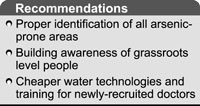
The recommendations include a combined survey to sketch the arsenic scenario in Bangladesh, proper identification of all arsenic-prone areas along with specific arsenic-free aquifer, finding out actual number of arsenic patients, building awareness for grassroots level people on services of community clinic, well-equipped community clinics, need for innovating context-specific sustainable and cheaper water technologies and imparting training for newly-recruited doctors etc.
The experts also suggested that the government utilise the rural public health funds of Annual Development Programme (ADP) to identify arsenicosis patients and ensure better treatment for them.
They said the upcoming seventh five-year plan should concentrate and highlight on arsenic issues and stressed the need for taking stern action against the authorities responsible for installing tube-wells without arsenic test.
They called for formation of a national management committee to identify the level of necessary tasks in various stages to mitigate arsenic problem. Policy Support Unit (PSU) recently accumulated 148 arsenic related researches conducted during the period between 2009 and 2014. The findings from these researches will be disseminated and utilised properly.
The experts also put emphasis on proper implementation of 'National Policy for Arsenic Mitigation 2004 and Implementation Plan for Arsenic Mitigation'.
The NGO forum said tube-wells in rural areas have been identified with high arsenic concentration which is alarmingly higher than the standard set by the World Health Organisation (WHO) and many more areas are feared to have been contaminated with the same.
It is estimated that 7.5 million people are facing arsenic related health risks while 2.4 million people are the victims of potential arsenic contamination.
Arsenicosis patient management still portrays a vulnerable picture of rural health services in Bangladesh where study shows 48 per cent of the arsenic-affected patients were found to remain out of any treatment facilities.
Though 65,910 arsenicosis patients are registered, but more than 50 per cent of patients remain unregistered for poverty, ignorance, lack of information, superstition and other social facts, according to the data of Directorate General of Health Services (DGHS).
doulot_akter@yahoo.com