
Can we learn from Nepal quakes?
Rana Datta | Thursday, 14 May 2015
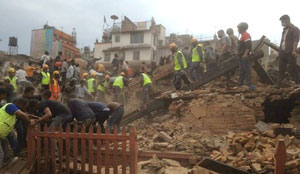
The earthquakes in Nepal on April 25 and May 12 give a cautionary signal for Bangladesh. Despite the fact that buildings are collapsing here and there and experts are declaring Bangladesh prone to earthquake risks, do we really care?
Bangladesh is situated adjacent to the plate margins of India and Eurasia where devastating earthquakes occurred in the past. It means we are not in a safe zone. Historical seismic catalogues (ISET, 1993) reveal that Bangladesh has been affected by earthquake disasters since ancient times. Earthquakes occurring in 1664, 1828, 1852 and 1885 are shown to have Dhaka at the epicentre.
By close examination of the seismic maps, it is clear that north-eastern Bangladesh are more vulnerable to earthquake hazards than the central, eastern, southern, south-western and western regions of the country. The most vulnerable cities in the northeast are Mymensingh, Kishoreganj and Sylhet. The north-western, central and south-eastern cities, which include Dinajpur, Rangpur, Dhaka, Comilla, Chittagong and Cox's Bazar, are comparatively less vulnerable than those cities. The south-western and western cities like Rajshahi, Faridpur, Khulna, Barisal etc are the least vulnerable. But Dhaka having 15 million people, the most congested urban population, will be the worst affected.
Here we cannot but remember the industrial accident that was the worst possible man-made human disaster causing death to 1,129 garment workers apart from maiming and seriously injuring hundreds of others at the Rana Plaza of Savar. This disaster took place due to collapse of a building which was very poorly designed and poor-quality materials were used. Therefore, it is not beyond the wildest dream that many more buildings of such poor structural design will collapse. We definitely need some specific equipment to rescue the people from any collapsed buildings. But, the question is--are we prepared or well-equipped to meet the challenge?
Geographically, Bangladesh is an earthquake-prone country; its northern and eastern regions in particular are known to be prone to earthquakes of magnitudes greater than 5 on the Richter scale as per the geologists' prediction. They also predict that the geotectonic set-up of the country, which is located along two of the planet's active plate boundaries, suggests high probabilities of damaging future earthquakes and the possibility of rarer but extraordinarily large earthquakes that can cause damage far from their epicentres.
As earthquake hazards have been the prime concern of structural engineers for many years not only in Bangladesh but also in the rest of the world, advanced research has been and is being carried out throughout the world to make structures earthquake-resistant. It is a great threat to us that Bangladesh lies in the vicinity of the world's loftiest mountain range, the Himalayas and is well within an active tectonic zone.
The Bangladesh National Building Code 1993 (BNBC-93) has been studied. It has been compared with Uniform Building Codes, 1991 and 1997 (UBC-91 and UBC-97), National Building Code of India, 1983 (NBC India-83), and Outline Code of Bangladesh, 1979. The study reveals that the developed countries have increased the safety against earthquake by suggesting higher values of base shear. But the BNBC is the least conservative as compared to other codes and practices. This may have serious implications in a major earthquake in the country. Wind analysis of BNBC is quite similar to those of other codes.
To determine earthquake impacts on a structure, static analysis has gained popularity in many countries, including Bangladesh, because of the simplicity of the method. This calls for the use of an established and tested building code so as to ensure the safety of the structure and its occupants against the natural hazard.
But, due to the lack of sophisticated earthquake monitoring equipment and facilities in Bangladesh, the level of earthquake activities in the country is poorly defined. As a result, data on micro-seismicity is totally missing, although such activities are quite frequent.
As per the Town Improvement Act 1953 (TI Act 1953), Rajdhani Unnayan Kartipakkha (RAJUK) is the legitimate authority to prepare land use plans, take care of implementation process and control development and manage the growth of Dhaka. But in reality, RAJUK only ensures if the design and planning are being followed during a construction. They never investigate the quality of construction materials used.
Damage during an earthquake results from several factors: Strength of shaking, length of shaking, type of soil, type of building, and resonance frequency of building.
Therefore, the above-mentioned damaging factors put an impact on the following facts: Life and Society, Property (Buildings, structures and their contents), Civic Amenities, Lifeline facilities, Heritage, and Economy and development
To reduce the damage of earthquake, we have to follow the following guidelines:
During the earthquake, if indoors:
- Keep calm and do not rush out in panic,
-Drop to the ground;
-Turn off gas, electricity and water supplies;
-Supporting the shelving, fixing tall furniture to the wall and keeping items low and safe;
-Take cover by getting under a sturdy table or other pieces of furniture;
-Hold on until the shaking stops. If there isn't a table or desk near you, cover your face and head with your arms and crouch in an inside corner of the building;
-Stay away from glass, windows, outside doors and walls, and anything that could fall, such as lighting fixtures of furniture;
-Stay in bed if you are there when the earthquake strikes;
-Hold on and protect your head with a pillow, unless you are under a heavy light fixture that could fall;
-Recognising the shelters and their routes both at home and nearby;
-Recognising the place of switch for gas and electricity and how to turn off;
-Stay inside until the shaking stops and it is safe to go outside. Research has shown that most injuries occur when people inside buildings attempt to move to a different location inside the building or try to leave. Be aware that the electricity may go out or the sprinkler systems or fire alarms may turn on. Do not use the elevators but use the stairs.
During the earthquake if outdoors:
-If you are driving a car or riding a bike, do not stop immediately.
-If you are walking in the street, run into an open space or the pedestrian corridor.
-Keep away from the gas station, glass curtain wall, vending machine, electric pole and construction site, etc.
-Look out for any possible objects falling from above and put your arms on your head.
-If you are on a bus or a train, do not panic and jump outside.
-If you are in a suburb, stay away from the hill, riverside and seaside and find an open space for shelter.
-If you are on a viaduct or an underground passage, walk away calmly and immediately.
After the earthquake:
-Beware about the effect of aftershock.
-Help each other for the disaster rescue.
-Check electric power and gas supply.
-Listening to the radio or watching TV any time and escaping from any rumour.
-Do not use the telephone unless somebody has been injured or a building is damaged or burning. The emergency services may need all lines for the rescue.
-Inspect the house for cracks.
-If the gas pipeline is damaged or there is a smell of gas, do not use any gas or electric devices. Open the doors - leave the house immediately and report to the authority.
Action after earthquake disaster: Post-earthquake, quick damage inspection of buildings is the first essential step to mitigate the secondary disaster caused by aftershocks. The purpose of this inspection is to quickly inspect and judge the risk of collapse of damaged buildings or fall of building components due to aftershocks and to inform the habitants about the safety of their houses as soon as possible. The result of quick inspection also provides the basic information to estimate the number of temporary houses and refuge centres necessary for the displaced people.
The following facts tell us why Dhaka city is one of the most vulnerable cities in Bangladesh, if any major earthquake occurs:
-Population of Dhaka: 15 million and one of the fastest growing cities in the world
-Widespread poverty
-More than 28 per cent live below the poverty line
-More than 3.4 million citizens live in slums
-30 per cent lack access to sanitation services
-Challenges of rapid urbanisation
-Uncontrolled rural to urban migration
-Lack of land-use planning
-Dearth of government regulations and building standards
-Complex governance structures
-Overlapping authority in urban planning
-Political conflict leads to lack of decision-making
According to experts, Bangladesh is not well prepared to tackle the aftermath of any strong earthquake. Five geological fault lines run through the country, exposing it to major quakes. They also suspect that if an earthquake with a 7.0 magnitude occurs in any large city, there would be a major human tragedy due to the faulty structures of many buildings. Among the cities, Sylhet is the most vulnerable to earthquake. Located on two fault-lines, Sylhet also ranks among the 20 cities most vulnerable to earthquake in the world.
It is high time the government made people aware about earthquake through television programmes and also by other mass media. It will also be an ideal notion to arrange earthquake demonstration so that people can learn how to escape to a safe zone.
The writer is Senior Assistant Secretary of BKMEA.
ranaduttabkmea@gmail.com