
Cancer treatment in sorry state
FE Report | Thursday, 5 February 2015
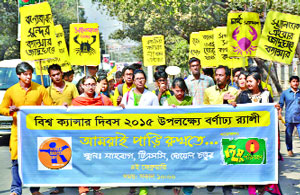
Cancer treatment facilities are in a disturbingly poor state in the country compared to the growing number of patients, now at 1.4 million, as the government does not consider it a priority area.
According to the unofficial data, the number of total centres with cancer treatment facilities is only 15 against the requirement of 160 (one per million).
Of the 15 centres, nine are in the public sector and six in the private sector. But the treatment cost is 20 times higher at the private hospitals than at the government ones. That's why the pressure of cancer patients has been increasing day by day at the nine public hospitals, experts have said.
Most of the equipment and machinery used for cancer treatment are out of order. Even the radio therapy machines are not available at all medical colleges.
According to sources, there are only 100 cancer specialists in the country. Of them, 60 work in public hospitals and the rest in private centres. All of them live in the capital.
Against this backdrop Bangladesh observed the World Cancer Day 2015 on Wednesday. The day was observed with the theme of the day being 'Not beyond us', taking a positive and proactive approach to the fight against cancer and highlighting that solutions do exist and that they are within our reach.
Different organisations including Bangabandhu Sheikh Mujib Medical University (BSMMU), National Institute of Cancer Research and Hospital and other private hospitals and social organisations have organised various programmes to observe the day.
According to the data of World Health Organisation (WHO), globally one out of every 180 people has been affected with cancer. There are 1.4 million (14 lakh) cancer patients in the country and 0.25 million (2.5 lakh) new cancer patients add to the figure every year. Of them, 0.15 million die.
National Institute of Cancer Research and Hospital director Dr Moarraf Hossain told the FE that there should be one cancer treatment centre for every one million people. But as a poor country, Bangladesh should have at least 30 centres.
"We provide treatment to 500 patients daily. But we cannot treat any patient who needs emergency treatment due to excessive pressure," he said.
Mr Hossain also said cancer is the second deadliest killer in the non-communicable disease category and the scope for being exposed to various cancerous elements is increasing day by day.
For that reason, the sector needs special attention to areas including increasing the number of treatment centres, installation of modern treatment equipment and machinery, increasing the number of cancer specialists, nurses and technicians, he added.
According to data, 66 per cent of the cancer patients are aged between 30 and 65 years. Most of these patients are affected with lungs, oral, cervical and breast cancer. Thirty per cent of the women patients are affected with cervical cancer. About 50 per cent of the cancer patients can be cured, if the disease can be detected at an early stage, experts say.
msshova@gamil.com