
Cassava farming brings fortunes for farmers
Mohammad Wazed Ali, back from Tangail and Habiganj | Tuesday, 10 January 2017
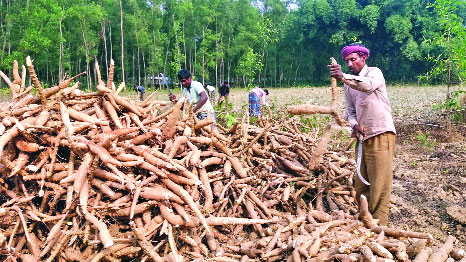
Cultivation of cassava, popularly known as 'Shimul Alu', is getting popular among the farmers as demand grows for producing starch used in food processing and pharmaceuticals.
Starch is a carbohydrate which is a major form of stored energy in plants, especially maize, cassava, corn and wheat.
Farmers are now showing more interest in cassava cultivation because its prices have increased significantly. It can be cultivated in fallow lands and hilly areas with low cost and labour as it requires a little irrigation, fertiliser and insecticides.
During a recent visit to Mymensingh and Tangail district, this correspondent found farmers busy with harvesting of cassava which was then being taken by representatives of various companies.
"Around 6-8 ton cassava can be produced per acre of land. We sell it at Tk 7,000 per ton and cost per acre is around Tk 18,000 to Tk 20,000. Thus, we can earn Tk 20 to 25 thousand per acre," said Hanif Mollah, a farmer of Modhupur in Tangail district.
He said cassava cultivation is now lucrative as its prices have increased several times.
"Once we could sell cassava at Tk 1,500 per ton. Two to three years ago, we sold it at around Tk 6,000 per ton but now Pran is buying cassava from us at Tk 7,000 per ton," he added.
Salim Ahmed, also a farmer of the area in Tangail, told the FE that they are gradually expanding cassava cultivation as they are getting good prices and there is a huge response from companies.
Chief operating officer of PRAN Agro Business Ltd Mahtab Uddin said once farmers knew a little about cassava cultivation and its lucrative sides but Pran came forward with different assistance schemes to boost production of this root crop.
"The farmers get Tk 17,000 interest-free loans from us for per acre cassava farming with buy-back guarantee against their crops," he added.
This year, about 5,000 farmers cultivated cassava on 3,700 acres of land under PRAN's contract farming in Mymensingh, Jamalpur, Tangail, Habiganj, Comilla and Khagrachhari districts.
Mr Mahtab Uddin said this year they have a plan to collect 20,000 to 22,000 tons of cassava from 3,700 acres of land.
"But from next year, we aim at cultivating 10,000 acres of land and have a plan to collect around 60,000 tons of cassava," he added.
He said PRAN set up a cassava processing plant in Habiganj Industrial Park in Shaistaganj of Habiganj district which has the capacity to process around 60,000 tons of cassava per year. The company has a plan to use its full capacity to meet demand of starch and glucose of different industries.
General Manager of Pran Habiganj Industrial Park Manzurul Haque told the FE that there is a huge demand and supply gap of starch where cassava can play a crucial role.
He said starch of cassava can be used as a raw material for processing food like bread, cake, biscuit, and noodles. Besides, it is also being used in garment and pharmaceutical industries.
Around 50 per cent of starch is being imported from China, India and Thailand to meet the demand of starch in various sectors, he added.
He said quality of starch from the country's cassava is even better than that of China, India and Thailand. So, Pran is focusing on ensuring quality starch and lessening its import dependency by providing assistance for cassava cultivation.
"Now cassava is harvested once a year but Pran is trying to cultivate it twice a year by supplying high- yield seeds to farmers and providing scientific methods," he added.
The company is trying to improve the tuber crop by carrying research at its laboratory in Narsingdi. The company also has signed a memorandum of understanding with the Bangladesh Agricultural University to promote cassava cultivation in the country.
To reduce cost in cassava farming, PRAN has also brought modern harvester and planter machine from Thailand. The company is providing organic fertiliser to increase production and fertility of the land so that production can be increased which in turn will boost cassava output, reduce import dependency and increase farmers' income.
Appropriate time of planting and harvesting cassava is November to December. Cassava plants' height is 5 to 9 feet. However, the land should be water-resistant. Its leaf and remaining portion also can be used as compost fertiliser on farmland.
wazeddu@yahoo.com