
Cheaper imports make turf uneven for rubber growers
Pankaj Dastider | Monday, 16 March 2015
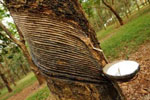
CHITTAGONG, Mar 14: Rubber growers are in an extremely difficult situation as a large quantity of finished rubber is lying unsold in the gardens in Chittagong and in the Hill Tracts due to discrepancy in taxes on local production and imports.
The disparity in taxes has caused an uneven competition for the growers in the domestic market, growers have said.
Their demand for parity in taxes to accelerate rubber production locally remains resolved.
At least 650 tonnes of finished rubber remains unsold in only three gardens in Raozan upazila of Chittagong. Growers said production of rubber was facing a serious setback due to a drastic fall in prices of local rubber and some of them were not in a position to pay up the wages of their workers.
They said 398 tonnes of processed rubber in Haldia Rubber Garden, 185 tonnes in Dabua Rubber Garden and 67 tonnes in Raozan Rubber Garden-all three are in Raozan upazila - remain unsold currently due to low import cost and import prices.
There is a high demand for rubber in the international market. Besides, about 450 industries are dependent on rubber as the raw material in the country. But the sector has so far been neglected by the government as nothing has been done to remove the impediments and make this sector viable, rubber garden owners have said.
Finished rubber is now selling between Tk 100 and Tk 120 per kg against Tk 300 to Tk 320 per kg two years back.
"We are not getting parties to sell rubber even at this low price, because they are bent on importing it from Vietnam and other countries as the import duty is very low," said manager of a rubber garden at Raozan.
Rubber growers alleged that the discrepancy between local production of rubber and import of the same was created after 2010 when the government imposed a total of 24 per cent tax on the local rubber producers.
Rubber growers are paying 15 per cent VAT (value added tax), 5.0 per cent income tax and 4.0 per cent tax on other services while the importers are required to pay only 5.0 per cent duty on import of finished rubber.
Growers have urged the government to exempt VAT and other taxes on the local rubber production and declare it as an agricultural product.
"The tax rate on local production of rubber is much higher than that on import. So, the local producers are facing financial losses and an uneven competition. Taking this advantage many businessmen in the sector are attracted to import rubber rather than producing it," said private rubber garden owner Salimul Haque Chowdhury.
"The government has taken several measures for development of production of paddy, wheat and jute but there is no step on this potential cash crop. The governments in India, Vietnam and Thailand have offered huge financial and infrastructural support including subsidy but there is no such facility for rubber cultivation in the country," he said.
Rubber is cultivated in an area of over 0.1 million (one lakh) acres of land owned by Bangladesh Forest Industries Development Corporation (BFIDC), Chittagong Hill Tracts Development Board and privately-owned rubber gardens but infrastructure in the rubber cultivation area is very poor.
Late Dr Moqsudul Alam, who invented gene of rubber and was an expert working on it throughout his life, also urged the government to consider rubber as an agricultural product, he said.
Relating to the disparity in tax Mr Haque said Finance Minister Abul Maal Abdul Muhith admitted the discrepancy in taxes and recently sent a demi official (D/O) letter to the National Board of Revenue (NBR) with instructions to resolve it.
In a letter to the Prime Minister the rubber gardeners in December last urged that rubber import be suspended and the sector be provided with all facilities of the agriculture sector, because rubber cultivated in the country can meet the national demand entirely and a good amount of finished rubber can also be exported.
pankajdastider@gmail.com