
WEEKLY KITCHEN MARKET REVIEW
Chicken, beef still pricey; soybean oil crunch persists
FE REPORT | Saturday, 28 March 2026
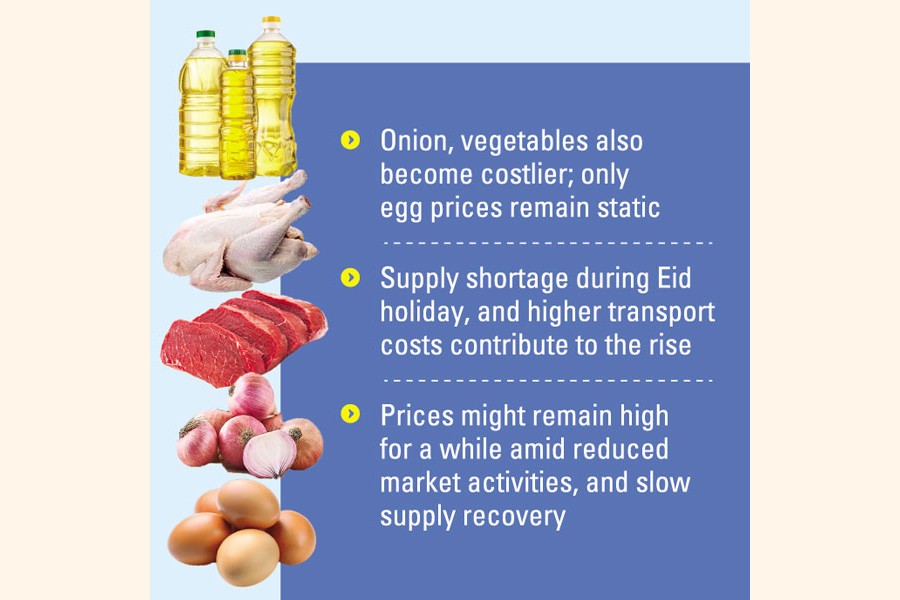
Prices of chicken, beef and mutton remained high in the capital's kitchen markets, while the shortage of bottled soybean oil also persisted, reflecting continued supply constraints despite the end of Eid-ul-Fitr holidays.
A visit to several city markets on Friday showed that normal trading was yet to begin, with many shops still closed and customer turnout remaining low.
Broiler chicken was selling at Tk 200-220 per kg, slightly lower than Tk 230-240 before the Eid festival. Sonali chicken prices remained high at Tk 360-400 per kg.
Beef prices stood at Tk 820-850 per kg on Friday, up from Tk 800-820 a week before the Eid, while mutton was selling at Tk 1,200-1,300 per kg.
Traders said higher demand during the festival and slow recovery in supply from the rural areas kept meat prices elevated, a pattern often seen during the peak demand period.
Faridul Alam, a vendor at Adabor Bazar in the city, said prices might remain high for a few more days. With the Eid-ul-Azha ahead, meat prices might not decline, if cattle prices stay firm.
Egg prices, however, remained static, with farm eggs selling at Tk 110-115 a dozen.
Traders said onion prices increased slightly to Tk 45-55 per kg from Tk 40-45 before the Eid due to lower supply during the holiday. Transport disruptions and reduced market activities contributed to the rise.
Prices of several vegetables also increased. Brinjal was sold at Tk 70-100 per kg, cucumber at Tk 50-60 per kg, and tomato at Tk 50-60 per kg - each marking a Tk 10-20 per kg hike.
Other vegetables, including local beans and carrot, were sold between Tk 45 and Tk 60. Okra, snake gourd and sponge gourd were retailed at Tk 80- 100 per kg, a Tk 20 per kg hike after the Eid.
Md Jahid, a vendor at Mohammadpur Agricultural Market, said supply shortage during the Eid holiday and higher transport costs pushed up prices.
Meanwhile, the crisis in bottled soybean oil persisted, with most grocery shops lacking one- or two-litre bottles. Consumers often had to search multiple shops to find bottled oil amid the ongoing supply disruption.
Some retailers were selling each one-litre bottle at Tk 205-210, while loose soybean oil prices rose to Tk 190-195 per litre from Tk 180-185 two weeks ago, indicating continued upward pressure on edible oil prices.
Meanwhile, UNB adds, fruit prices in Dhaka have fallen significantly after the Ramadan and the Eid holidays, with several imported varieties dropping by more than Tk 100 per kg within just a few days, offering some relief to consumers.
A visit to major wholesale and retail markets - including Badamtoli, Karwan Bazar, Rampura, Badda and Shantinagar - on Friday found that prices of most imported fruits have eased notably from their Ramadan peaks.
Malta, which was sold at Tk 350-380 per kg during Ramadan, is now priced at Tk 280-300. Before the Ramadan, it ranged between Tk 260 and Tk 280 per kg.
Apple prices have also declined, currently selling at Tk 300-340 per kg depending on the variety, down from Tk 350-400 during the fasting month.
However, prices remain slightly above the pre-Ramadan range of Tk 280-320.
Oranges are now being sold at Tk 380-400 per kg, compared to Tk 420-450 during the Ramadan, while earlier prices hovered between Tk 340 and Tk 350.
Among other imported fruits, pomegranate prices have dropped to Tk 450-500 per kg from Tk 580-600 during the Ramadan, though still higher than the pre-Ramadan range of Tk 400-480.
Pear has seen one of the sharpest declines, falling by around Tk 150 per kg to Tk 350, down from Tk 500 during the Ramadan.
In the grape market, black grapes are selling at Tk 500 per kg, red grapes at Tk 450, and green grapes at Tk 400, while most varieties had exceeded Tk 500 during the Ramadan.
Locally grown fruits have also become more affordable.
Ripe papaya is now priced at Tk 70-120 per kg, down from Tk 140-180, while guava prices have fallen to Tk 70-100 from Tk 120-150.
Watermelon, which entered the market during the Ramadan, is now being sold at around Tk 50 per kg, down from Tk 100 at the start of the season.
Traders attributed the fluctuations largely to wholesale market dynamics, particularly at Badamtoli, the country's key fruit hub.
Some alleged that a syndicate-like mechanism influences prices at the wholesale level which in turn affects retail markets.
A fruit seller in Badda said retail prices often rise by around Tk 50 per kg after sourcing from wholesalers.
Another trader noted that prices at Badamtoli are frequently determined through pre-arranged auctions, limiting competition.
Consumers said despite the recent decline, prices have yet to fully return to pre-Ramadan levels.
They urged stronger market monitoring and greater competition to help stabilise fruit prices in the capital.
tonmoy.wardad@gmail.com