
China launches infrastructure bank
FE Report | Saturday, 25 October 2014
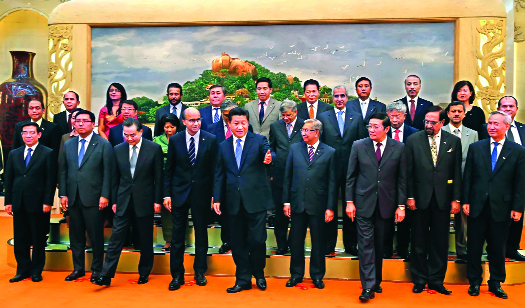
Twenty-one Asian countries, including Bangladesh, signed a memorandum of understanding (MoU) Friday in Beijing to launch the US$100 billion China-led Asian Infrastructure Investment Bank (AIIB), an alternative multilateral lender.
The 20 other founder-members are Brunei, Cambodia, China, India, Kazakhstan, Kuwait, Laos, Malaysia, Mongolia, Myanmar, Nepal, Oman, Pakistan, the Philippines, Qatar, Singapore, Sri Lanka, Thailand, Uzbekistan and Vietnam.
Economic Relations Division (ERD) officials said visiting State Minister for Finance MA Mannan inked the deal on behalf of Bangladesh.
A top ERD official told the FE Friday: "Now the prospective founding-members who signed the MoU will sit for discussions to confirm their stakes in the proposed $100 billion multilateral bank. Bangladesh will try to become a key member of the Bank."
The official said the founder-members would complete the signing and ratification of the Articles of Agreement in 2015 and AIIB will be formally established by the end of the next year.
AIIB is conceived as an inter-governmental regional development institution in Asia, which is being launched despite reported dissent from the United States.
As agreed, Beijing will be host city for AIIB's headquarters.
The world's second-largest economy, China, took initiative to set up the AIIB as an alternative to the World Bank and the Asian Development Bank (ADB) to ensure adequate financing for developing infrastructures of the poorer and developing countries, especially for the countries in Asia.
In early August, Beijing had formally invited Dhaka to join the bank. Bangladesh on September 5 participated in the Chinese government- organized "multilateral information-sharing meeting" on the proposed bank.
The ERD officials said the MoU specifies that the authorized capital of AIIB will be $100 billion and the initially-subscribed capital is expected to be $50 billion.
Three countries-Australia, Indonesia and South Korea-avoided signing the MoU Friday although they earlier had expressed interest in participating in the Beijing ceremony.
After the accord signing, Chinese Finance Minister Lou Jiwei said the AIIB is open and welcomes all countries that are committed to Asia's development in particular alongside global economic development.
He said the consultation process of AIIB follows the sequence "regional first and non-regional later."
Countries that signed the Memorandum of Understanding on Establishing AIIB Friday are all regional countries in Asia and will be the first batch of prospective founding-members.
"These regional Prospective Founding Members will begin the negotiation of the Articles of Agreement (AOA) thereafter. Other countries can also become Prospective Founding Members and join the process of negotiating AOA if they endorsed this MOU and be accepted by the existing Prospective Founding Members," he told the function.
Meanwhile, World Bank country director in Bangladesh Mr Johannes Zutt, in reply to a question, had recently said that they welcomed initiative for setting up the AIIB. "But it should maintain high-standard and feasible safeguard policies."
Financial analysts in Bangladesh have welcomed the initiative of setting up the AIIB as they see the proposed bank as an alternative multilateral lending institution for developing infrastructure.
Dr Zaid Bakht said AIIB could be a parallel multilateral regional bank like the existing ADB for helping the poor and developing countries in boosting their infrastructures and cutting hunger.
"Since Bangladesh needs huge investment in improving its infrastructure, the AIIB could be another options alongside the World Bank and ADB for getting concessional funds," he added.
Meanwhile, Brazil, Russia, India, China and South Africa (BRICS) had also announced that they would form a US$50 billion multilateral bank soon.
Bangladesh has also decided to join the new initiative of the BRICS nations.
Bangladesh is already a member of the World Bank and the ADB which are helping the country in reducing poverty and upgrading infrastructure.
Meanwhile, agencies reported that Australia, Indonesia and South Korea skipped the launching ceremony in Beijing as the United States aired concerns about the new rival to the Western-dominated multilateral lenders, report agencies.
The China-proposed bank is seen as a challenge to the World Bank and the Asian Development Bank, both multilateral lenders Washington and its allies count as their biggest financial backers, reports Reuters.
"China, which is keen to extend its influence in the region, has limited voting power over these existing banks despite being the world's second-largest economy," said one report.
Media reports said US Secretary of State John Kerry put pressure on Australia to stay out of the bank.
However, State Department spokeswoman Jen Psaki said: "Secretary Kerry has made clear directly to the Chinese as well as to other partners that we ?welcome the idea of an infrastructure bank for Asia but we strongly urge that it meet international standards of governance and transparency.
"We have concerns about the ambiguous nature of the AIIB proposal as it currently stands, that we have also expressed publicly."
The Australian Financial Review said on Friday that Kerry had personally asked Australian Prime Minister Tony Abbott to keep Australia out of the AIIB.
"Australia has been under pressure from the US for some time to not become a founding member of the bank and it is understood Mr Kerry put the case directly to the prime minister when the pair met in Jakarta on Monday following the inauguration of Indonesian President Joko Widodo," the paper said.
South Korea, one of Washington's strongest diplomatic allies in Asia, has yet to say it will formally participate in the bank.
"We have continued to demand rationality in areas such as governance and safeguard issues, and there's no reason (for Korea) not to join it," South Korean Finance Minister Choi Kyung-hwan said in Beijing Thursday.
Earlier this month, commenting on reports that there was pressure from Washington to stay out of the AIIB, the South Korean finance ministry said: "South Korea has not delayed its participation but has been negotiating with China because it thinks more consideration is necessary on details of the planned bank such as the AIIB's governance and operational principles."
kabirhumayan10@gmail.com