
China\\\'s rate-cut likely to hurt banks, curb new loans to small borrowers
Engen Tham of Reuters in Shanghai | Monday, 24 November 2014
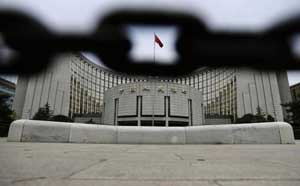
China's latest interest rate cut is set to dent the profitability of domestic lenders, especially mid-sized banks, which are already suffering from higher bad loans and a slowdown in profit growth.
The central bank unexpectedly cut rates late on November 21, stepping up efforts to support small and medium-sized enterprises (SMEs) which are struggling to repay loans and access credit, as the economy slides to its slowest growth in nearly a quarter of a century.
It slashed the one-year benchmark lending rate by 40 basis points to 5.6 per cent while lowering the one-year benchmark deposit rate by 25 basis points to 2.75 per cent.
The narrowing of interest rate margins will eat into lenders' profitability, with Cinda Securities' chief strategist, Jiahe Chen, predicting it will cut profits by up to 5.0 per cent.
Interest margins generated from lending have already been shrinking for second-tier lenders, which have been squeezed by competition from online financiers and a rise in funding costs stemming from an industry tussle for deposits.
Fitch Ratings downgraded its credit rating of China Guangfa Bank, a medium-sized lender, two days before the rate-cut announcement, and said the level of off-balance-sheet lending among second-tier banks was a concern.
The squeeze on profits will make it tougher for lenders to raise capital to meet new international rules designed to protect depositors from banking collapses. Retained profits are one way in which banks can build up regulatory capital.
"In the past when Chinese banks disburse loans, they mainly relied on profits from their own capital to replenish their capital," Jiang Jianqing, chairman of China's biggest commercial bank, the Industrial and Commercial Bank of China Co Ltd, told a conference in Beijing on November 22.
The People's Bank of China said in announcing the rate cut that it wanted to help smaller firms gain access to credit.
While the measures may ease the financing costs of these firms' existing loans, it is unlikely to encourage banks to write new loans to lower-rung borrowers, bankers said.
Smaller companies are considered high risk and banks do not want to increase their exposure to weaker borrowers, they said.
"At the moment banks have a lot of problems with them, they have higher rates of default ... we're suspicious of their creditworthiness, so we're very careful about lending to them," said a senior loan officer at a top-10 bank.
He declined to be identified because he was not authorised to speak to the media.
Among China's five largest banks, lending will continue to favor China's state-controlled companies, state-invested enterprises and those involved with large projects overseen by the government, bankers added.
In the third-quarter, China's banks reported rising bad loans and slowing profit growth, amid fears that a credit crunch could spread further.
"We've been moving away from SME lending over the last two years in my department. We won't start lending now," said another senior loan officer at one of the country's top five banks.
Meanwhile, Satellite images show China is building an island on a reef in the disputed Spratly Islands large enough to accommodate what could be its first offshore airstrip in the South China Sea, a leading defense publication said on November 21.
The construction has stoked concern that China may be converting disputed territory in the mineral-rich archipelago into military installations, adding to tensions waters also claimed by Taiwan, Malaysia, the Philippines, Vietnam and Brunei.
IHS Jane's said images it had obtained showed the Chinese-built island on the Fiery Cross Reef to be at least 3,000 meters (1.9 miles) long and 200-300 meters (660-980 ft) wide, which it noted is "large enough to construct a runway and apron."
The building work flies in the face of US calls for a freeze in provocative activity in the South China Sea, one of Asia's biggest security issues. Concern is growing about an escalation in disputes even as claimants work to establish a code of conduct to resolve them.
Dredgers were also creating a harbour to the east of the reef "that would appear to be large enough to receive tankers and major surface combatants," it said.
Asked about the report at a defense forum in Beijing on November 22, Jin Zhirui, a colonel with the Chinese air force command, declined to confirm it but said China needed to build facilities in the South China Sea for strategic reasons.
"We need to go out, to make our contribution to regional and global peace," Jin said. "We need support like this, including radar and intelligence."
The land reclamation project was China's fourth in the Spratly Islands in the last 12 to 18 months and by far the largest, IHS Jane's said.
It said Fiery Cross Reef was home to a Chinese garrison and had a pier, air-defense guns, anti-frogmen defences, communications equipment, and a greenhouse.
Beijing has rejected Washington's call for all parties to halt activity in the disputed waters to ease tension, saying it can build whatever its wants in the South China Sea.
Hong Kong media have reported that China plans to build an air base on Fiery Cross Reef. In August, the deputy head of the Chinese Foreign Ministry's Boundary and Ocean Affairs Departments said he was unaware of any such plans.