
Choosing reform, remembering July, securing the Republic
Serajul I Bhuiyan | Wednesday, 21 January 2026
On February 12, Bangladesh faces a question of profound historical importance one that goes beyond the usual trappings of election politics and into the very moral foundations of the republic itself. The people will not only elect their representatives; they will also be called upon to respond to a more profound question of constitutional moment: whether the moral power of the July 36 Revolution will be given expression in irreversible democratic guarantees, or whether, once again, the door will be left ajar for authoritarianism to slip back into the state quietly, legally, and incrementally.
Far from a symbolic gesture or an elitist construct, this referendum is the essence of a people who took a stand against fear, impunity, and exclusion and a people who paid a high price of blood and pain for their sovereignty over their political future. At its roots, this referendum is a statement of a radical principle: sovereignty lies with citizens, not with untrammeled power. February 12 is more than an election day; February 12 is a constitutional moment of reckoning.
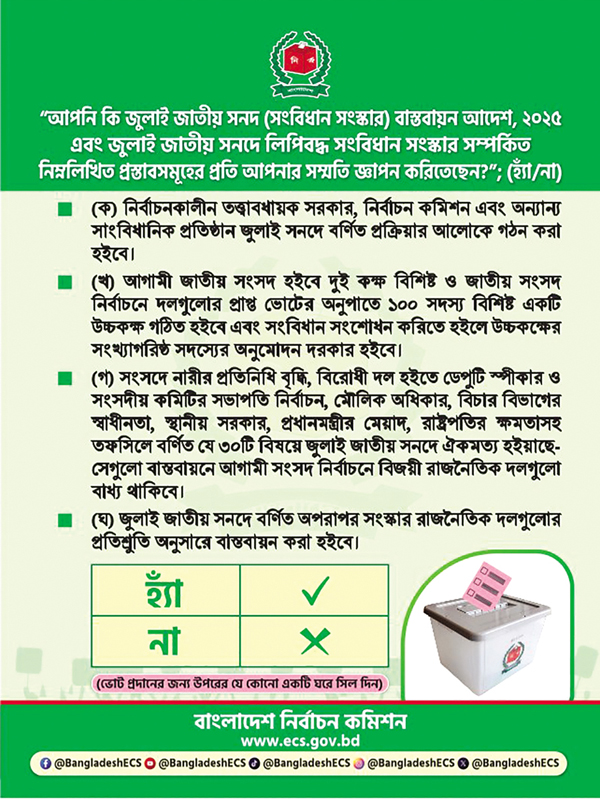
Why the referendum counts: The lesson from history remains grim. The reason for the failure of revolutions has nothing to do with the loss of courage, but the structure of power remains. This has also been the case in Bangladesh, where people power has compelled political transitions, but the structure has remained the same. This has led to the same cycle: elections have been held, parliaments established, and constitutions referred to, yet power has continued to be consolidated.
The referendum specifically addresses this weakness. The referendum aims to translate the moral power of July into a set of constitutional guarantees to will into being. “Yes” voters express the conviction that democracy must be crafted, not simply willed. They recognise the tough lesson of the past fifty years: Elections alone cannot secure freedom if the agencies of observation are flexible, the police force is politicized, and accountability is discretionary.
In fact, the referendum serves as a democratic firewall by incorporating safeguards into the constitutional order. The referendum establishes an institutional memory within a political culture which is often characterized by amnesia to prevent past failures from simply being repackaged as future stability.
From sacrifice to statecraft: The July 36 Revolution was not a moment of blind fury. It was a collective gesture of outrage at a system that had closed all the democratic channels, made votes meaningless, squashed all opposition, and made impunity the norm. The sacrifices of the July 36 Revolution deserve more than just memorials.
However, the best memorial remains an affirmative vote. It will ensure that July is not just an interruption in the series of elite settlements but the start of a new political era. The referendum turns mourning into governance by codifying safeguards against the misuse of power and the trampling of civil liberties. To squander this opportunity is to turn a turning point in history into a tragedy, another installment in the book of lost opportunities. The “Yes” vote means that Bangladesh will choose change over the known comforts of stagnation, and democracy over the convenience of control.
The reform vision: The reform agenda to be adopted in the referendum is based on a set of principles that have long been a hallmark of Dr Yunus’s philosophy: democracy fails when power is wielded by institutions not guided by principle. Based on the experiences of a country like Bangladesh, the reform agenda emphasizes the need for independence, transparency, and accountability as non-negotiable democratic principles.
This is neither a personality project nor an act of partisanship. This is state-building through institutional transformation building institutions strong enough to outlast any leader or political party. This is to ensure that future administrations, regardless of their political stripe, operate within a framework they cannot easily manipulate.
A ‘Yes’ vote, then, is an investment in democracy with depth. It is an investment in an ethical vision of governance, one in which prioritization is done as follows: prioritize restraint over domination, prioritize law over loyalty, and prioritise citizenship over convenience.
The price of ‘NO’: ‘No’ will not just postpone change; it will also break the bridge between the sacrifices of July and the republic’s constitutional future. It will preserve the same flaws that made repression, manipulation, and the abuse of power. It will mean that the lessons of the past have not been learned.
Such a course of events would embolden those accustomed to living amid ambiguity and the weakness of institutions. Without the safeguards of the Constitution, the politicised administration and the compliant oversight agencies would once again be the order of the day. Regression rarely comes in the form of tanks; it often marches under the guise of legal technicalities and the fatigue of the citizenry.
In this situation, July might be remembered not as a time of change but as an interlude.
Core principles at stake: Essentially, the referendum is meant to address the structural imbalances that have undermined democratic rule in Bangladesh over the years. Chief amongst these is the need to depoliticise the state. It is inconceivable that a democratic republic can be sustained when the civil service, the law-and-order machinery, and regulatory institutions become appendages of political power. The referendum is meant to place such institutions back on track as non-partisan protectors of the public weal.
Another important aspect is promoting accountability. Without the investigation and punishment of corruption, abuse of power, and election manipulation, democracy becomes but a mere illusion because of fear and intimidation. This is because the reform is intended to give power to truly independent institutions to carry out their mandates without fear of intimidation and reprisal, and in so doing, the referendum holds that nobody is above the law.
Another important plank of the reform platform is the safeguarding of civil liberties. The freedom of speech, of assembly, and of dissent cannot be mere rhetorical ideals to be brought to life only during election times. The proposed referendum is intended to guarantee these ideals as permanent, enforceable guarantees, so that citizens, the press, and the opposition are assured they can act without fear of consequences during times of political stability and turmoil.
Finally, the referendum corrects the perpetual imbalance of power that has resulted from excessive executive power. By promoting the separation of powers and checks and balances among the three branches of government, it ensures that power does not become centralized in any one institution or office. This is crucial in ensuring that the government remains accountable and transparent to the citizens.
Together, these principles constitute a democratic architecture. They are meant to prevent the concentration of power, limit the potential for authoritarian drift, and ground Bangladesh’s democracy in the rule of law rather than the benevolence of those temporarily at the helm.
Preventing the re-emergence of authoritarian: Authoritarianism returns not by coercion but by persuasion — by a reasoned argument that order is more important than liberty, that efficiency is more important than accountability. This is a cycle that Bangladesh knows all too well. The referendum is intended to put a stop to that cycle by making illiberal changes more expensive in politics.
A ‘Yes’ vote is an expression of a collective voice, saying, “We will not accept governance through fear, silence, and violence, in the name of order.” It is preventive, not reactive. It eliminates the conditions that made July inevitable.
The moral choice: Countries, like people, also have their moments when they face the alternatives of remembering and forgetting. It is demanding to remember, and it calls for reform, accountability, and self-control. Forgetting, on the other hand, is easier and more dangerous.
February 12 is the moment when Bangladesh is faced with a choice. Voting ‘Yes’ is an act of collective memory, an act that remembers suffering, remembers failure, and remembers the need for change. Voting ‘No’ or opting out is an act of forgetting, and forgetting is an act that repeats.
Why reform is resisted: The opposition in the referendum is quite revealing. On the domestic front, the existing networks associated with the old regime, including some associated with the banned Awami League, will have every reason to oppose any reform that seeks to end the culture of impunity and patronage. Unchanged constitutions are hard to turn back; the absence of change leaves space for a return.
But beyond these international players, there may also be regional players who are uncomfortable with this new reality. A more confident and rule-bound Bangladesh would not be as vulnerable to pressure and backchannel politics. For these players, it is not a matter of ideology; it is a matter of interest.
The strategic cost of rejection: ‘No’ would have larger implications than the domestic politics of the country. ‘No’ would mean a lack of confidence in the country’s ability to consolidate the democratic advances achieved in the face of crisis. But, more importantly, ‘No’ would mean the failure of the moral challenge of the month of July, where the people stood up not only for a change of government but for a change of the style of governance. Unless the change is made to the constitution, the forces of fear and concentration may regroup, reorganize, and come back, this time under the cloak of legality.
Why ‘Yes’ is the firewall regression: A ‘Yes’ vote locks out the possibility of regression. It turns a revolutionary document into a constitutional one, making it much more difficult for authoritarianism, either domestic or foreign backed, to exploit procedural weaknesses. It says that the future of Bangladesh will be decided by its own people, not some hidden agendas that feed on the weakness of its institutions.
In this regard, the referendum is about irreversibility. The referendum ensures that the month of July cannot be quietly reversed, and the republic can oppose any kind of regression or meddling, whether internal or external.
The referendum is not a distraction in electoral politics, but rather its basis. Without structural change, elections risk being procedurally correct but substantively empty. Through change, they are restored to their former status as tools of true self-government.
By saying ‘Yes’ on February 12, the people of Bangladesh can mark the end of a journey that began in July, bringing the people’s struggle from the streets to the constitution, from protest to policy, from sacrifice to safeguard. It is a statement that says Bangladesh will not give away its future in exchange for a temporary calm labeled as stability.
Dr Serajul I Bhuiyan is a professor and former chair of journalism and mass communications at Savannah State University, Savannah, Georgia, USA. sibhuiyan@yahoo.com